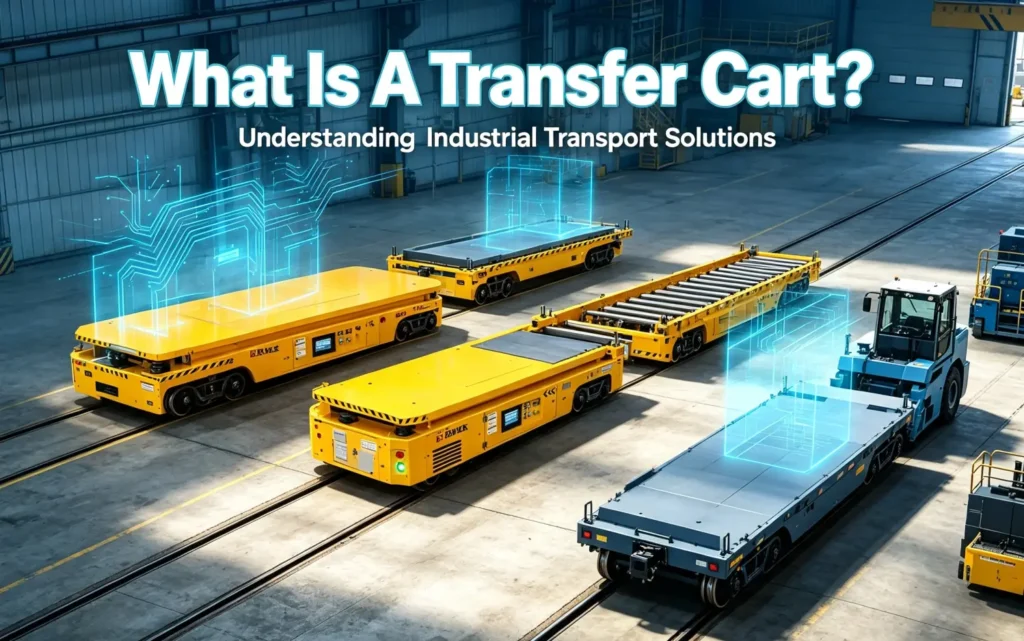
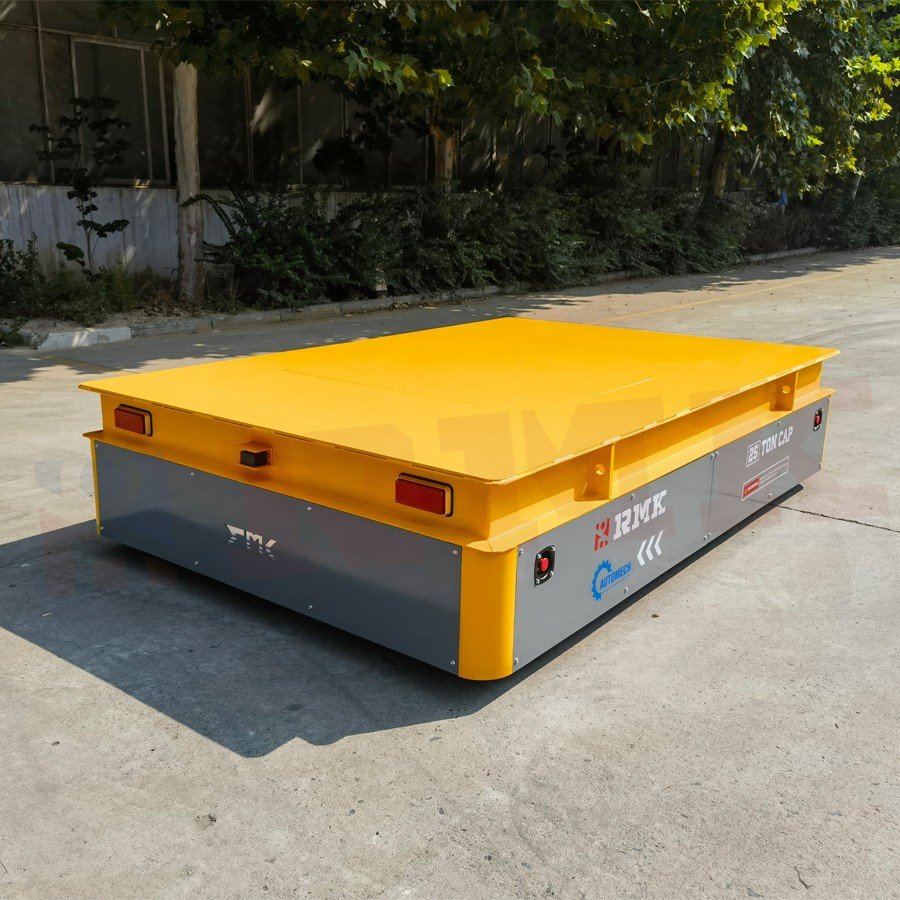
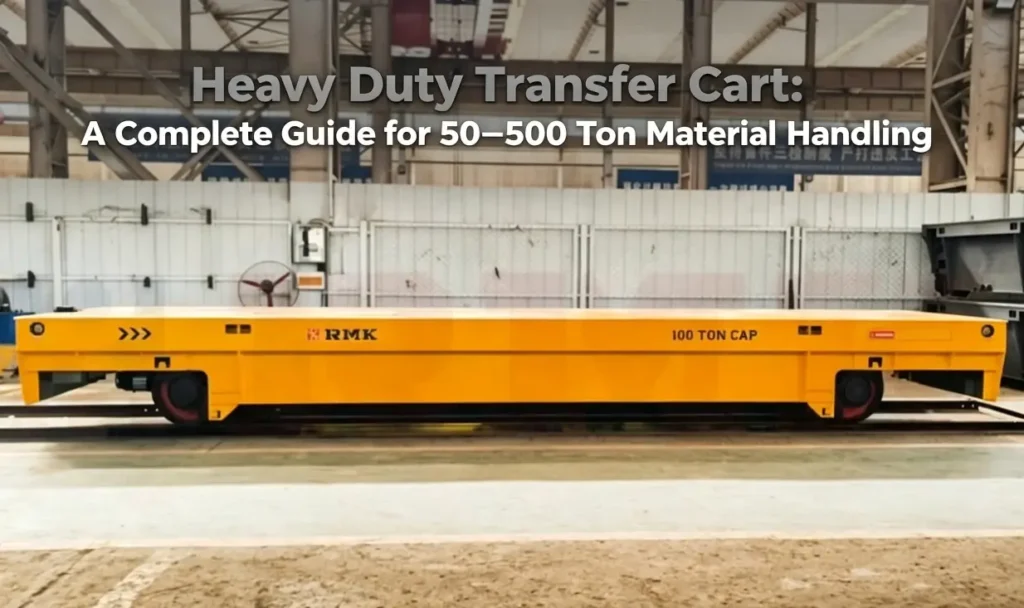
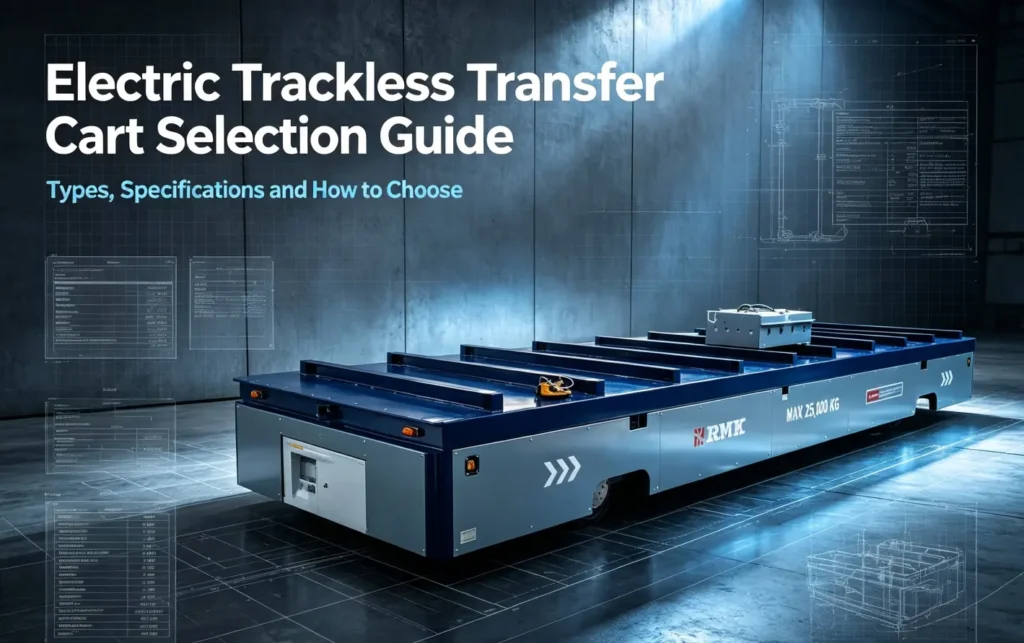
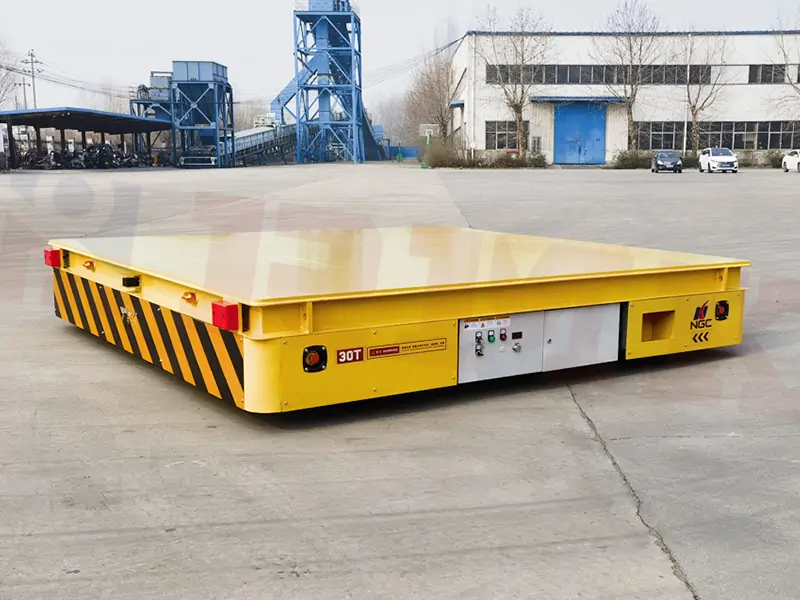
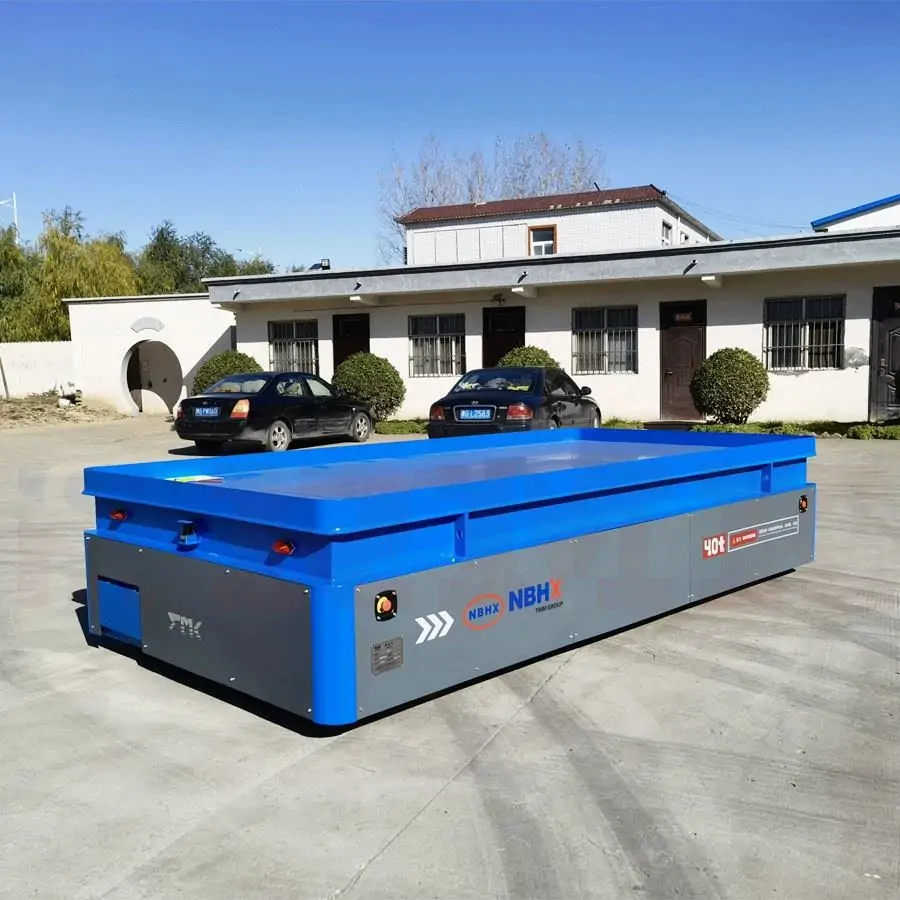
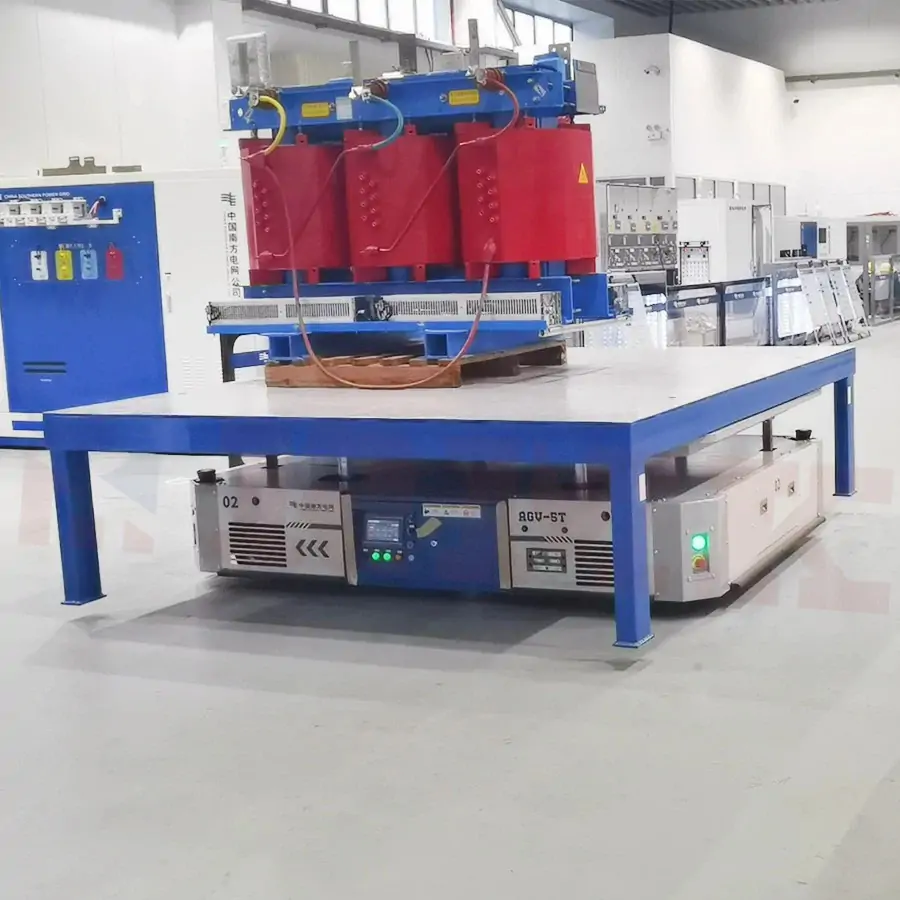
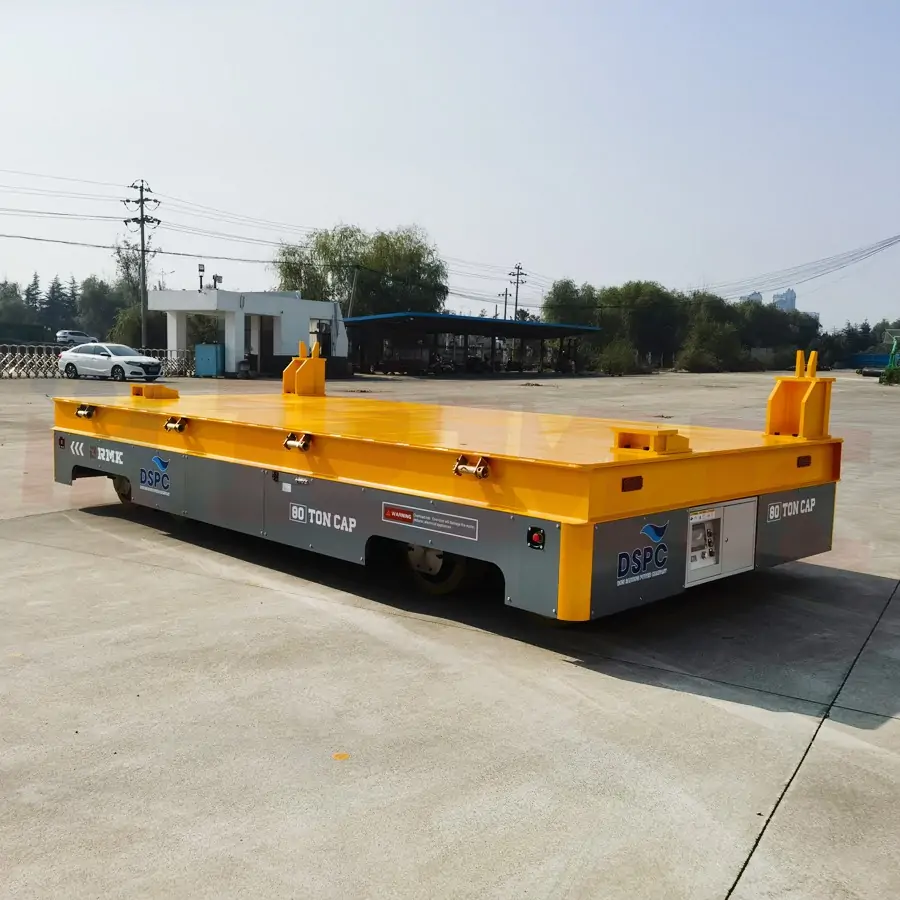
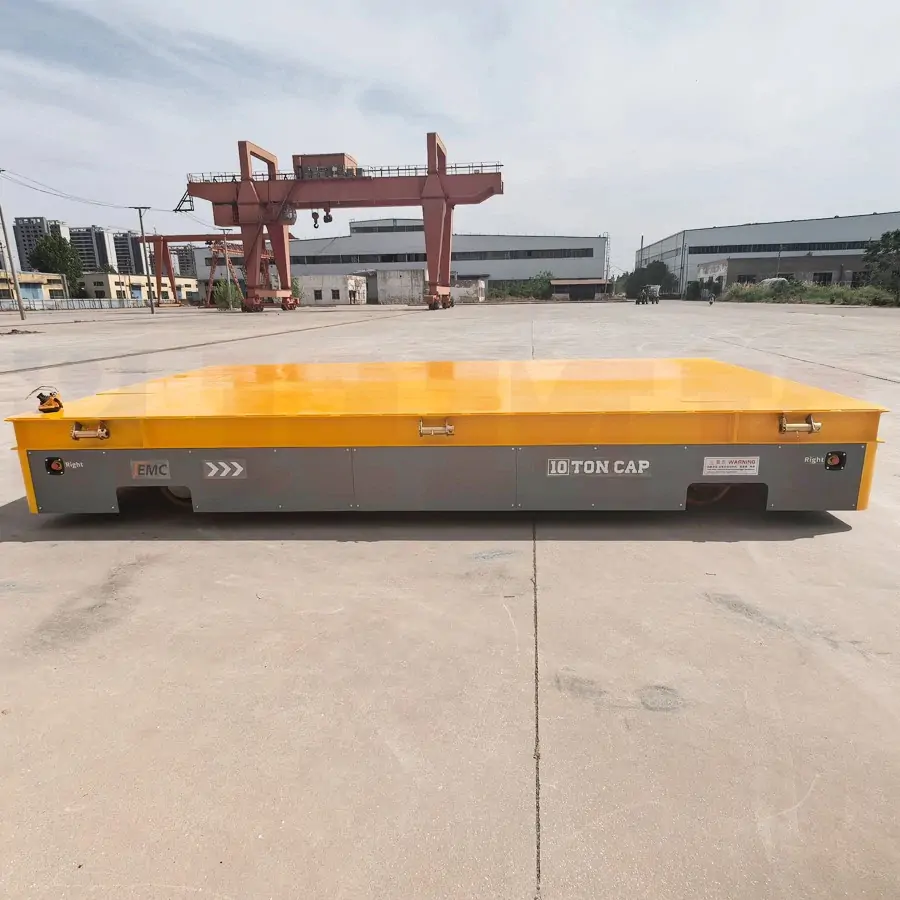
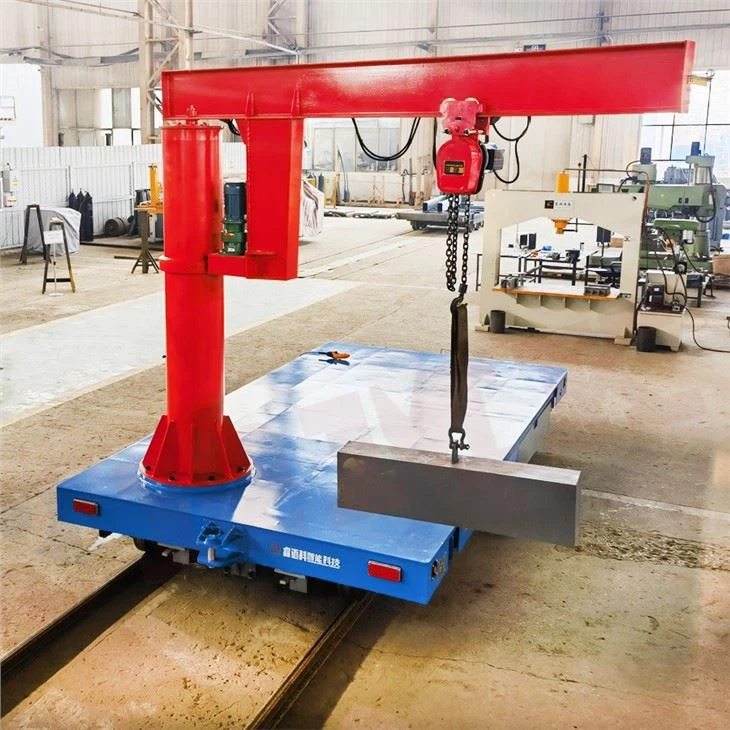
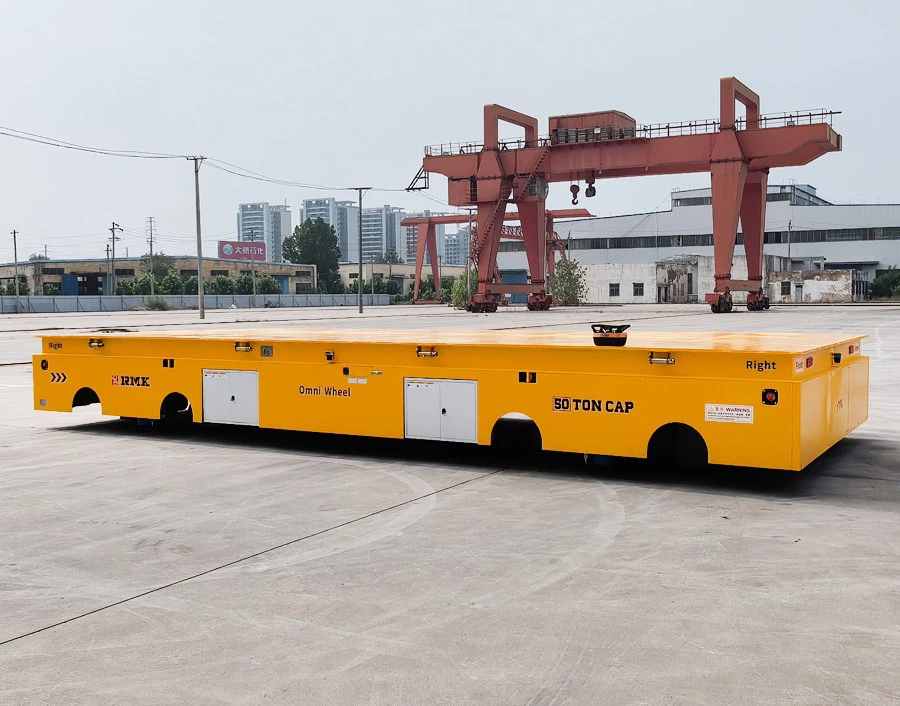
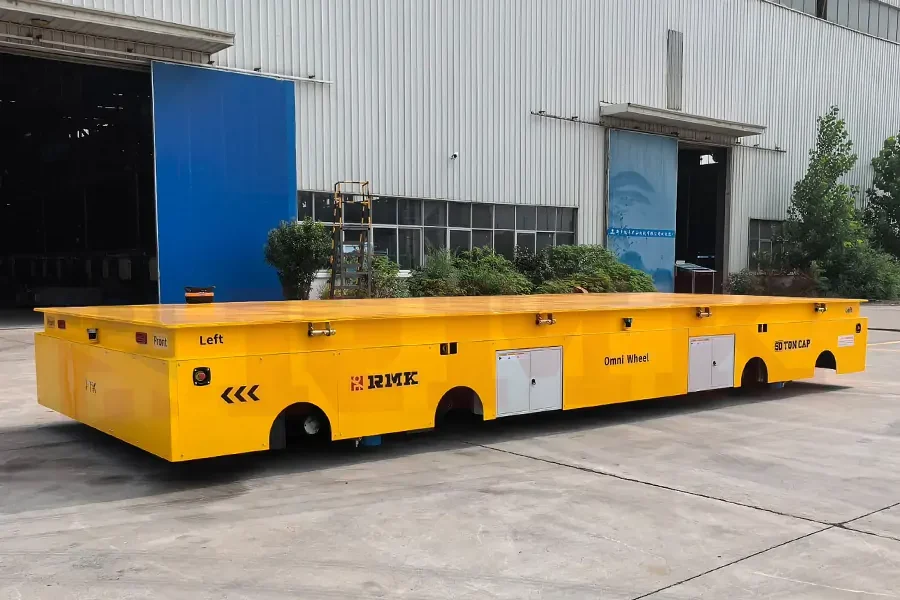
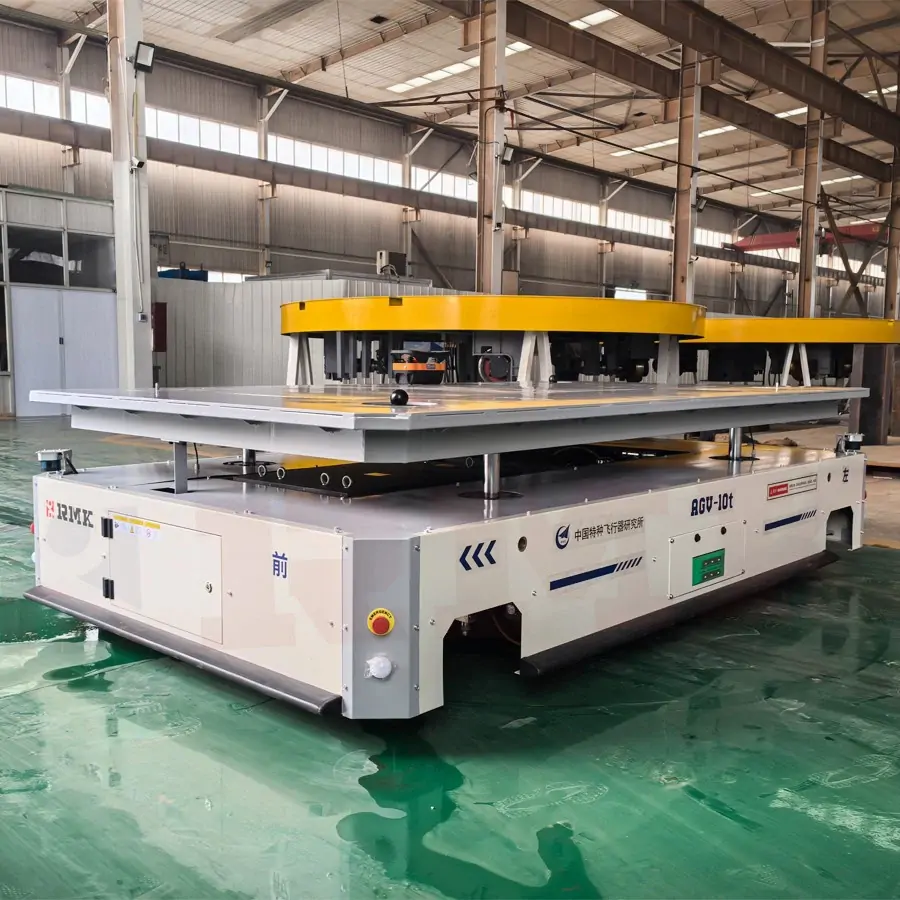
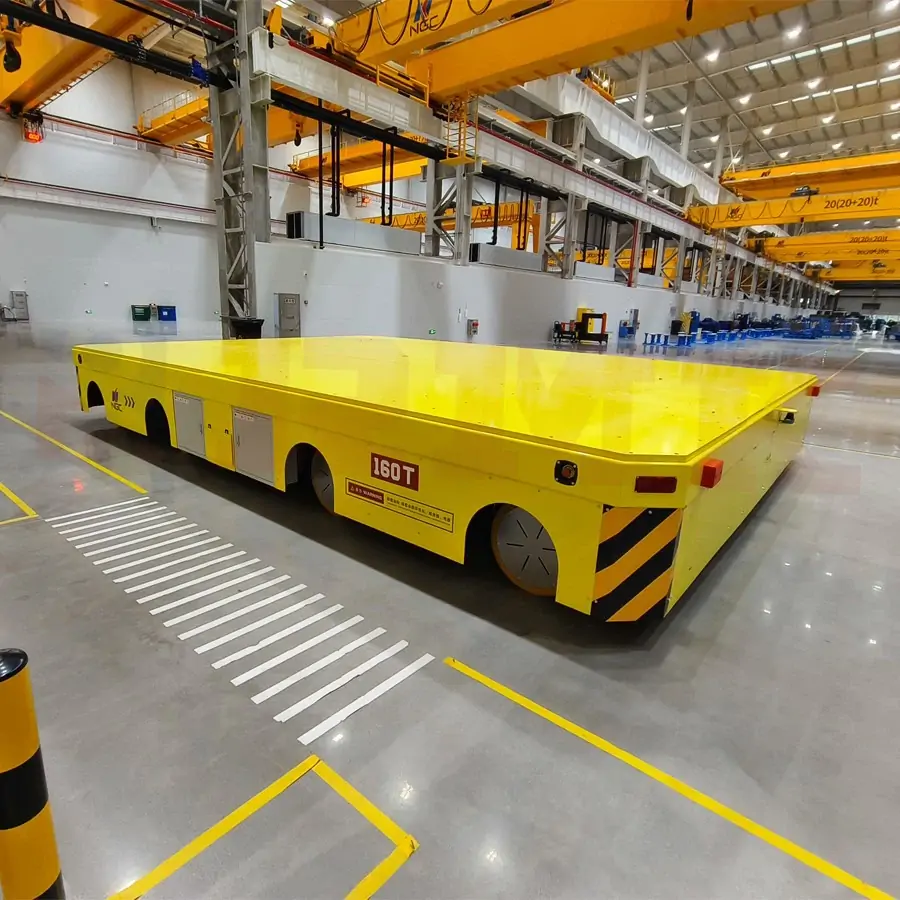
A Heavy Duty Transfer Cart is an electric material handling vehicle used for transporting heavy loads in factories and industrial facilities. It is designed for loads beyond standard transfer carts, typically above 10 tons. It is also known as a heavy-duty transfer trolley, industrial transfer car, or rail transfer vehicle. These carts are commonly used for moving steel structures, molds, machinery parts, and other large components.
A Heavy Duty Transfer Cart consists of a welded steel frame, drive system, wheels, and control system. The frame is designed according to the rated load and working conditions. Power options include battery, cable reel, busbar, and rail power supply. Travel speed is usually 0–30 m/min, depending on the load capacity and operation requirements. The wheel and axle system is selected based on load distribution, travel distance, and duty cycle.
Heavy Duty Transfer Carts are specified by load capacity, platform dimensions, wheel arrangement, and operating environment. For a 50-ton transfer cart, four wheels may carry about 12.5 tons per wheel under balanced loading. The axle, bearings, and frame structure are designed for actual loading conditions, including possible off-center loads. Control systems are available with pendant control, wireless remote control, travel limit switches, and safety sensors for industrial operation.
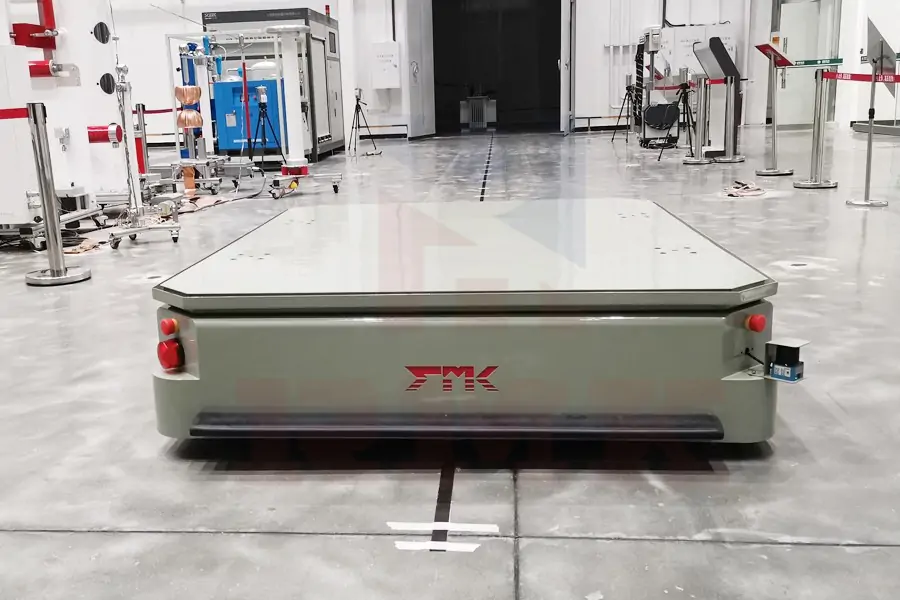
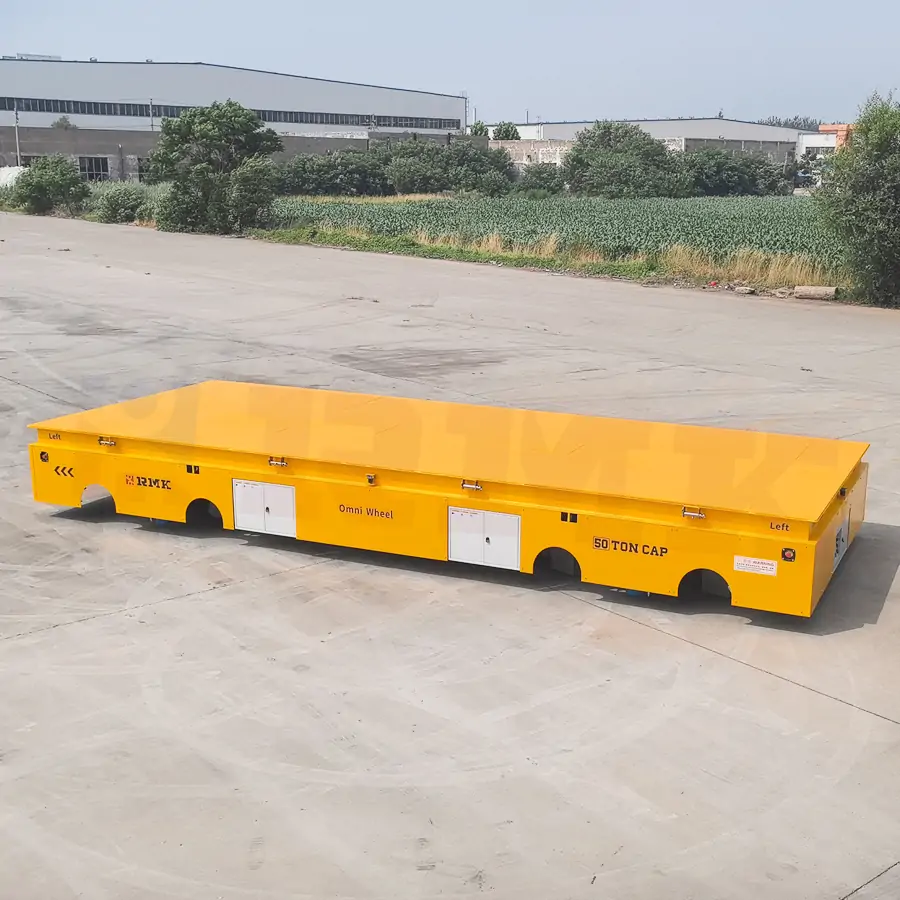
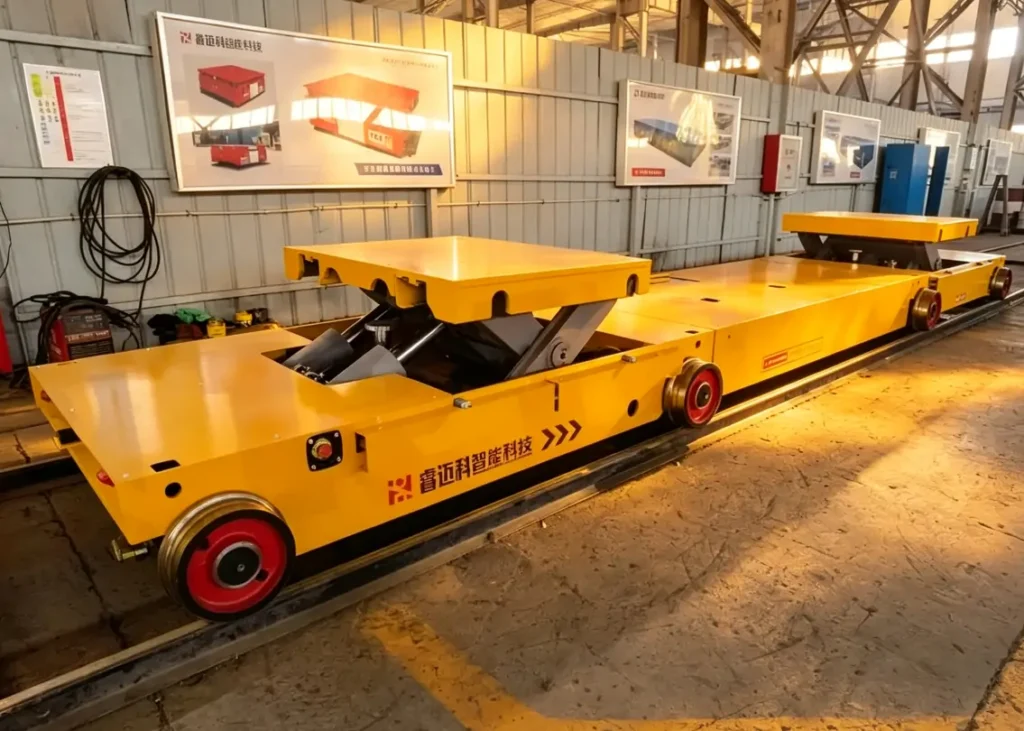
Types of Heavy Duty Transfer Carts
Articles Related to Heavy Duty Transfer Carts
- What Is a Heavy Duty Transfer Cart?
- How Does a Heavy Duty Transfer Cart Work?
- Types of Heavy Duty Transfer Carts: Complete Guide
- How Much Weight Can a Heavy Duty Transfer Cart Carry?
- How Much Does a Heavy Duty Transfer Cart Cost?
- Heavy Duty Transfer Cart Buying Guide: How to Choose the Right Model
Working Principle
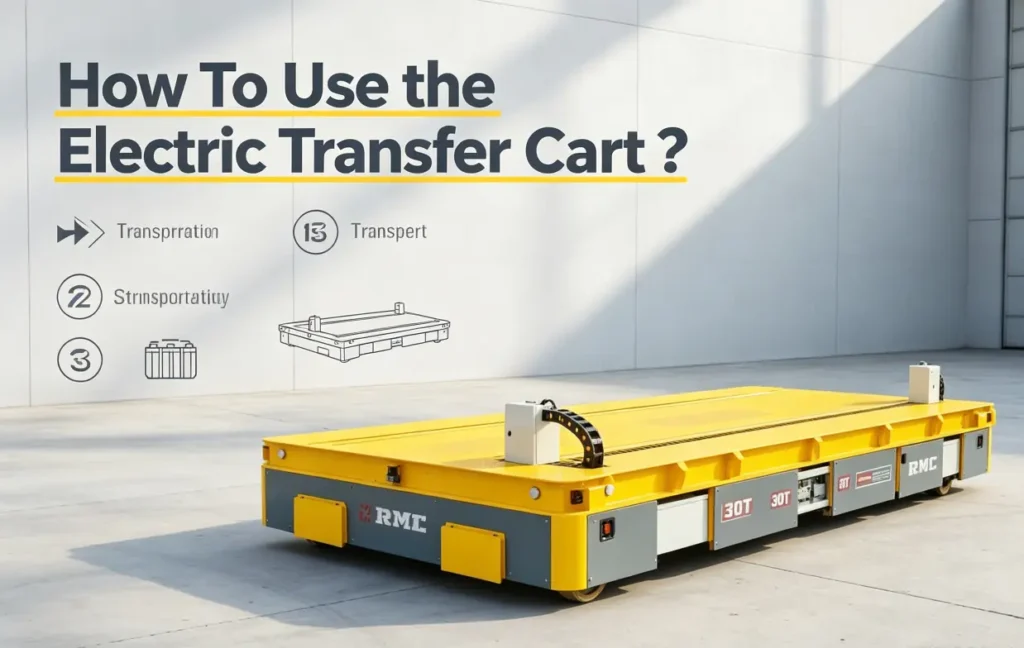
A Heavy Duty Transfer Cart works through an electric drive system that converts motor power into wheel traction, allowing the cart to move heavy loads on rails or prepared factory floors. The motor transfers torque through a gearbox to the wheels, driving the cart along the transport route.
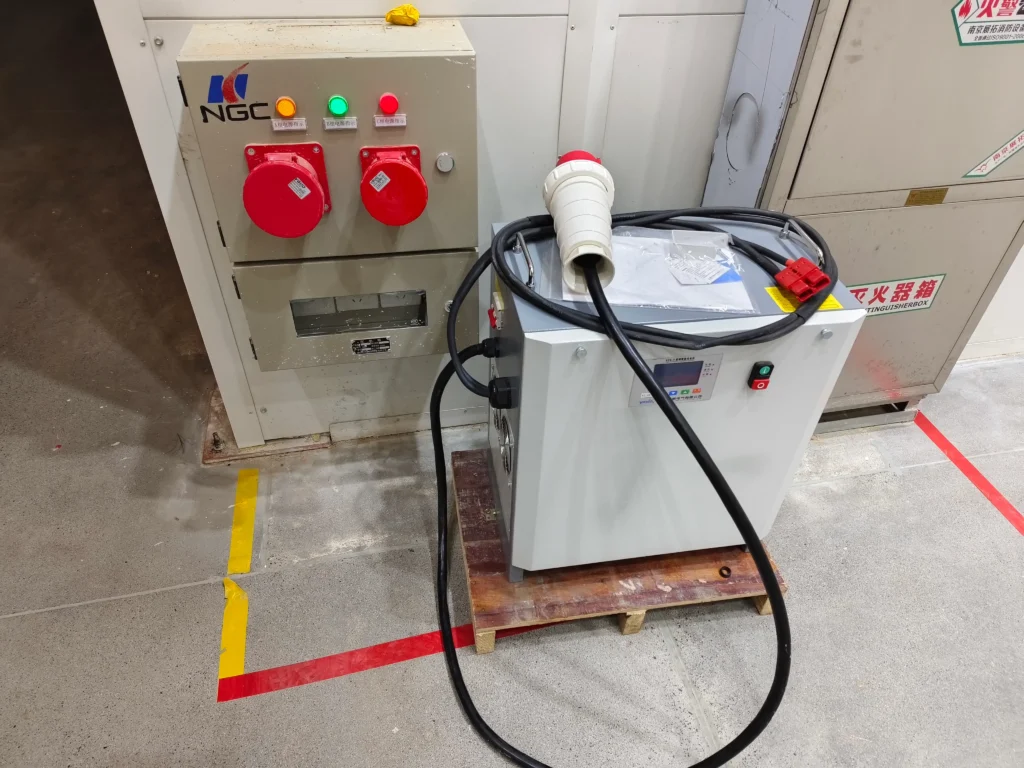
The power supply options include cable reel, busbar, battery, and low-voltage rail systems. Battery-powered carts are suitable for flexible routes without fixed power lines. Cable reel and rail-powered carts are used for fixed paths and continuous operation. A variable frequency drive (VFD) controls travel speed and direction, with common speeds of 0–30 m/min for smooth movement.
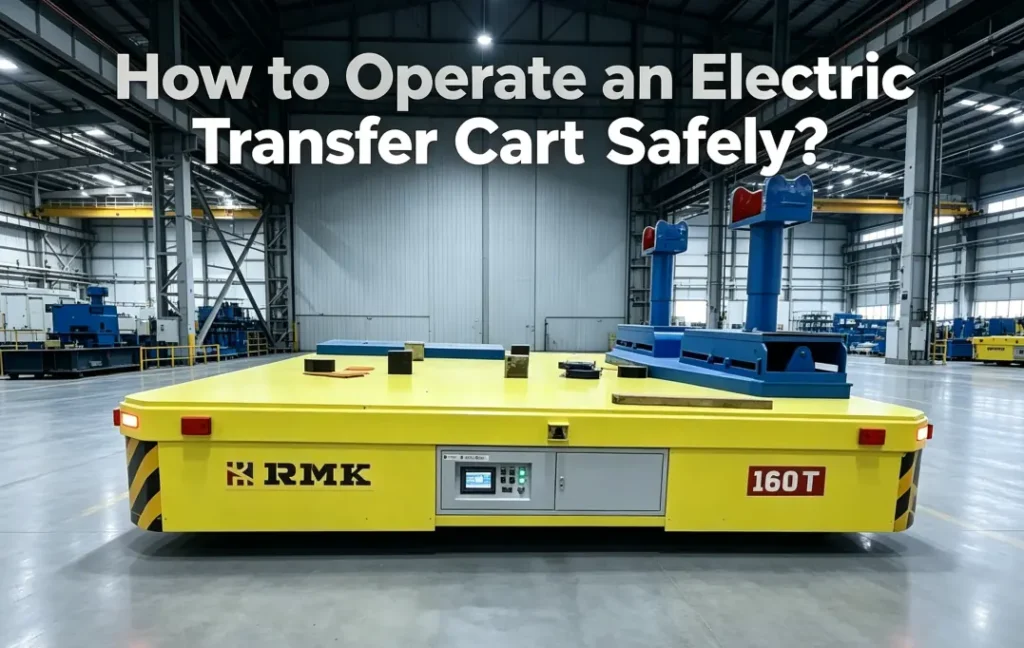
The control system manages cart operation through pendant control or wireless remote control. Wheel, axle, and bearing selection are based on load weight, wheel pressure, and working cycle. Limit switches and anti-collision sensors can be installed for applications requiring controlled positioning or multiple carts operating on the same track.
Specifications
Heavy Duty Transfer Cart specifications are selected according to load capacity, transport distance, working frequency, and factory layout. The following parameters cover the common configuration range for industrial heavy load transfer applications.
| Parameter | Specification Range |
|---|---|
| Rated Load | 1–500 tons; up to 1500 tons for customized projects |
| Table Size (L×W) | 2000×1500 mm to 10000×3000 mm |
| Frame Structure | Welded steel plate and beam structure; plate thickness 8–16 mm |
| Power Supply | Battery, cable reel, busbar (conductor rail), low-voltage rail |
| Battery Specification | 48–72 V, 100–600 Ah |
| Battery Operating Time | 2.9–5.4 h under full-load operation |
| Travel Distance per Charge | 3.2–8.1 km |
| Running Speed | 0–30 m/min, VFD controlled |
| Wheel Quantity | 4 wheels standard; customized wheel arrangements available |
| Wheel Type | Steel wheels for rail transfer; rubber wheels for trackless operation |
| Ground Clearance | 50–75 mm (rail-guided type) |
| Rail Gauge | 1200–2000 mm |
| Control Mode | Pendant control, wireless remote control, PLC control |
| Steering Mode | Fixed rail guidance, 360° steering, turntable transfer, cross-rail transfer |
| Safety Devices | Alarm light, emergency stop button, travel limit switch, anti-collision sensor |
| Application | Steel plants, shipyards, machinery factories, foundries, heavy manufacturing |
Note: Table size, wheel load, and drive system are designed according to the rated load and actual operating conditions. For special applications such as ultra-heavy transportation or oversized structures, customized designs are available.
Heavy Duty Transfer Cart Types
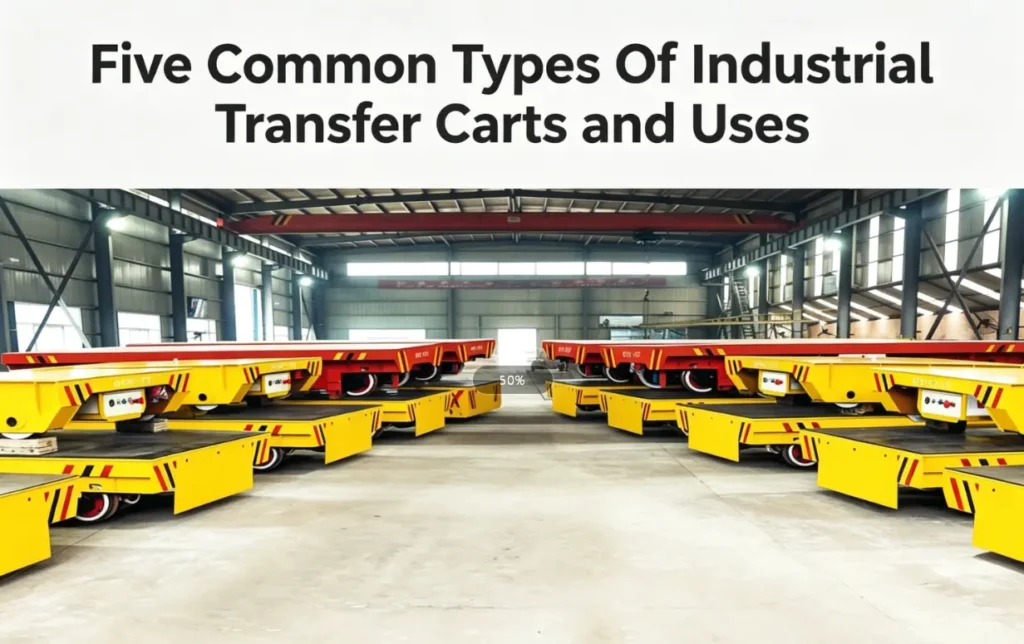
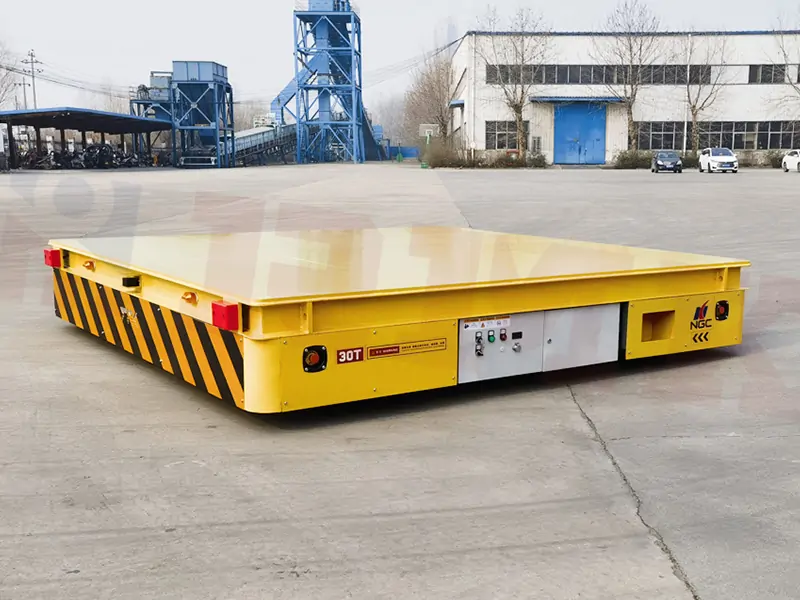
Heavy Duty Transfer Carts are available in different configurations based on factory layout, travel route, load requirements, and automation level. The main types include battery-powered, rail-guided, trackless, and AGV transfer carts.
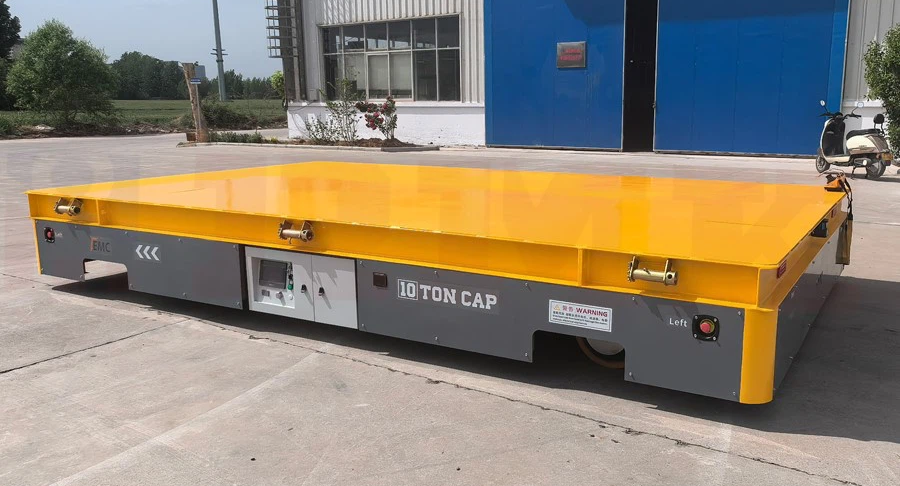
Battery Powered Transfer Cart
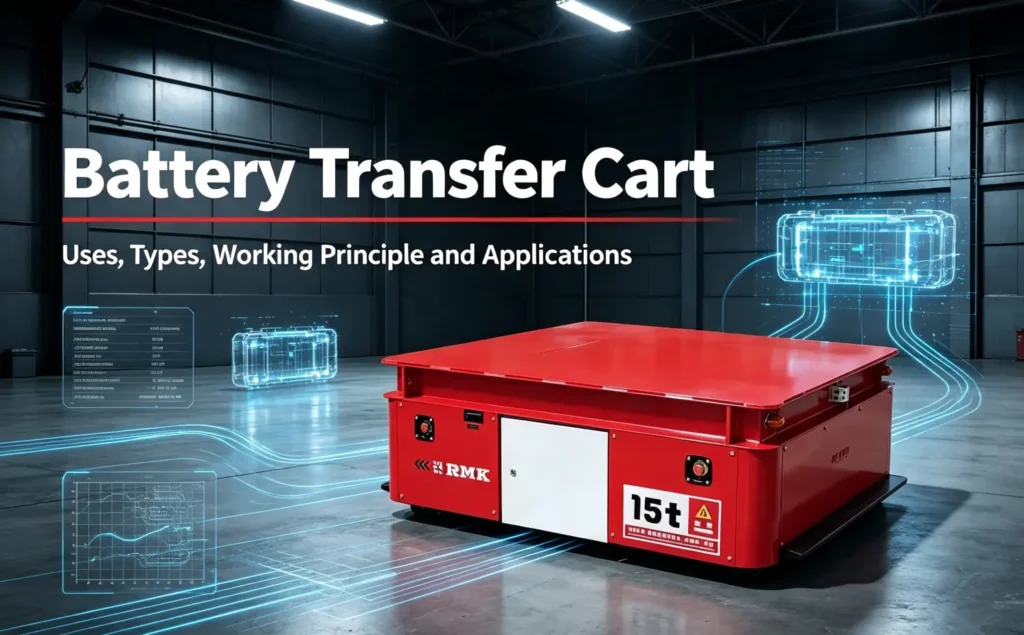
A battery-powered transfer cart uses onboard batteries as the power source and does not require external power lines during operation. It is suitable for factories with flexible production layouts, multiple transfer points, or areas without fixed rails.
- Load capacity: 1–500 tons
- Power supply: Rechargeable battery system
- Control method: Wireless remote control or pendant control
- Steering: Fixed direction or 360° steering options
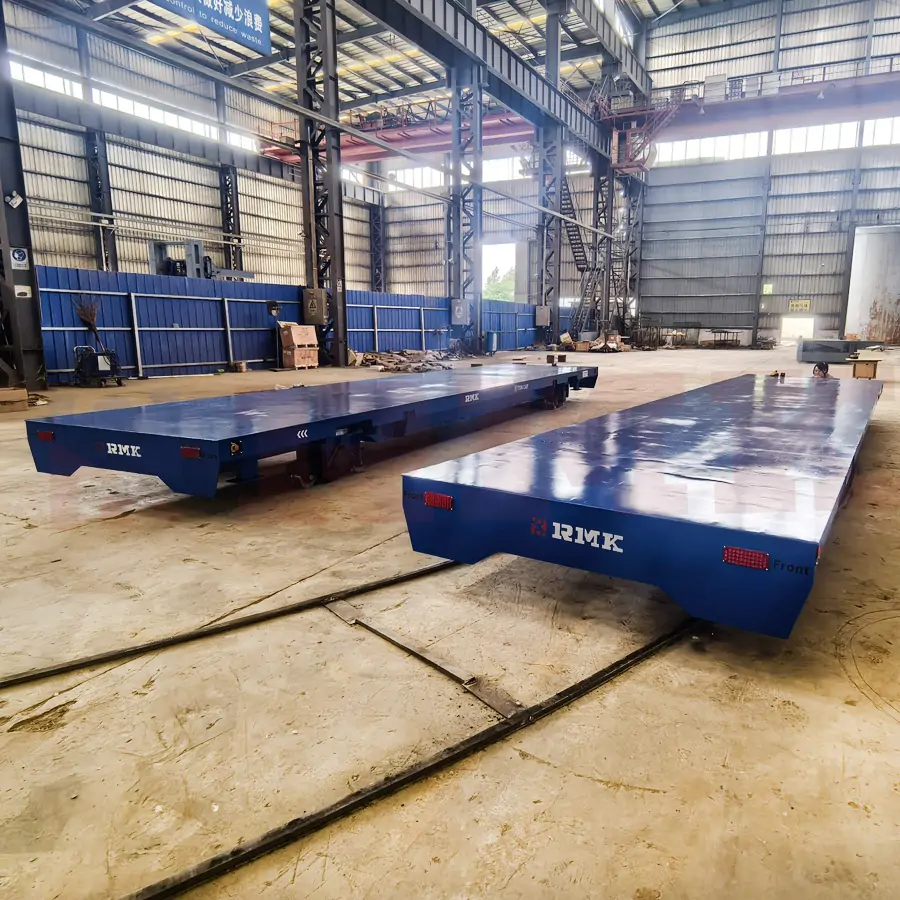
Rail Transfer Cart
Rail Transfer Cart runs on fixed steel rails and is designed for repeated transportation between fixed locations. It is widely used in steel plants, machinery factories, and heavy industrial production lines where stable operation is required.
- Load capacity: 1–500 tons
- Travel route: Fixed rail track
- Power options: Rail power, cable reel, or low-voltage rail
- Travel speed: 0–30 m/min
Trackless Transfer Cart
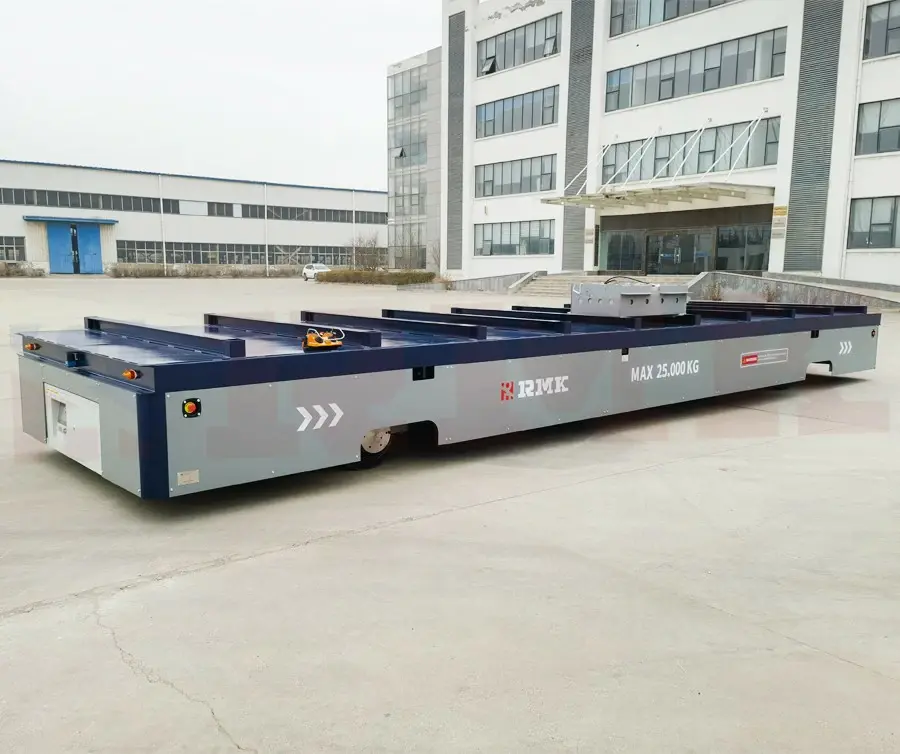
Trackless Transfer Cart uses rubber wheels and travels directly on factory floors without rail installation. It is suitable for large workshops with changing transport routes and limited rail space.
- Load capacity: 1–300 tons
- Steering system: 360° steering
- Drive system: Four-wheel drive or multi-wheel drive
- Control method: Wireless remote control
AGV Transfer Cart
AGV Transfer Cart integrates navigation and control systems for automated material transportation. It is used in smart factories and production lines requiring automatic handling processes.
- Load capacity: 1–300 tons
- Navigation: Laser navigation, magnetic navigation, or other positioning systems
- Control system: PLC control
- Operation mode: Automatic transport and positioning
Advantages
High Load Capacity
Designed for heavy material handling, Heavy Duty Transfer Carts support loads from 1 to 500 tons, with customized solutions available for larger industrial components.
Multiple Power Options
Available with battery, cable reel, busbar, and low-voltage rail power systems to match different factory layouts and operating conditions.
Flexible Configuration
Platform size, steering system, control method, and deck design can be customized according to load dimensions and transport requirements.
Stable Heavy Load Transportation
The welded steel structure, heavy-duty wheels, and drive system provide stable movement for large equipment, molds, and industrial materials.
Suitable for Various Industrial Environments
Used in steel plants, shipyards, machinery factories, foundries, and manufacturing facilities for repeated heavy load transfer.
Low Maintenance Operation
Electric drive systems with simple mechanical structures reduce routine maintenance requirements compared with traditional handling equipment.
Applications
Heavy Duty Transfer Carts are used for horizontal transportation of heavy equipment, large components, and oversized materials in industrial facilities. They are widely applied in industries that require repeated movement of high-load materials between production areas, storage areas, and assembly stations.
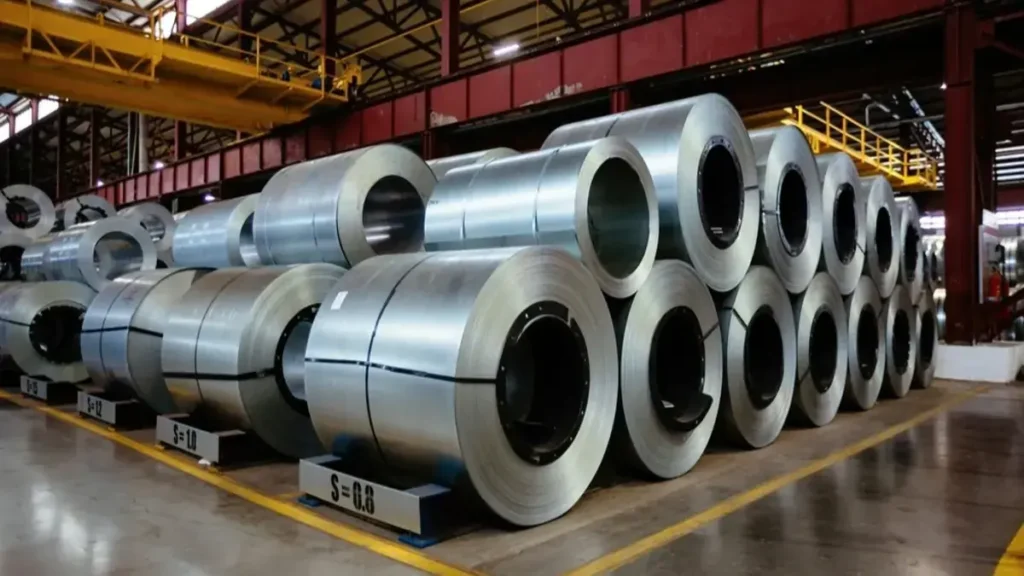
Steel Plants
Used for transporting steel coils, ladles, steel structures, and heavy steel components between processing areas.
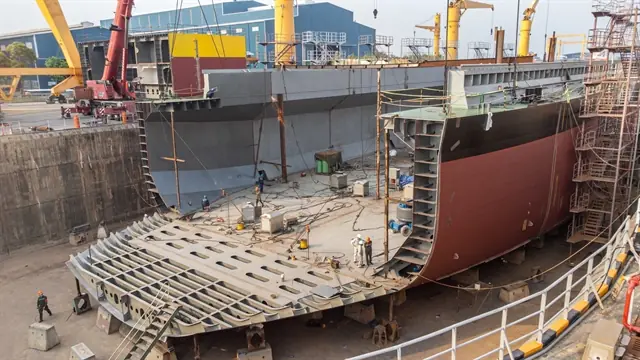
Shipyards
Used for moving ship blocks, hull sections, and large fabrication parts during ship construction.
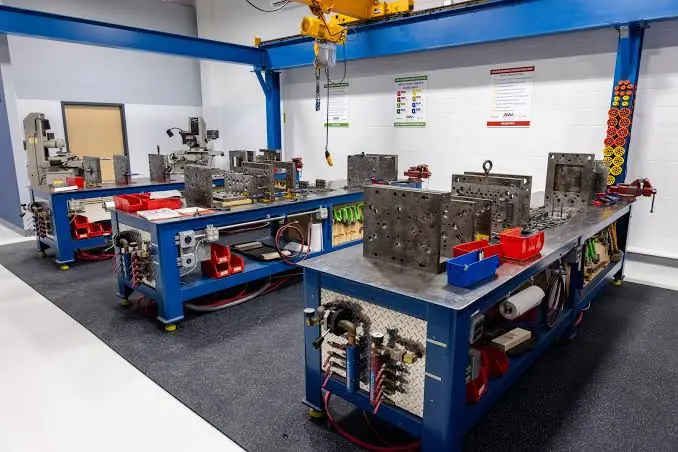
Machinery Manufacturing
Used for transferring machine tools, production equipment, molds, and large mechanical components.
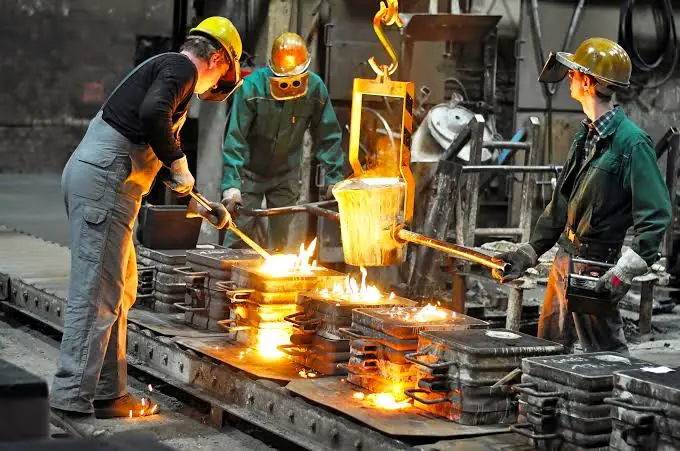
Foundries
Used for handling castings, molds, and heavy materials in high-temperature production environments.
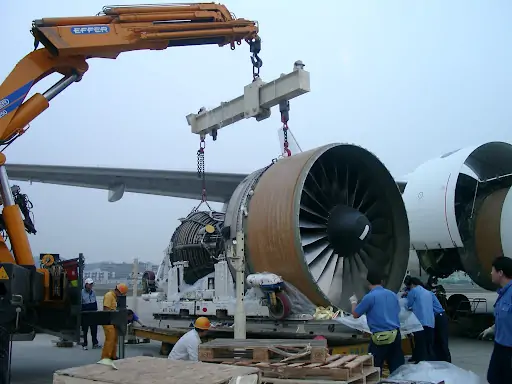
Aerospace Manufacturing
Used for transporting aircraft structures and precision assembly components inside manufacturing facilities.
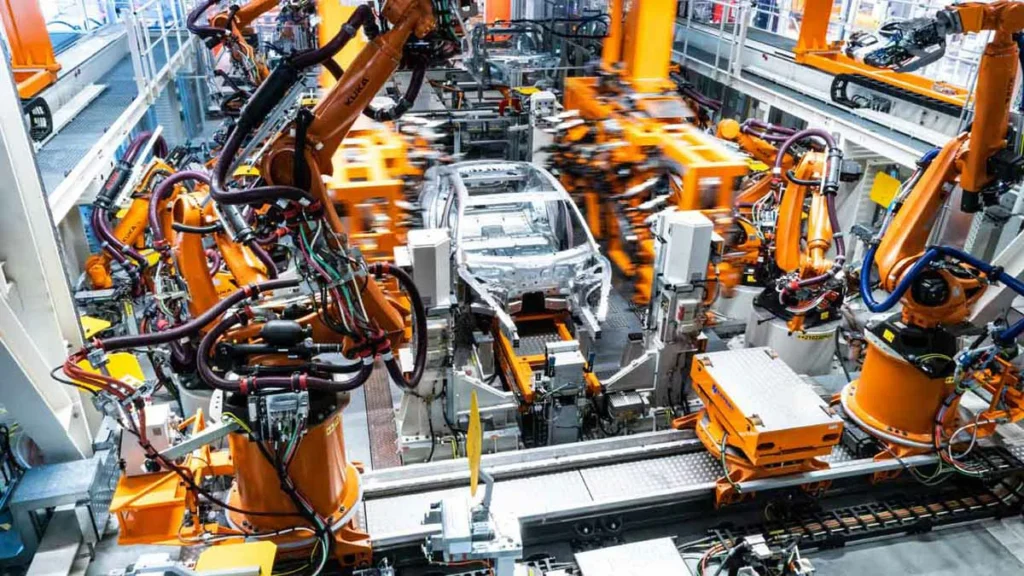
Automotive Manufacturing
Used for moving vehicle bodies, production fixtures, and heavy tooling between workstations.
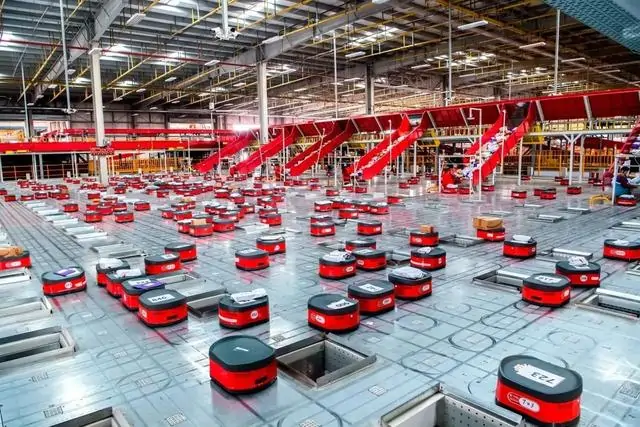
Warehouse and Logistics Centers
Used for transferring oversized loads and heavy goods where forklifts are not suitable.

Power and Energy Industry
Used for transporting transformers, generators, and large equipment during manufacturing and maintenance.
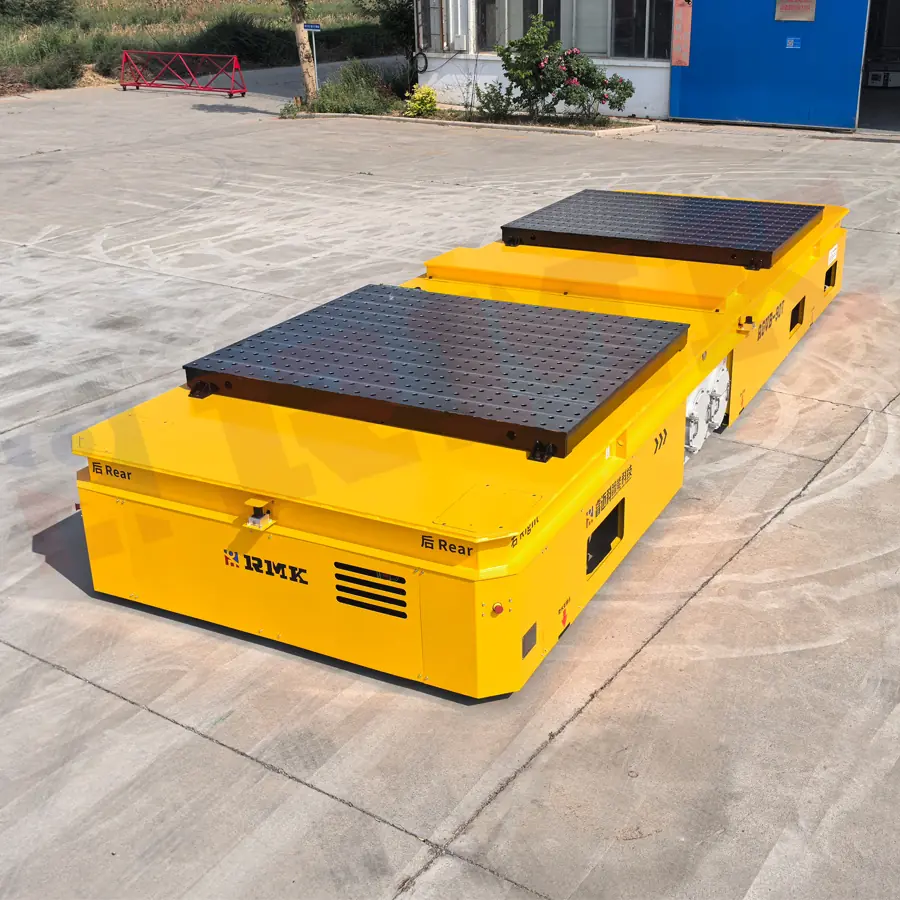
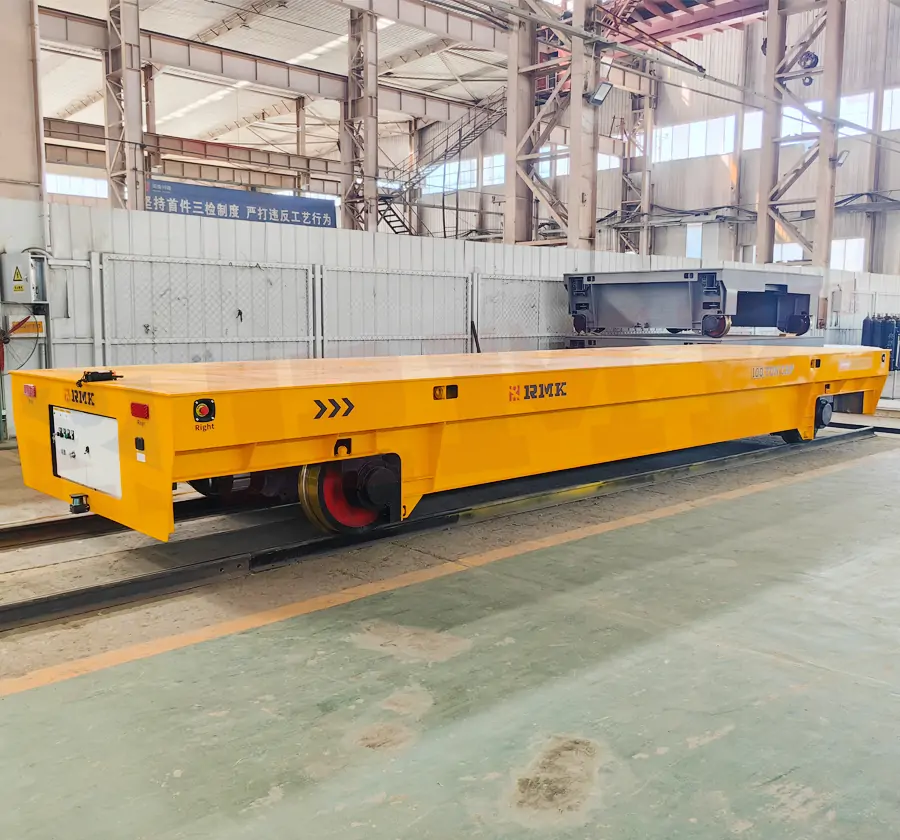
Cases
How to Choose a Heavy Duty Transfer Cart?
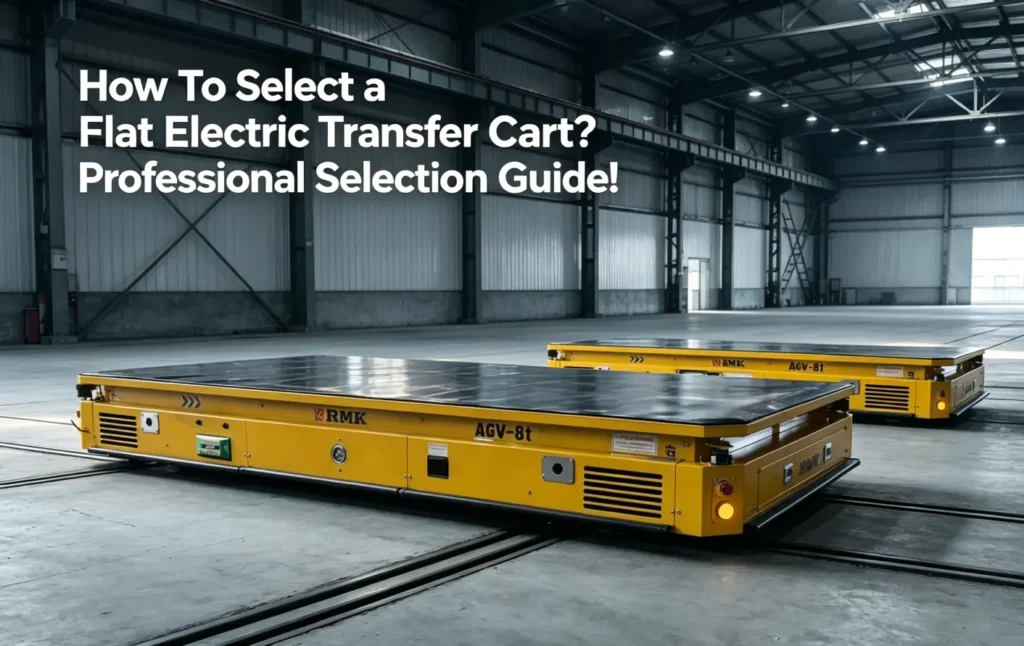
Selecting a Heavy Duty Transfer Cart requires evaluating the load weight, transport route, working environment, and operation frequency. The cart configuration should match the actual handling requirements instead of only considering the rated capacity.
- 1. Load Capacity: Select the cart capacity according to the maximum load weight and load distribution. The platform, wheels, drive system, and frame structure should match the actual working load.
- 2. Power Supply: Choose the power system based on the transport route and operating cycle. Battery powered carts suit flexible routes, while cable reel, busbar, and rail power systems fit fixed transportation lines.
- 3. Working Environment: Consider floor conditions, indoor or outdoor operation, temperature, dust, and moisture levels. Different environments require suitable wheel types, protection levels, and structural designs.
- 4. Transport Route: Fixed routes are suitable for rail transfer carts. Workshops with changing paths can use trackless transfer carts. Automated production lines may require AGV transfer carts.
- 5. Platform Size and Load Shape: The platform dimensions should match the size and shape of the transported material. Custom decks, fixtures, rollers, or supports can be added for special loads.
- 6. Control Requirements: Select the control system according to operation needs. Wireless remote control is suitable for manual handling, while PLC control is used for automated production processes.
- 7. Duty Cycle: Consider daily running time, travel distance, and loading frequency. High-frequency operations require suitable drive systems, power capacity, and cooling configurations.
The right Heavy Duty Transfer Cart configuration depends on the load, route, and operating conditions. Proper selection helps match the cart with the production process and handling requirements.
The load capacity of a transfer cart does not refer to the actual weight of the items it carries. To learn how to calculate load capacity, see the article: “How to Choose the Load Capacity of a Heavy-Duty Transfer Cart?”
Heavy Duty Transfer Cart vs Forklift vs Crane
Forklifts, cranes, and Heavy Duty Transfer Carts are used for different material handling tasks. A forklift is designed for lifting and stacking, a crane is used for vertical lifting and overhead movement, while a transfer cart is designed for moving heavy loads horizontally along a fixed route.
| Item | Transfer Cart | Forklift | Crane |
|---|---|---|---|
| Motion | Horizontal movement on rails or floor | Horizontal movement + lifting | Vertical lifting + overhead movement |
| Load Range | 1–500 tons, up to 1500 tons customized | 1–50 tons | 1–500 tons and above |
| Travel Path | Fixed rail or floor track | Flexible movement with aisle space | Fixed runway or lifting area |
| Lifting Ability | No lifting, deck transport only | Lifting with mast | Full vertical lifting |
| Best Application | Heavy and repetitive transport | Flexible warehouse handling | Large-scale lifting operations |
A Heavy Duty Transfer Cart is suitable for heavy loads that need repeated horizontal movement on a fixed route. Forklifts are used when flexibility and lifting are required. Cranes are used for vertical lifting and large working areas. Many factories combine these systems based on different handling requirements.
Custom Heavy Duty Transfer Cart Custom Heavy Duty Transfer Cart
Heavy Duty Transfer Carts can be customized according to load requirements, transport routes, and factory conditions. Custom options cover capacity, platform design, power supply, control system, and steering method.
- Load Capacity
Customized capacity for different load weights, including heavy machinery, steel structures, and oversized components. - Platform Size
Customized deck dimensions and support structures based on the load size and shape. - Power Supply
Battery, cable reel, busbar, or low-voltage rail power options for different operating conditions. - Steering System
Fixed rail, 360° steering, turntable, and cross-rail transfer options. - Control System
Pendant control, wireless remote control, and PLC automatic control options. - Safety Devices
Emergency stop, limit switches, alarm lights, and anti-collision sensors can be configured.
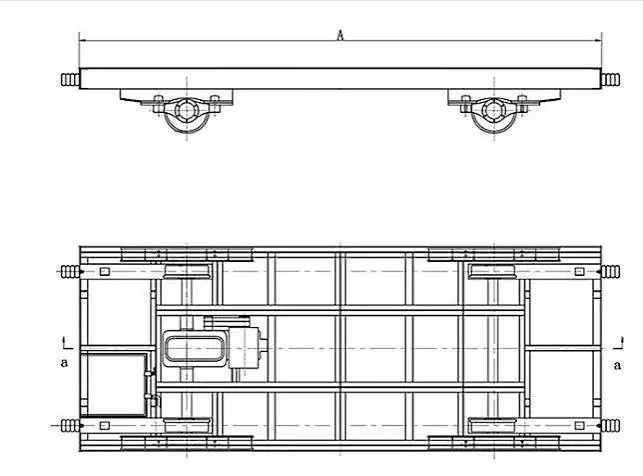
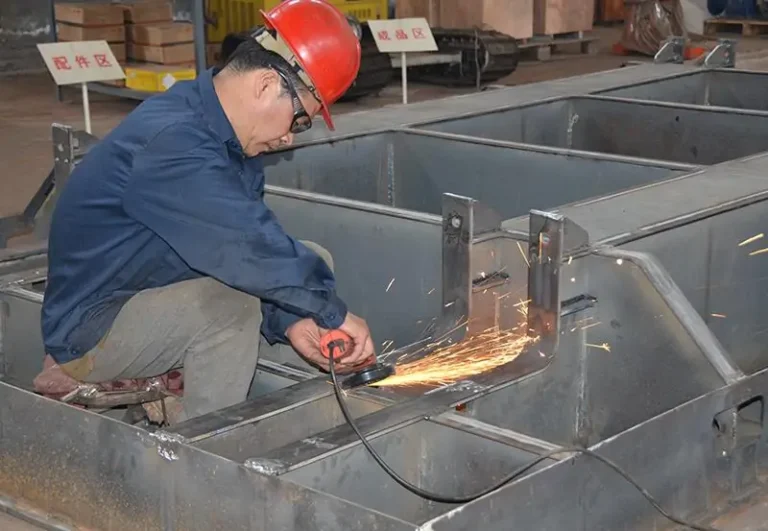
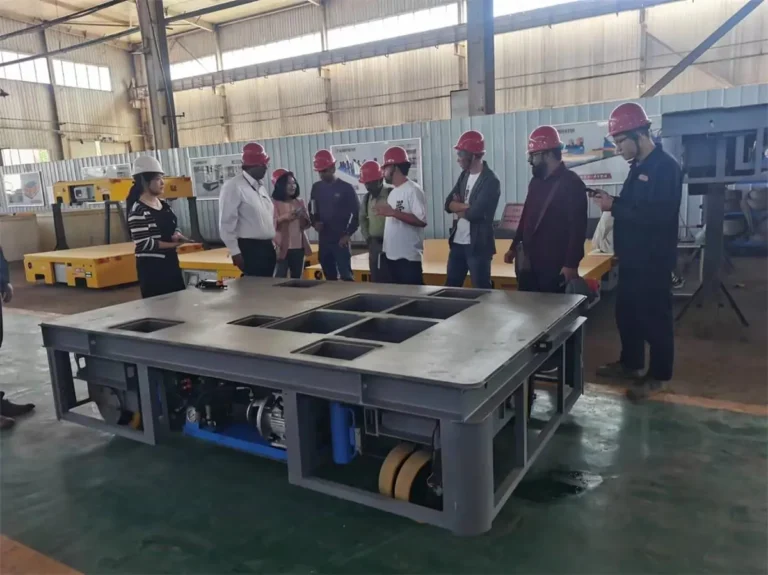
REMARKABLE provides custom Heavy Duty Transfer Cart solutions based on load requirements and working conditions. The engineering team supports design, manufacturing, and configuration selection for different industrial handling applications.
For more information on customization options and the scope of customization for transfer carts, see the article: “Custom Transfer Cart: Complete Guide to Design and Customization”
Heavy Duty Transfer Cart Manufacturer and Supplier
REMARKABLE provides Heavy Duty Transfer Cart solutions for heavy load horizontal transportation in steel plants, machinery factories, shipyards, and manufacturing facilities. The carts are designed for different load capacities, platform sizes, transport routes, and working conditions, supporting applications from standard material transfer to customized heavy-duty handling.
As a Heavy Duty Transfer Cart manufacturer and supplier, REMARKABLE offers battery-powered, rail, and trackless transfer cart options with customized designs based on customer requirements. The engineering team supports capacity selection, structural design, control configuration, technical communication, installation guidance, and after-sales service.
Contact REMARKABLE for a customized Heavy Duty Transfer Cart solution based on your load requirements and working conditions.

Customized Intelligent Material Handling Solutions
To ensure that a customized transfer cart fits your needs perfectly, please provide the following details:
- Load Capacity: _____ tons (1~500 ton)
- Table Size: _____ × _____ mm/m (e.g., 1500×3000)
- Power Options:
- ☐ Lead-acid ☐ Lithium-ion ☐ Other: _____
- ☐ Cable: _____V/_____A
- ☐ Standard 380V/50Hz/3-phase
- Cargo Details:
- Type: _____ (e.g., steel coils, machinery)
- Special Needs: _____ (e.g., anti-slip, corrosion-proof)
- Optional Features:
- ☐ Emergency stop ☐ Anti-collision sensors
- ☐ Rail guides ☐ Lifting mechanism ☐ Remote control
Get a Quote Now
FAQS
What is a Heavy Duty Transfer Cart?
A Heavy Duty Transfer Cart is an electric material handling vehicle designed to move heavy loads horizontally in industrial facilities. It uses a powered drive system to transport equipment, steel structures, molds, and other large components on rails or factory floors.
How much weight can a Heavy Duty Transfer Cart carry?
A Heavy Duty Transfer Cart typically handles loads from 1 to 500 tons. Customized models can be designed for heavier loads up to 1500 tons according to the application requirements.
What is the difference between battery and rail transfer carts?
Battery transfer carts use onboard batteries and can operate without fixed power lines, making them suitable for flexible routes. Rail transfer carts run on fixed tracks and are commonly used for repeated transportation between fixed locations.
Can a Heavy Duty Transfer Cart operate outdoors?
Yes. Heavy Duty Transfer Carts can be designed for outdoor operation with suitable protection for the electrical system, drive components, and control devices. The configuration depends on weather conditions and site requirements.
How fast does a Heavy Duty Transfer Cart move?
The standard travel speed is usually 0–30 m/min. The actual speed depends on load capacity, transport distance, operating frequency, and working conditions.
Can the transfer cart be customized?
Yes. Heavy Duty Transfer Carts can be customized according to load capacity, platform size, power supply, steering method, control system, and safety requirements.
What industries use Heavy Duty Transfer Carts?
Heavy Duty Transfer Carts are widely used in steel plants, shipyards, machinery manufacturing, foundries, automotive production, energy equipment manufacturing, and other heavy industries.
How do I select the right transfer cart for my factory?
Selection depends on load weight, material size, travel route, operating frequency, floor conditions, and automation requirements. The power system, platform design, and control method should match the actual working environment