
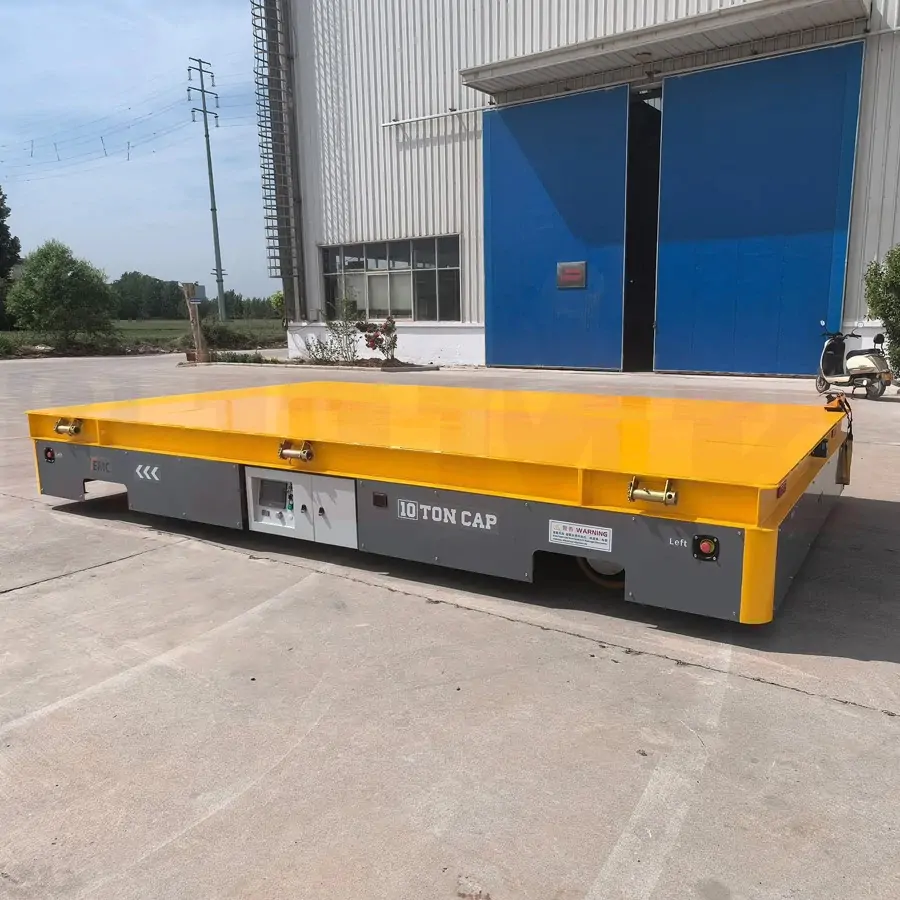
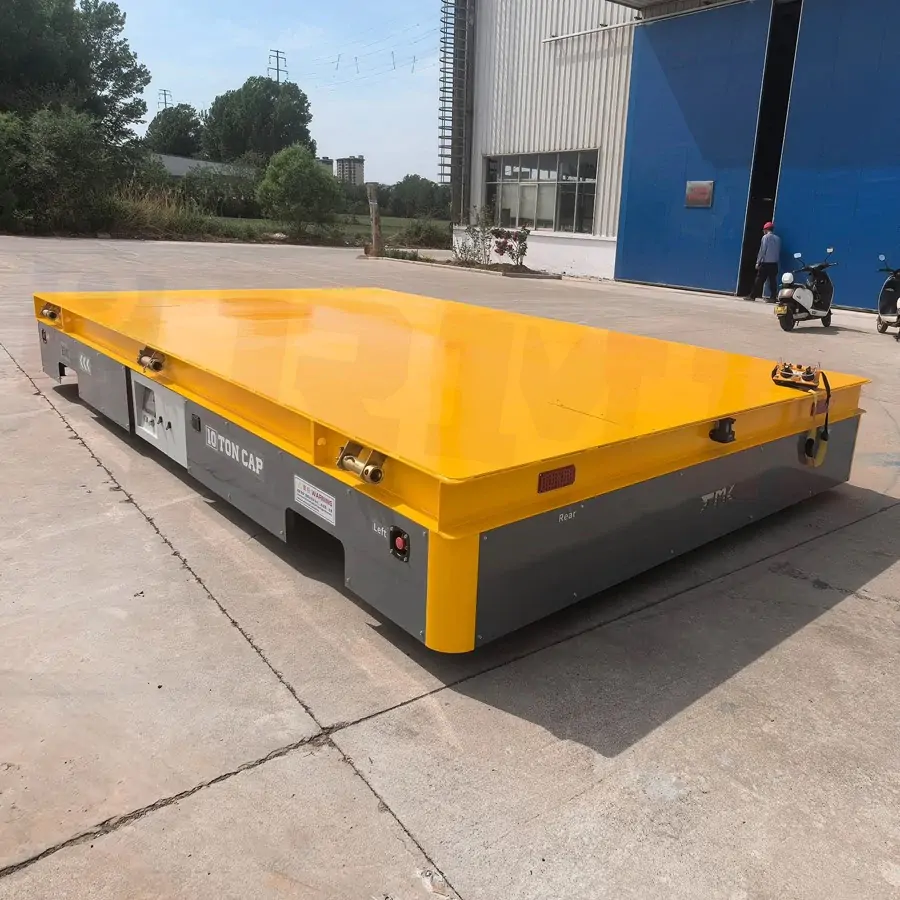
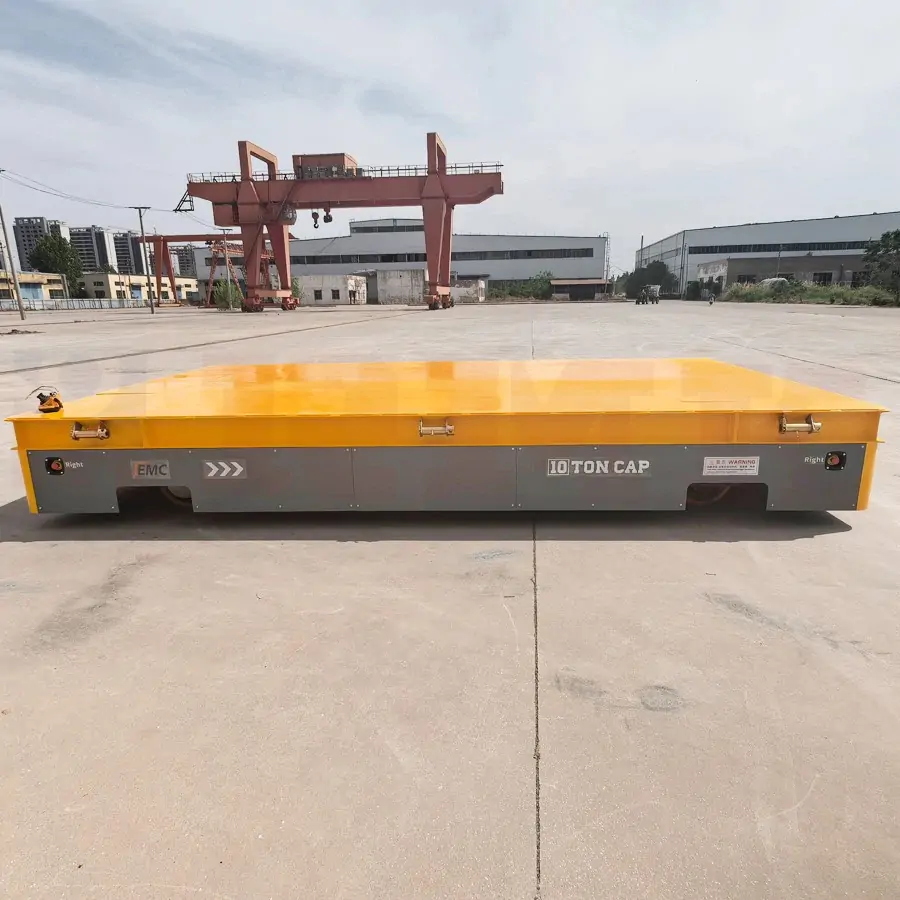
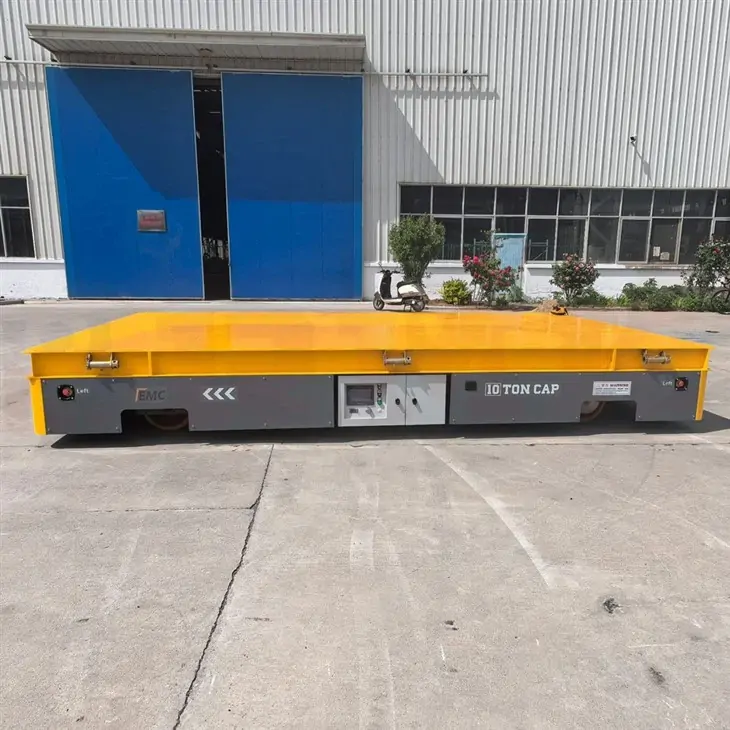
The 10-ton steel pipe battery transfer cart is designed for moving steel pipes between production, processing, and storage areas. This customized trackless model uses battery power, hydraulic steering, and remote operation. Its stated overall dimensions are 6000 × 2500 × 600 mm. Pipe supports, restraints, and an optional hydraulic tilting platform can be specified to suit the load and unloading arrangement.
- Rated load: 10 tons, subject to the agreed load distribution.
- Overall dimensions: 6000 × 2500 × 600 mm; confirm usable deck area.
- Travel: Trackless, with forward, reverse, and multidirectional movement.
- Power and wheels: Maintenance-free lead-acid battery and polyurethane-coated wheels.
- Controls and protection: Remote operation, emergency stop, warning light, and laser scanning sensor.
- Optional unloading: Hydraulic side tilting, engineered for the pipe load.
Product Overview
The steel pipe battery transfer cart, also known as a battery-powered transfer trolley or pipe handling cart, is an industrial material handling vehicle designed to transport heavy steel pipes between production, storage, and processing areas. This 10-ton model uses a maintenance-free lead-acid battery and a trackless chassis for in-plant transport.
The cart supports forward and reverse travel, lateral movement, and turning during travel. Confirm the usable deck area and support spacing on the approved layout drawing; the stated overall dimensions do not define the unobstructed loading area. A hydraulic tilting platform can be specified for side unloading. At the same time, the steering system, load restraints, and control configuration can be adapted to the pipe dimensions, load distribution, and factory layout.
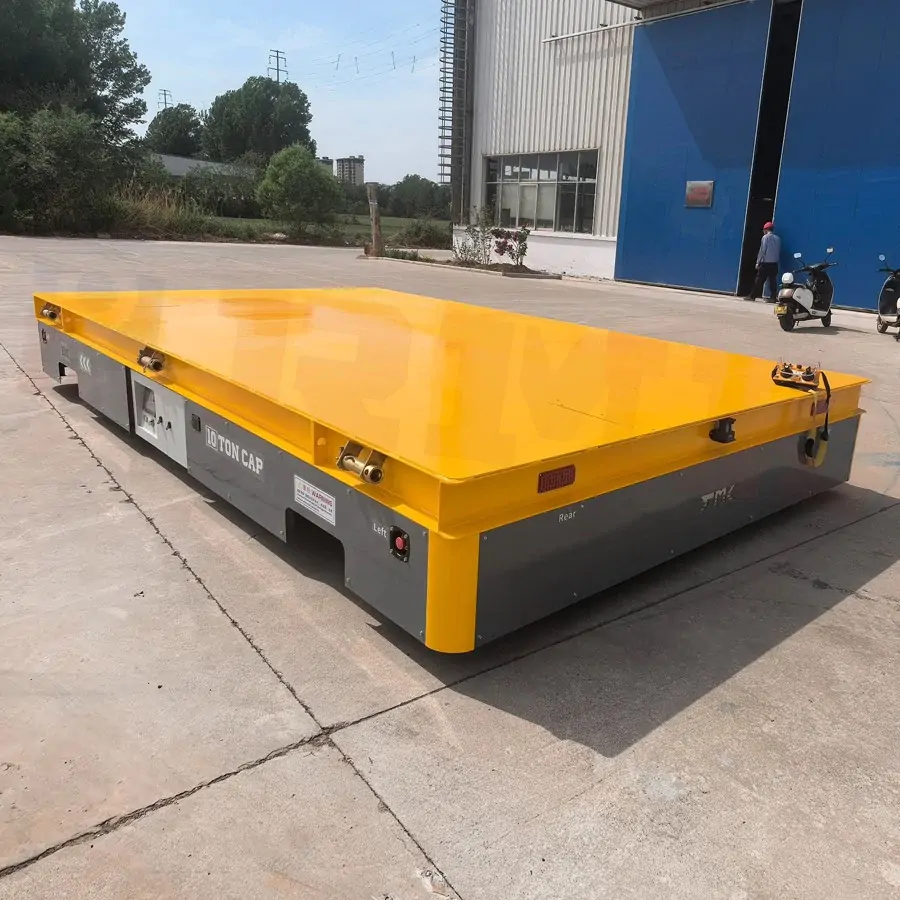
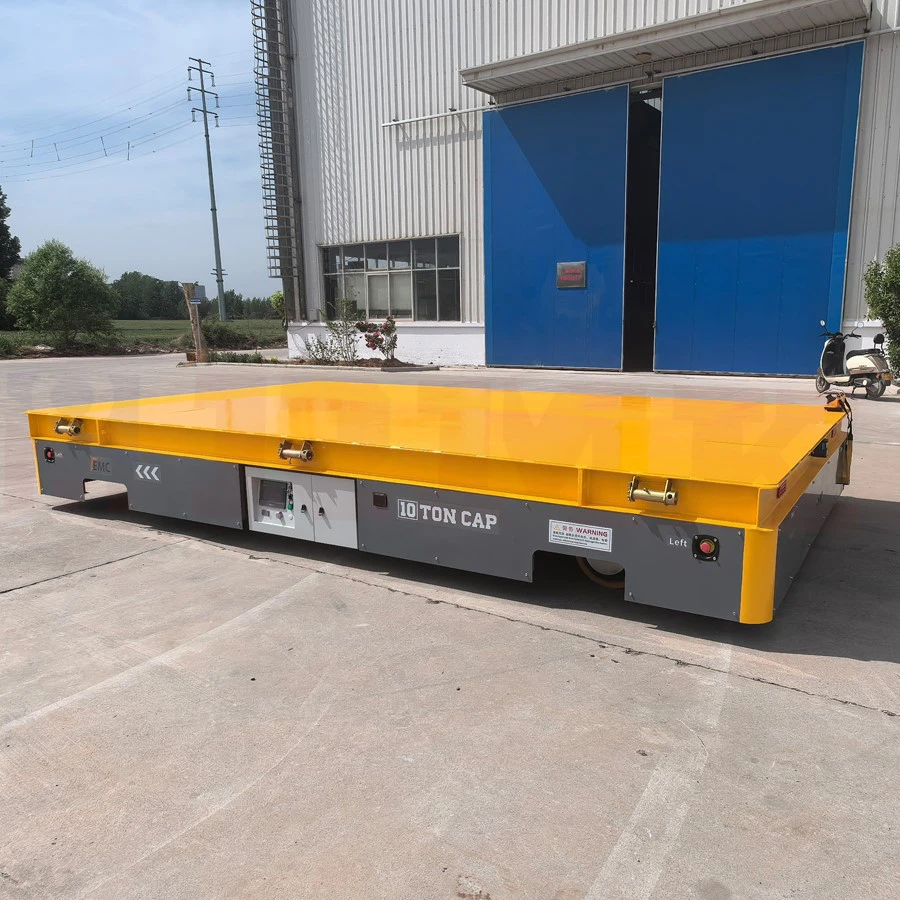
10 Ton Steel Pipe Battery Transfer Cart Specifications
| Parameter | Specification |
|---|---|
| Equipment Type | Steel pipe battery transfer cart |
| Rated Load Capacity | 10 tons |
| Overall Dimensions (L × W × H) | 6000 × 2500 × 600 mm |
| Power Supply | Maintenance-free lead-acid battery |
| Travel Type | Trackless |
| Movement | Forward, reverse, lateral movement, and turning during travel |
| Wheel Material | Polyurethane-coated wheels |
| Control Mode | Remote control; wired operation available |
| Steering System | Hydraulic steering |
| Safety Devices | Warning light, emergency stop button, and laser scanning sensor |
| Tilting Platform | Optional hydraulic tilting platform |
| Customization | Platform dimensions, load restraints and control configuration can be customized |
Specification basis: These specifications describe the proposed 10-ton model. Confirm the final configuration against the approved technical specification. Confirm whether the load rating uses metric tonnes, the usable deck dimensions, installed travel modes, and included safety devices. RMK offers customized configurations; optional equipment must be listed separately in the quotation.
How a Steel Pipe Battery Transfer Cart Works
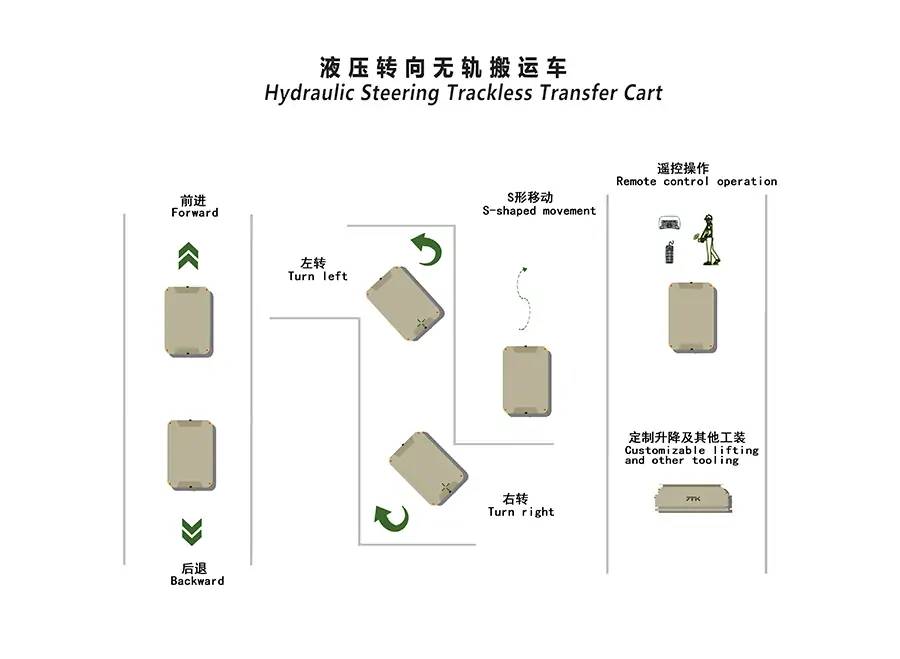
The 10-ton steel pipe battery transfer cart uses a battery-powered drive system for internal transport without fixed rails. The battery supplies power to the drive motor, which transmits torque to the drive wheels to move the loaded cart along the designated route.
Hydraulic steering controls the wheel direction for forward travel, reversing, and turning. Remote control allows the operator to maneuver the cart from a suitable operating position, particularly when transporting long steel pipes through production areas or between workstations.
The steering arrangement, drive-wheel configuration and control options should be selected according to the required movement, aisle width, turning space and floor conditions. Confirm the available travel modes and control functions against the final equipment configuration before ordering.
Remote operation example from RMK. The pictured configuration is illustrative; confirm the supplied model against the approved drawing.
Steel Pipe Battery Transfer Cart Components
The steel pipe battery transfer cart combines a load-bearing frame with electric drive, hydraulic steering, and a control system. Component selection must match the complete transported load, travel route, and stopping requirements.
- Frame and platform: Welded structure with load supports positioned for the pipe arrangement.
- Power and drive: Onboard lead-acid battery, drive motor, and transmission.
- Steering and wheels: Hydraulic steering and polyurethane-coated wheels, selected for the floor and required movement.
- Controls and safety: Wireless remote control, optional wired operation, emergency stop, warning light, and laser scanning sensor.
- Optional hydraulics: A tilting platform or a separately specified lifting system; lifting and tilting are different functions.
Features for Steel Pipe Handling
Heavy-Duty Transport
A stated 10-ton capacity for steel pipe handling, with platform supports and restraints designed for the actual load.
Multidirectional Travel
Forward, reverse, lateral movement, and turning can be configured to suit the route. Confirm the complete loaded swept path.
Optional Hydraulic Tilting
A side-tilting deck can be specified for controlled unloading into suitable receiving equipment. Tilting is an optional function.
Steel Pipe Handling Requirements
The design of a steel pipe battery transfer cart depends on pipe dimensions, load weight, and the handling route. These factors determine the platform size, load capacity, support structure, and steering configuration.
- Pipe Length and Diameter: Determine the platform dimensions and support-point spacing according to pipe length, diameter, and loading arrangement.
- Load Weight and Distribution: Calculate the total weight of individual pipes or bundled loads. The cart’s rated capacity must cover the full load, with the center of gravity kept within the designed support area.
- Loading and Unloading: Specify the loading position, unloading direction, and required transfer height. Side unloading may require a hydraulic tilting platform.
- Travel Route: Provide the route length, aisle width, turning space, and any slopes or floor joints to determine the drive and steering requirements.
- Floor Conditions: Check floor load capacity, flatness, surface condition, and traction to confirm wheel selection and safe operation.
Provide these details when requesting a steel pipe battery transfer cart. RMK can use them to assess the platform layout, travel configuration, and required functions for the application.
Platform Design and Steel Pipe Restraint
The transfer cart platform is designed around the steel pipe length, diameter, load weight, and loading arrangement. Platform dimensions and support positions must distribute the load across the deck and keep the center of gravity within the cart’s rated operating limits.
- Platform Dimensions: Customize deck length, width, and height according to pipe dimensions, bundle size, and available handling space.
- Pipe Support: Position support blocks or saddles to distribute the load and reduce pipe movement during travel. Support spacing depends on pipe length, diameter, and load weight.
- Anti-Rolling Restraints: Use V-shaped supports, stopper blocks, or other suitable restraints to prevent cylindrical pipes from rolling or shifting during acceleration, braking and turning.
- Center of Gravity: Arrange pipes evenly across the designated support area. Confirm the load distribution and center of gravity before finalizing the platform and chassis design.
Platform dimensions, support geometry, restraint height, and spacing should be specified according to the actual steel pipe dimensions and handling method. RMK can customize these structures to suit the load and operating conditions.
Optional Hydraulic Tilting and Unloading
A hydraulic tilting platform is an optional configuration for the 10-ton steel pipe battery transfer cart. It raises one side of the platform to incline the load toward the designated unloading side, reducing the need for manual repositioning. The tilting function is not included as standard equipment and must be specified when ordering.
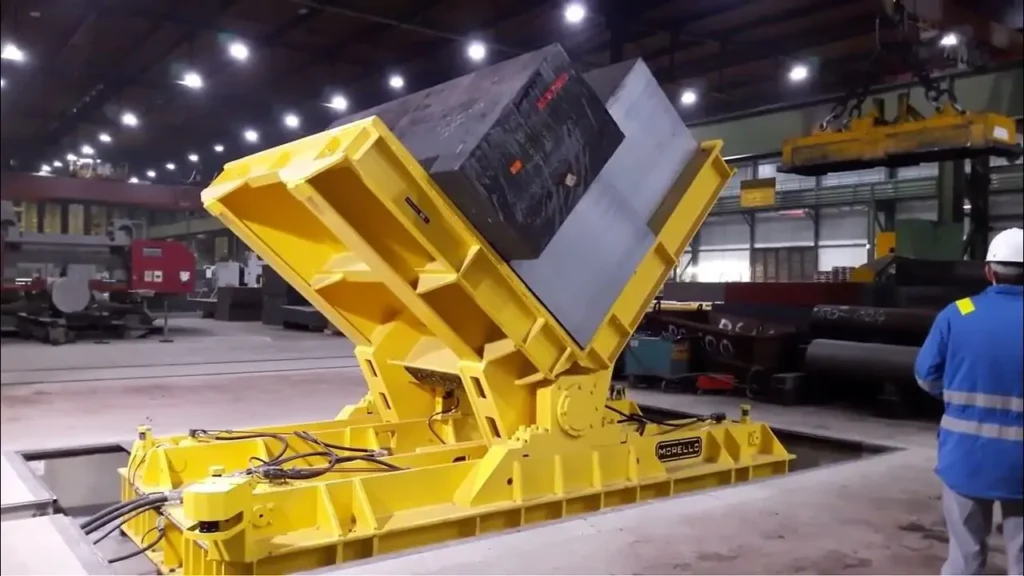
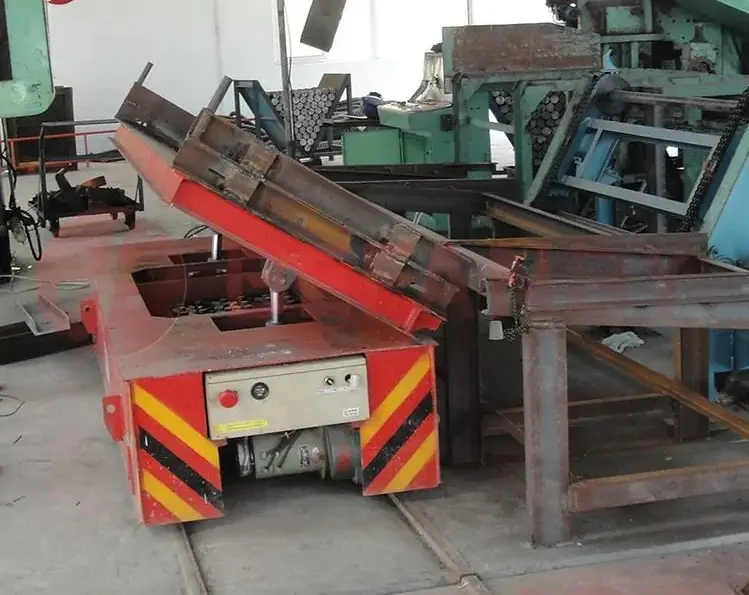
- Tilting Direction: Specify the required unloading side according to the receiving area, storage rack, or downstream process.
- Platform Design: Determine the tilting angle, hinge position, and hydraulic cylinder arrangement according to pipe dimensions, load weight, and unloading height.
- Load Stability: Engineer supports and a controlled release arrangement for the unloading sequence. Prevent unintended rolling and keep personnel outside the discharge area. The receiving equipment must safely accept the pipes before restraints are released.
- Operating Conditions: Check the load distribution, floor level, cart stability, and receiving equipment before confirming the hydraulic system design.
The tilting mechanism, unloading direction, and platform structure should be engineered for the actual pipe load and site layout. Confirm the allowable load and operating procedure with the final technical specification.
Safety Devices and Operating Conditions
The 10-ton steel pipe battery transfer cart can be configured with an emergency stop button, warning light, and laser scanning sensor. These devices support operator intervention and obstacle detection during in-plant transport. The final safety configuration should be confirmed against the equipment specification and site risk assessment.
- Emergency Stop: Initiates the specified emergency stopping function. Verify the stopping behavior, reset procedure, and restart prevention in the operating manual and commissioning checks; do not assume the loaded cart stops instantly.
- Warning Light and Audible Alarm: Provide visual and audible warnings during travel where included in the selected configuration.
- Laser Scanning Sensor: Detects obstacles within its configured detection zone. Sensor coverage and stopping distance must suit the cart’s speed, load and operating environment.
Before installation, verify the floor’s load-bearing capacity, flatness and surface condition. The travel route must provide sufficient aisle width, turning clearance and space for long steel pipes, including their overhang beyond the platform. Keep the route clear of obstacles and confirm safe stopping distances under loaded conditions.
The final operating layout and safety devices should be assessed against the actual load, travel speed, floor conditions and plant traffic.
Wheel choice must be checked against floor loading and traction. Our guide to types of wheels for transfer carts explains the available wheel arrangements and their typical uses.
Steel Pipe Battery Transfer Cart Applications
A steel pipe battery transfer cart is suited to planned transfers between pipe production, processing and storage points where the floor and route support the loaded vehicle. The platform should be designed for the pipe length, diameter, bundle arrangement and loading method.
- Production and processing: Move pipe loads between forming, cutting, inspection or finishing stations.
- Storage and dispatch: Transfer restrained pipes or bundles between racks, loading areas and designated collection points.
- Workshop connections: Move between workstations where a suitable trackless route is available, with clearance for pipe overhang.
For a different approach to long-pipe handling, see RMK’s 30m rail-guided vehicle project for steel pipes. That case uses a fixed rail route and a different load configuration; it is not a performance specification for this 10-ton trackless model. How to Specify a Steel Pipe Battery Transfer Cart
Select a steel pipe battery transfer cart according to the pipe load, handling method, and factory conditions. Confirm the following parameters before requesting a technical proposal.
- Steel Pipe Weight and Dimensions: Provide the weight, length, diameter, and quantity of individual pipes or bundles per load. These values determine the required capacity and platform dimensions.
- Rated Load Capacity: Calculate the total transported weight, including any fixtures or support structures carried on the cart. Select a rated capacity that accommodates the complete load within the manufacturer’s operating limits.
- Platform Structure: Specify the deck length, width, height, support spacing, and anti-roll restraints according to the pipe arrangement and loading method.
- Travel Route: Provide the route length, aisle width, turning points, travel frequency, and required movement directions. These details determine the drive and steering configuration.
- Floor Conditions: Confirm floor load capacity, flatness, surface material, joints, and gradients. Check wheel selection and traction against actual site conditions.
- Battery Runtime: Estimate operating hours per shift, travel distance, load frequency, and charging intervals. Select the battery capacity and charging arrangement according to the duty cycle.
- Unloading Requirements: Specify the unloading side, receiving height, and transfer method. If side unloading is required, confirm whether an optional hydraulic tilting platform is suitable for the pipe load and site layout.
Provide these parameters when requesting a quotation. RMK can use them to assess the cart capacity, platform design, drive system, and optional functions for the intended application.
For a broader view of platform, power, and control options, review the custom transfer cart design guide alongside your route drawing and pipe data.
Battery Runtime and Maintenance
Runtime for a steel pipe battery transfer cart depends on battery capacity, payload, travel distance, starts and stops, floor conditions, and the use of auxiliary functions. Operating duration and charging time should be agreed for the intended duty cycle. Request a duty-cycle calculation that covers the proposed shift and charging windows rather than assuming continuous operation.
For the specified maintenance-free lead-acid battery, use the approved charger and follow the battery supplier’s charging, ventilation, storage and inspection instructions. Maintenance-free does not mean inspection-free. Include checks of connectors, wheels, restraints, steering, hydraulic components and safety functions in the maintenance plan. Record acceptance tests with a representative load and agree on the manuals, spare parts, and service information to be supplied.
Use the battery transfer cart maintenance guide to plan inspection topics, then follow the intervals and procedures specified for the supplied equipment.
Steel Pipe Battery Transfer Cart Manufacturer and Supplier
REMARKABLE designs and manufactures steel pipe battery transfer carts for industrial material handling applications. Custom options cover rated load capacity, platform dimensions, pipe supports, anti-roll restraints, steering systems, battery power supply, and control methods. Hydraulic tilting platforms and additional safety devices can be specified according to unloading requirements and site conditions.
For project evaluation, provide the steel pipe length, diameter, total load weight, loading and unloading methods, travel route, and factory layout. RMK can assess the required cart configuration and provide a technical proposal and quotation based on your operating conditions.
Contact ua with your project requirements to discuss a customized steel pipe battery transfer cart solution.
FAQ
What is a steel pipe battery transfer cart used for?
A steel pipe battery transfer cart moves individual pipes or bundled pipe loads between production, processing and storage areas. Supports and restraints must suit the pipe geometry, while the chassis and steering must suit the route. It is intended for controlled in-plant transport under the agreed operating conditions.
How much weight can a steel pipe battery transfer cart carry?
The model described here has a stated rated capacity of 10 tons. Confirm the unit definition and rating basis in the final specification, including the permitted load distribution and the weight of carried fixtures. Capacity alone does not establish suitability for a long or uneven pipe load.
How are long steel pipes secured on a transfer cart?
Long pipes require supports positioned for their length, stiffness and weight distribution. V-shaped saddles, stops and suitable restraints help prevent rolling or shifting. The final arrangement must account for acceleration, braking, turns and overhang; a flat deck alone does not secure a cylindrical load.
Can a battery-powered transfer cart move steel pipes without rails?
Yes. This steel pipe battery transfer cart uses a trackless chassis and onboard battery power, so fixed rails are not required for its intended route. The floor still needs sufficient capacity, suitable surface conditions and adequate space. Confirm gradients, joints and thresholds before selecting the configuration.
Can a steel pipe battery transfer cart turn in a narrow workshop?
Suitability depends on the complete swept path of the cart and pipe load, including overhang. Confirm lateral travel, steering modes and required clearance with the supplier using the proposed layout. Obtain the required aisle width and turning envelope for the selected configuration before confirming the route.
Is a hydraulic tilting platform available for steel pipe unloading?
An optional hydraulic tilting platform can be specified. Its suitability depends on the pipe load, restraint design, unloading direction and receiving equipment. Confirm the rated tilting load, permitted angle, stability and unloading sequence before ordering. Tilting is not a standard feature of every steel pipe battery transfer cart.
What floor conditions are required for a 10-ton steel pipe battery transfer cart?
The floor must support the combined cart and payload, including concentrated wheel loads. Check flatness, traction, joints, gradients and surface damage with the site engineer and supplier. A 10-ton payload rating is not a floor-loading specification, and polyurethane wheels do not establish suitability for every floor.
What information is needed to customize a steel pipe battery transfer cart?
Provide pipe dimensions, quantity and total weight per trip, together with loading and unloading methods, route drawings, floor data and shift requirements. Include required travel modes, restraints, controls and safety functions. These inputs allow a steel pipe battery transfer cart proposal to be evaluated against the actual task.
Customized Intelligent Material Handling Solutions
To ensure that a customized transfer cart fits your needs perfectly, please provide the following details:
- Load Capacity: _____ tons (1~500 ton)
- Table Size: _____ × _____ mm/m (e.g., 1500×3000)
- Power Options:
- ☐ Lead-acid ☐ Lithium-ion ☐ Other: _____
- ☐ Cable: _____V/_____A
- ☐ Standard 380V/50Hz/3-phase
- Cargo Details:
- Type: _____ (e.g., steel coils, machinery)
- Special Needs: _____ (e.g., anti-slip, corrosion-proof)
- Optional Features:
- ☐ Emergency stop ☐ Anti-collision sensors
- ☐ Rail guides ☐ Lifting mechanism ☐ Remote control