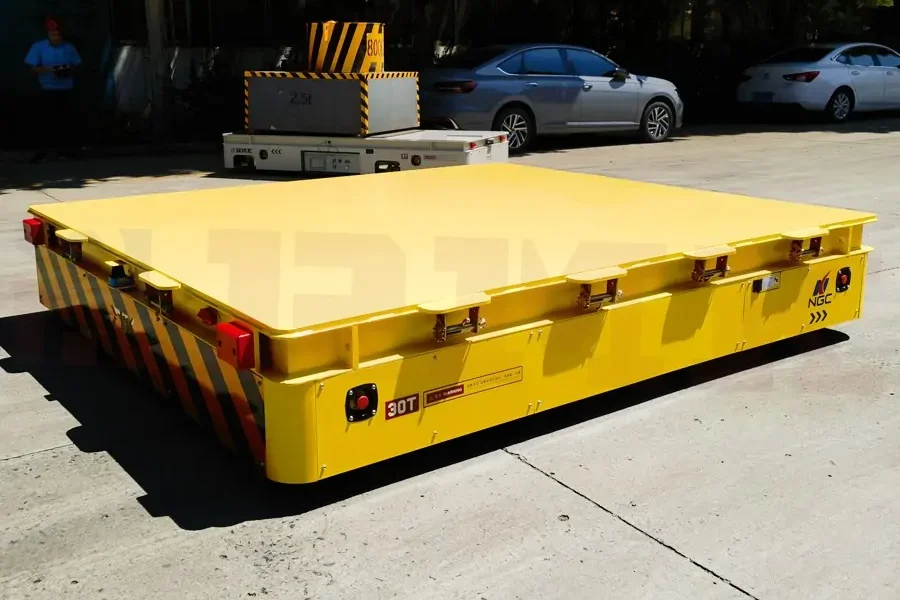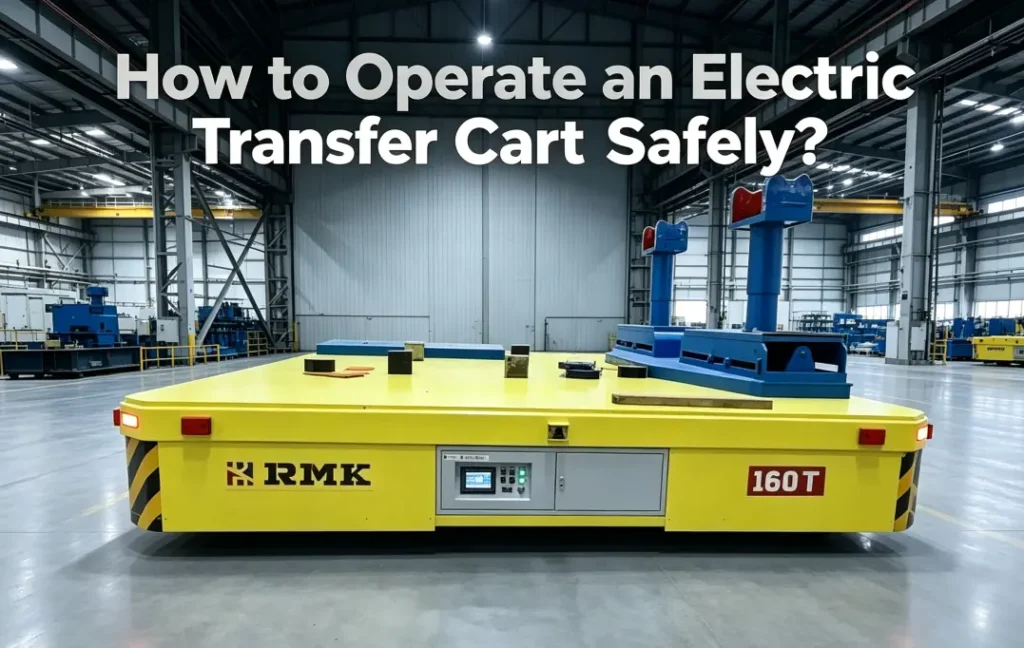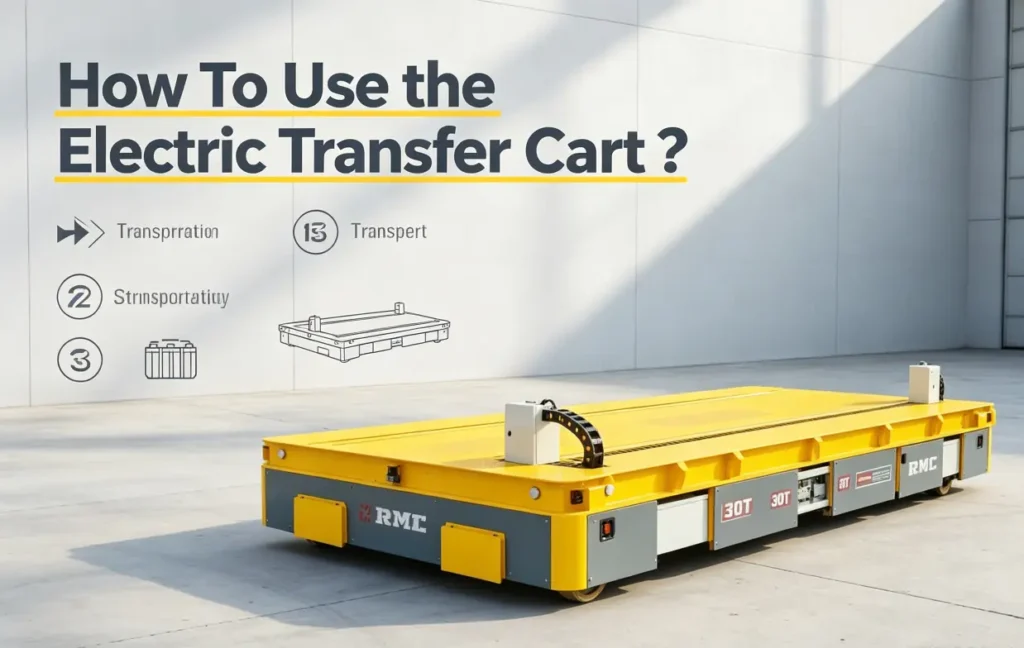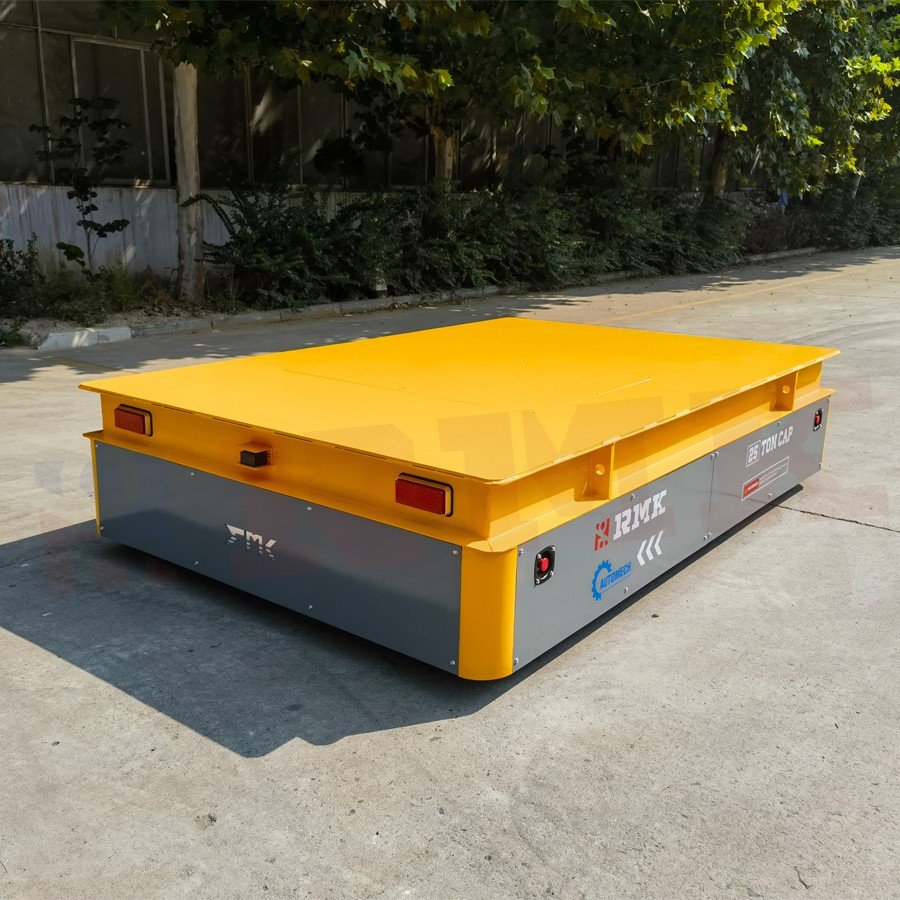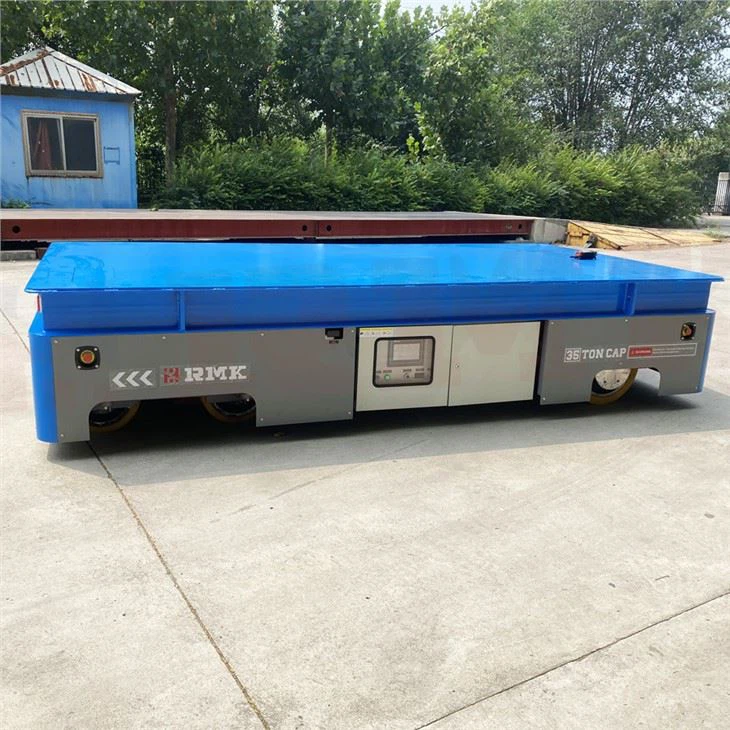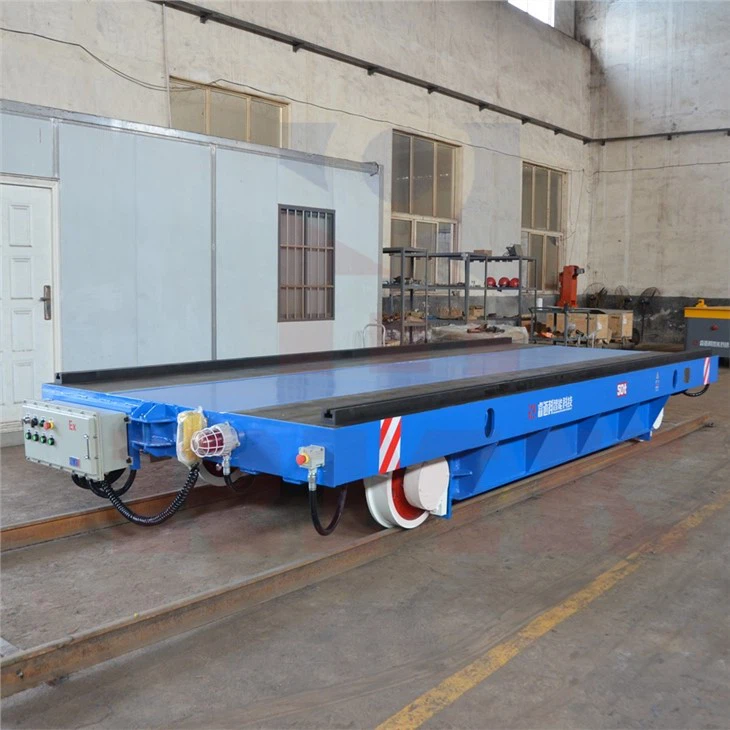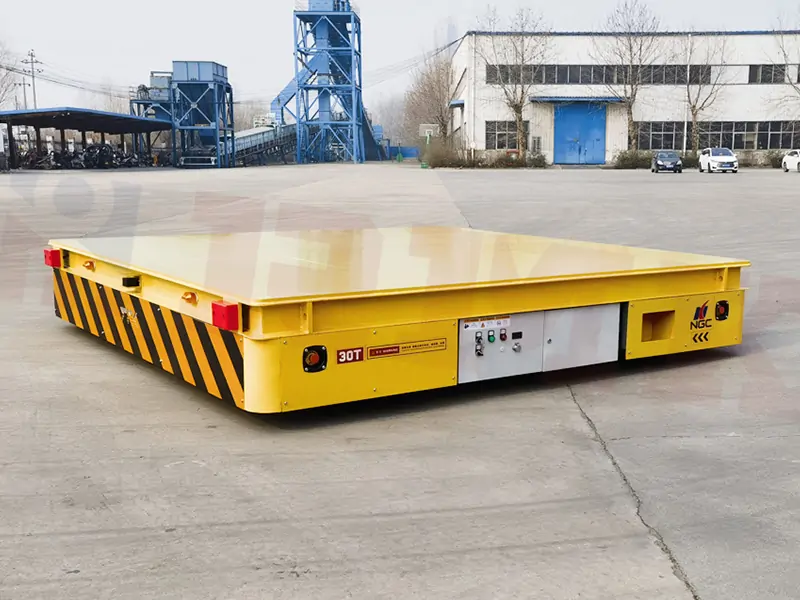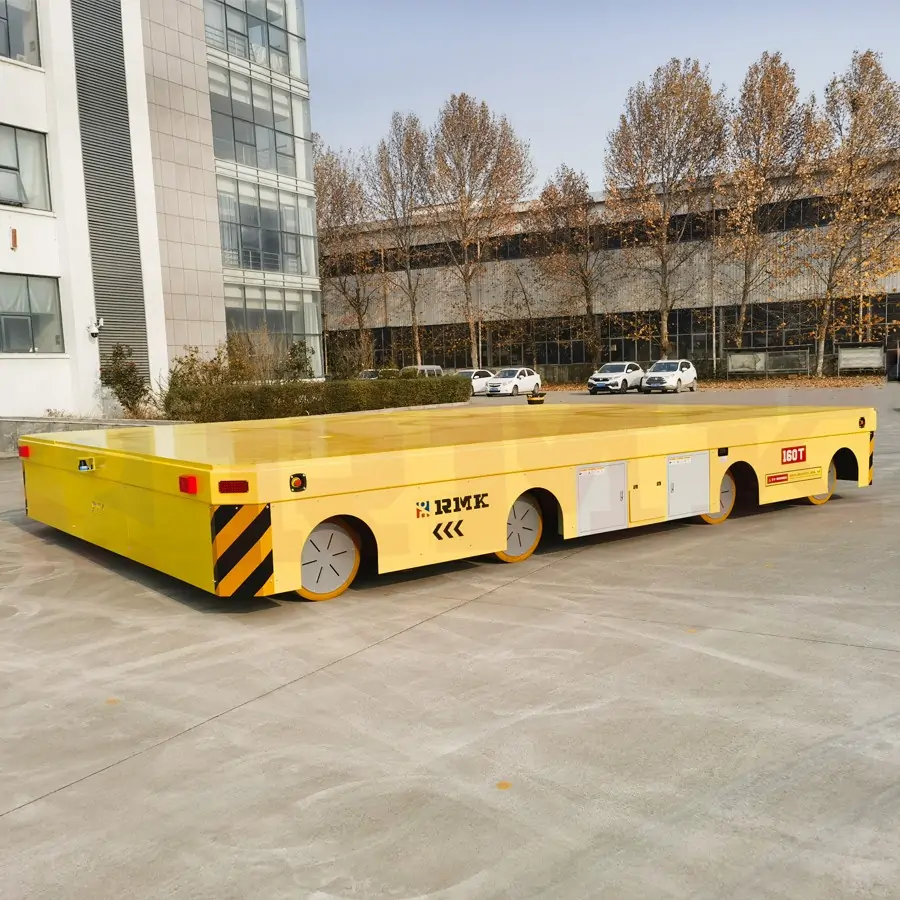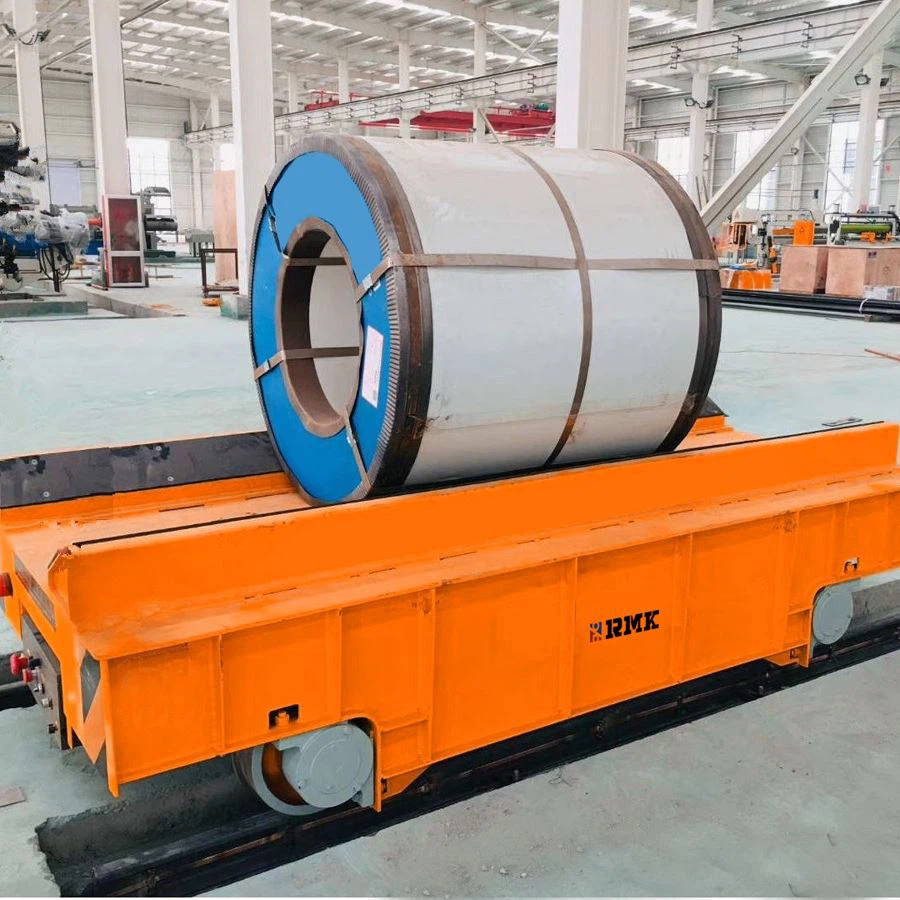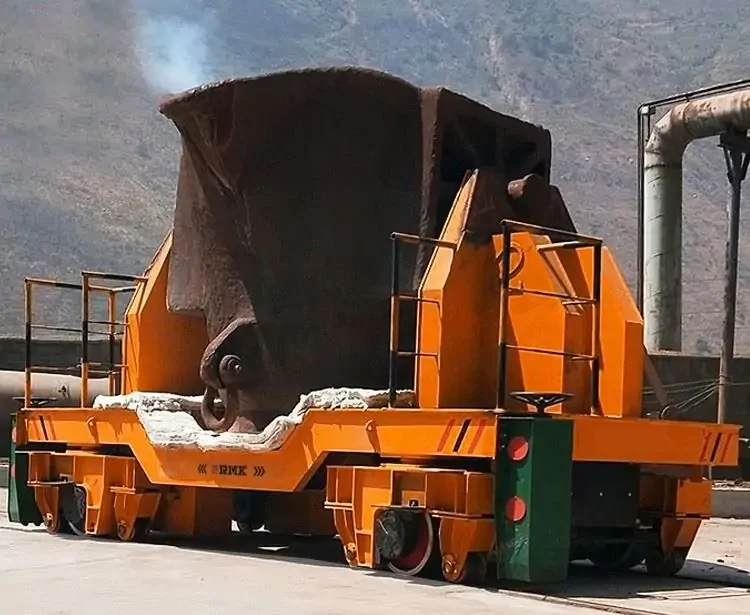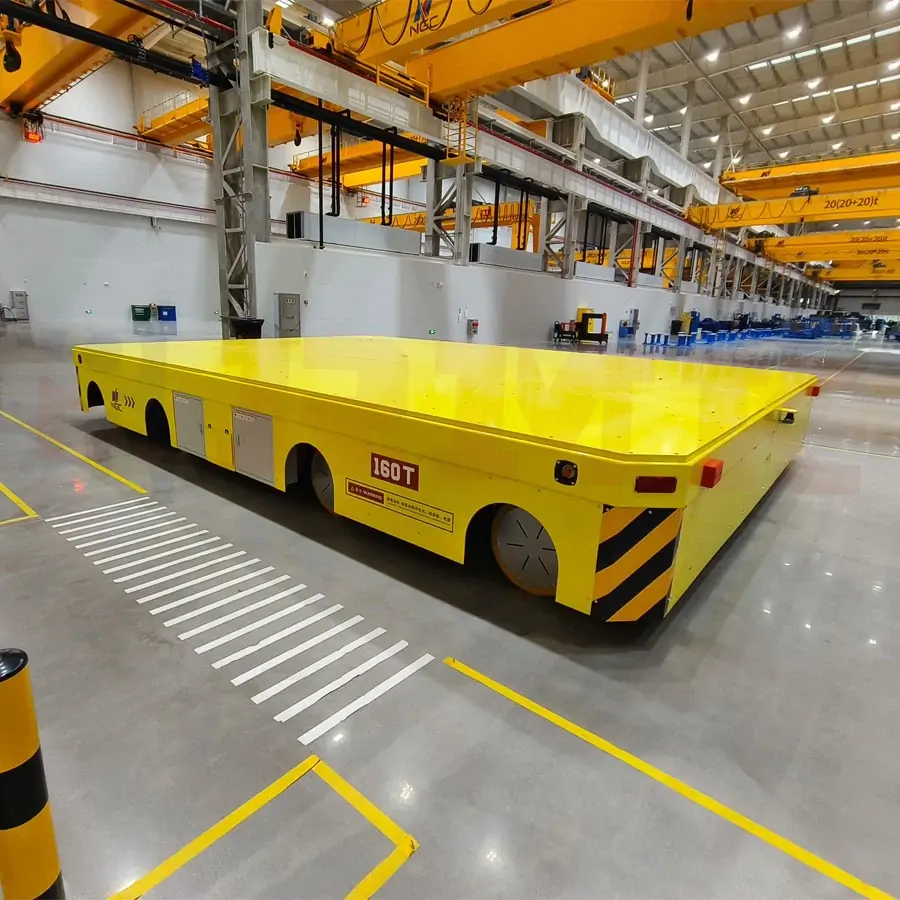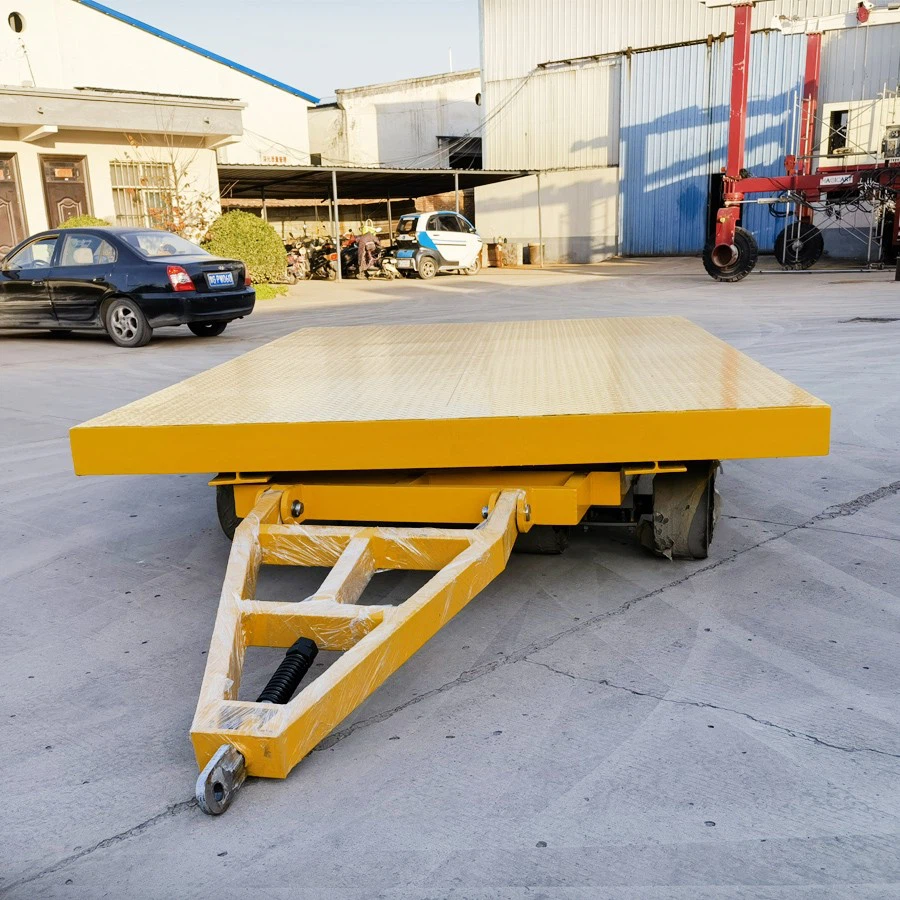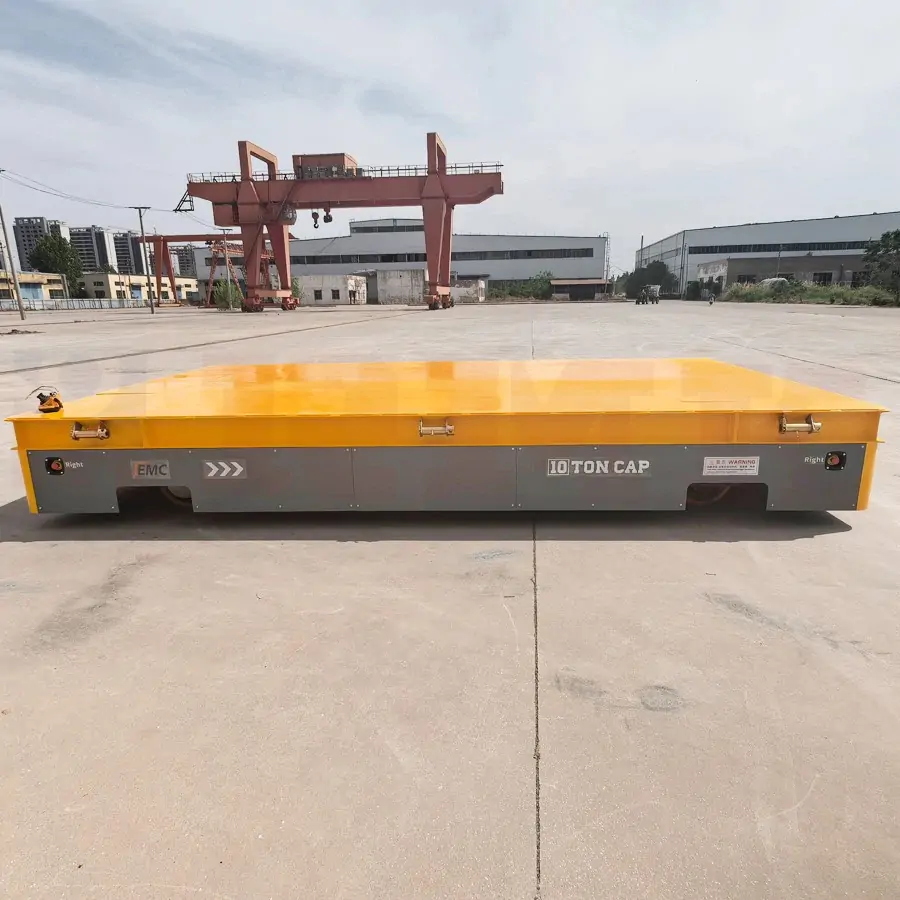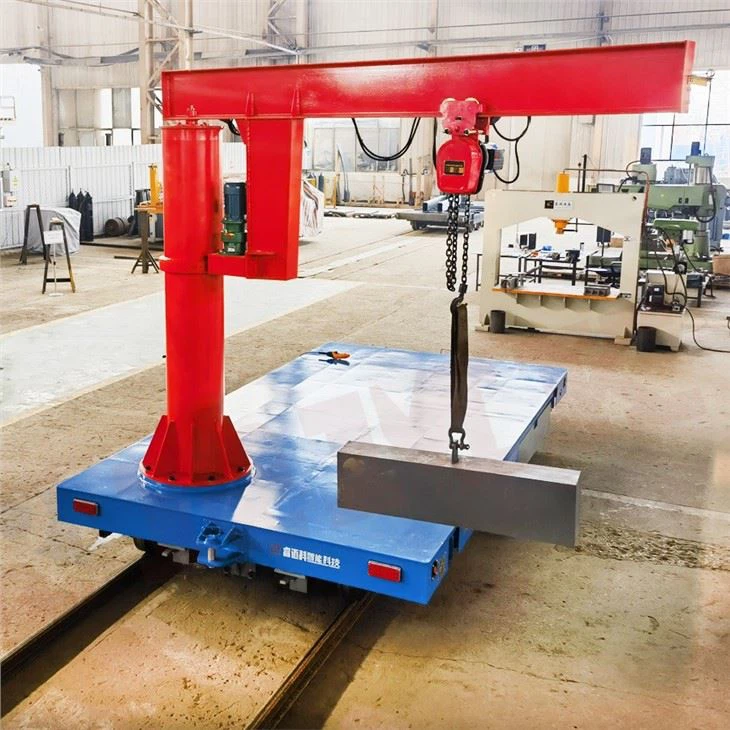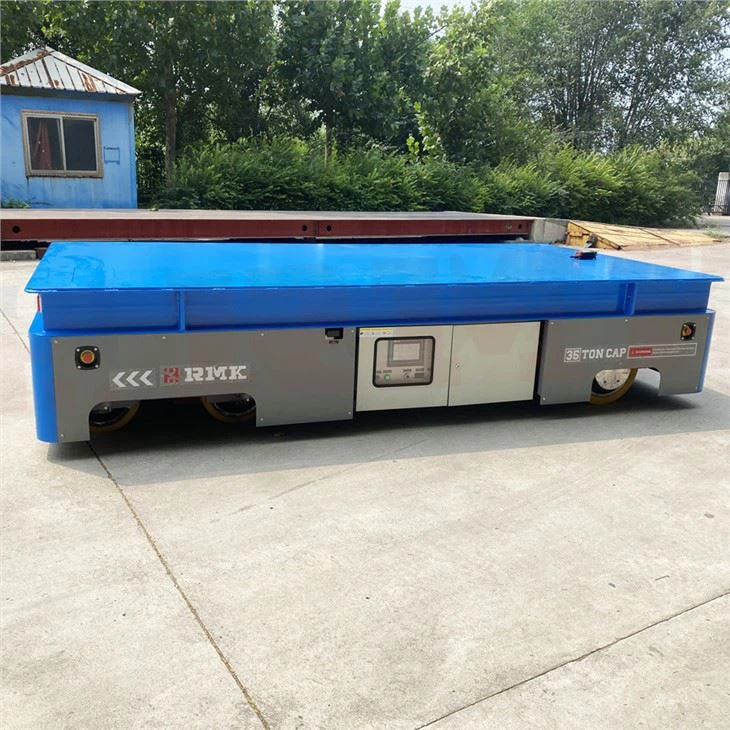
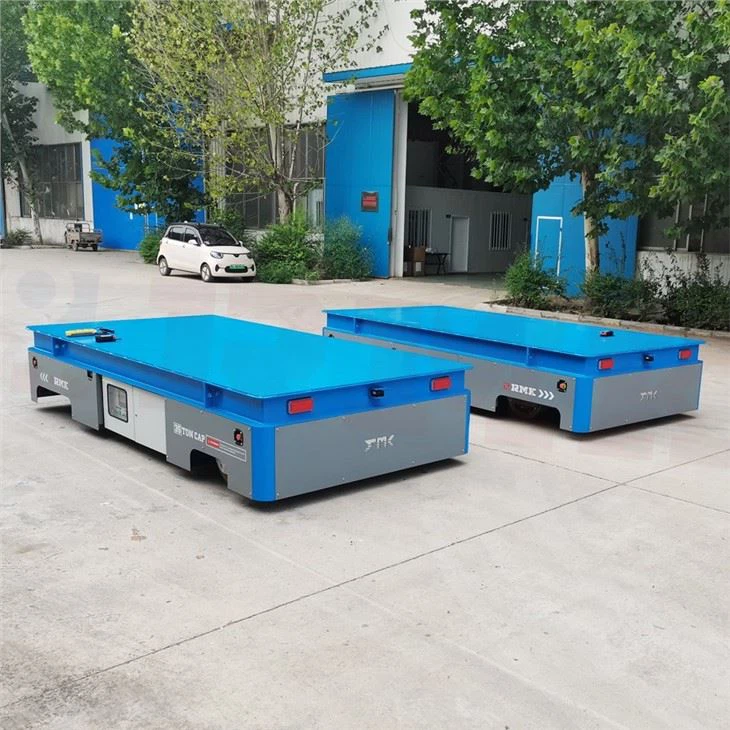
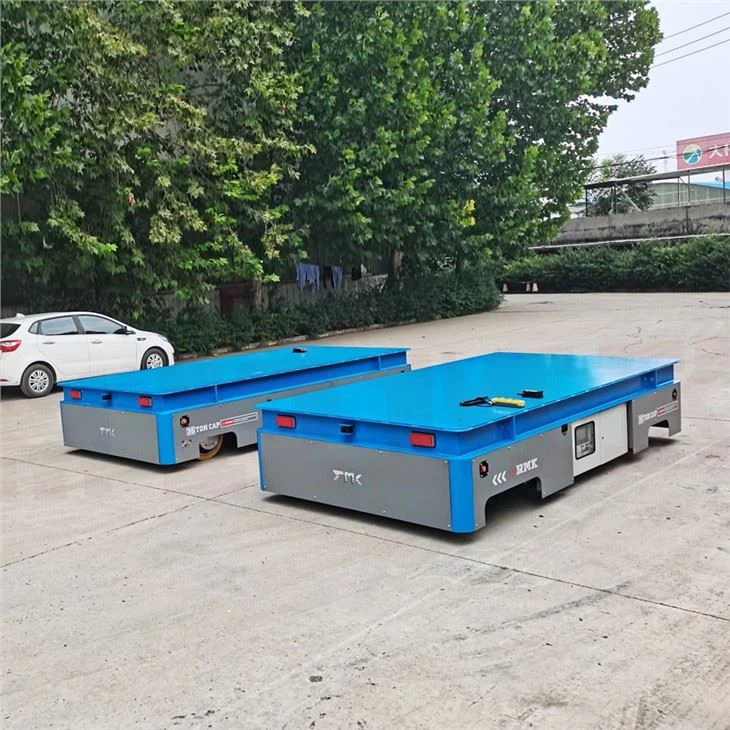
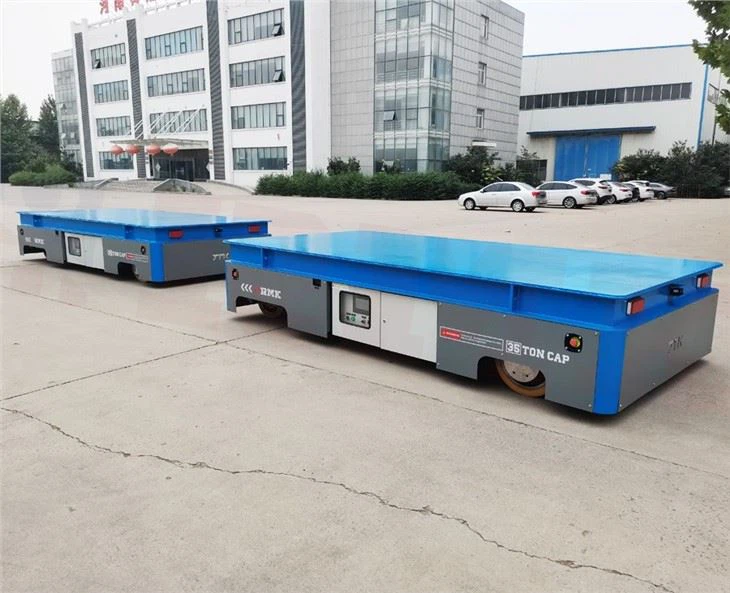
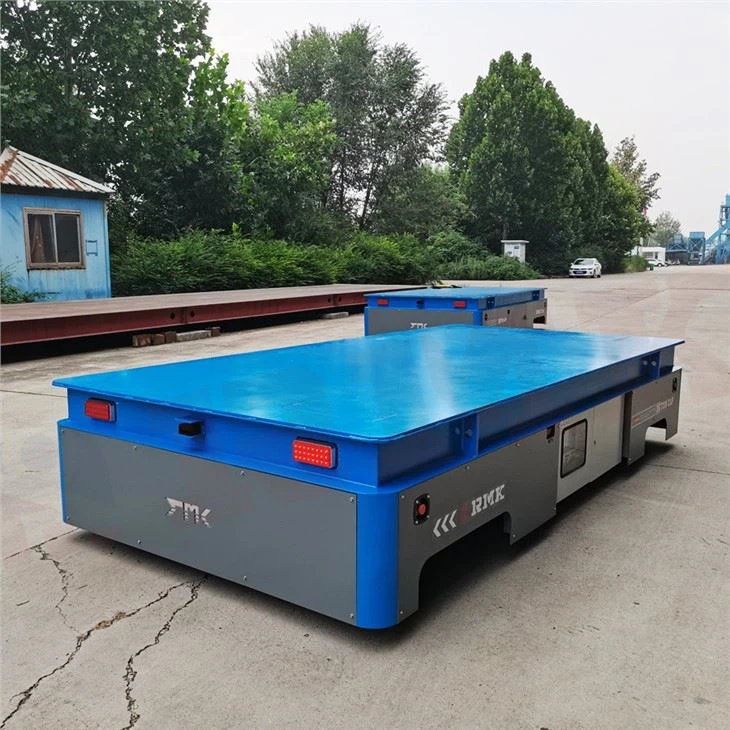
The electric mold transfer cart is a kind of industrial handling equipment designed for factory floors, mainly used to transfer heavy moulds such as injection moulds and stamping molds safely and efficiently. It is suitable for mould installation, mould change, and maintenance.
- Load capacity: 1~500 tonnes; heavy-duty models can reach more than 1500 tonnes
- Driving mode: manual/hydraulic/electric; electric model speed 0.1~0.5m/s
- Lifting adjustment: hydraulic or mechanical lifting and lowering, stroke 50~300mm, accuracy ±1mm
- Mobility: universal wheels (with brakes) or rail, 360° steering
- Table size: customised, with non-slip design
- Safety: anti-tipping structure to ensure stable handling, cushioning device, emergency braking, barricade detection system
Product Overview
A mold transfer cart, also known as a mold transport cart, mold handling cart, or die transfer cart, is an industrial material handling vehicle used to transport molds, stamping dies, and heavy tooling between storage areas, maintenance stations, and production machines.
RMK mold transfer carts are used in injection molding plants, metal stamping workshops, mold manufacturing facilities, and tool rooms. They handle mold movement during machine loading, unloading, mold changes, and transfers to maintenance or storage areas, reducing manual handling and forklift traffic.
RMK offers rail-mounted and trackless mold transfer carts with load capacities from 1 to 500 tons for standard heavy-duty models and custom designs for loads up to 1,500 tons. Platform dimensions, battery power, travel speed, hydraulic lifting, and positioning systems can be configured according to mold weight, factory layout, travel routes, and machine interface requirements.
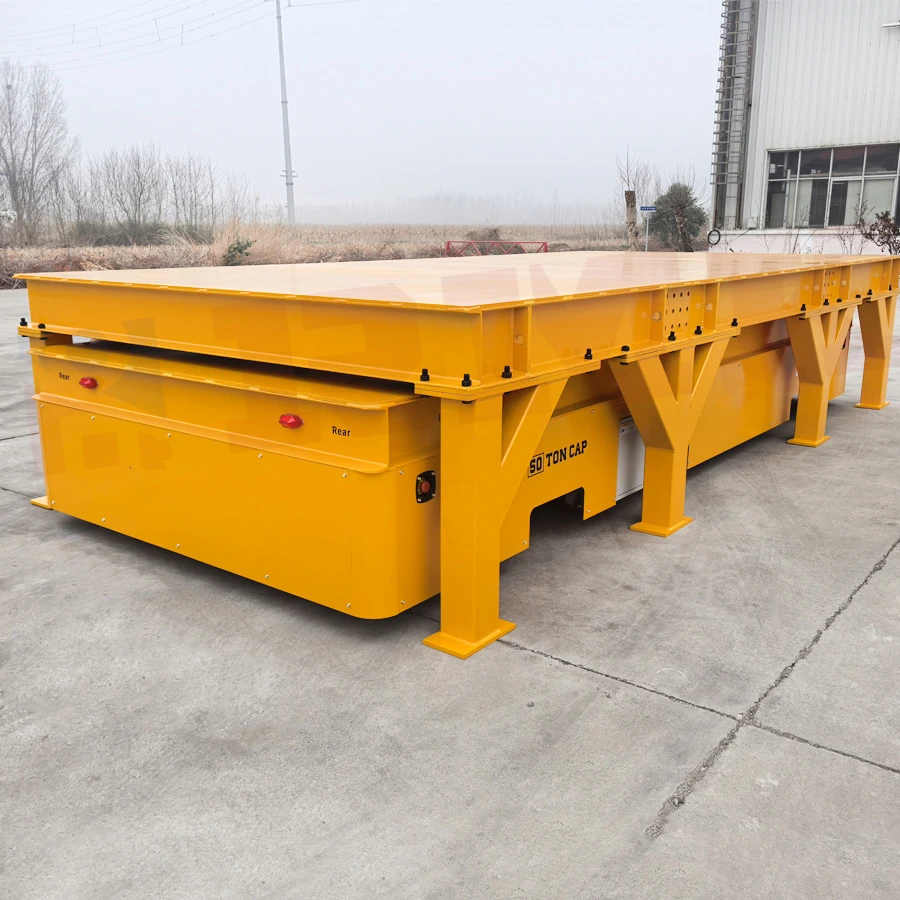
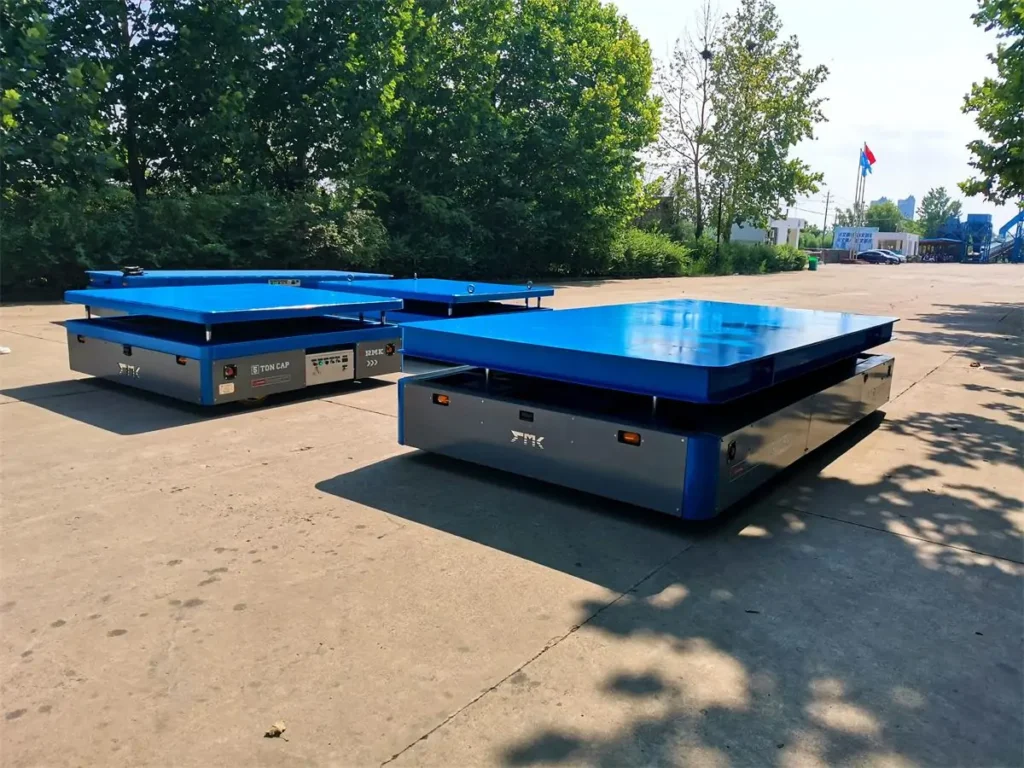
Electric Mould transfer cart for automobile manufacturing industry
12-ton injection mold transfer carts
Mold Transfer Cart Parts
Mold transfer cart components include drive systems, wheels, lifting devices, control systems, and safety devices. Component specifications are selected according to mold weight, dimensions, transfer route, and workshop conditions.
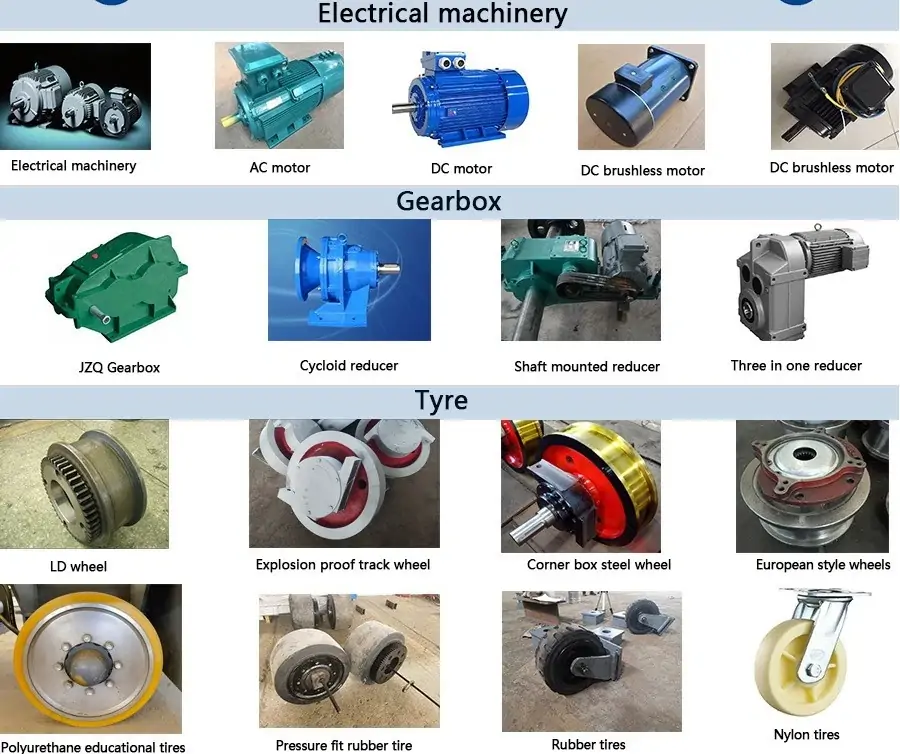
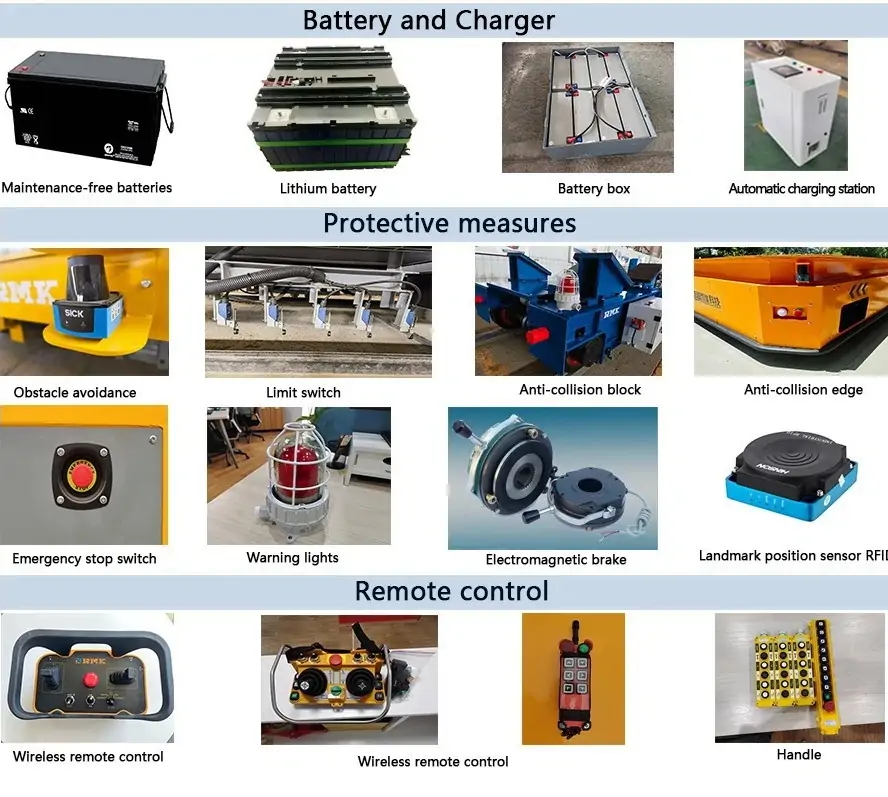
- Load-bearing system: high-strength alloy steel table, extendable platform extension plate, mould positioning block/stop block, V-groove positioning guide rail
- Lifting system: hydraulic cylinders (single-stage/multi-stage), hand-operated hydraulic pumps, electro-hydraulic power units, scissor lifting mechanism (mechanical), lifting and lowering safety locking pins
- Mobile system: heavy-duty universal wheels (with double brakes), rail-specific steel wheels, polyurethane-wrapped wheels (anti-vibration type), axle lubrication system
- Control system: hydraulic control handle, wireless remote control (electric type), foot-operated hydraulic switch, emergency stop button.
- Safety system: overload protection sensor, tilt alarm, anti-collision buffer bar, hydraulic explosion-proof valve.
- Positioning system: laser alignment indicator, digital height display, mould docking guide bar, adjustable support foot cups
- Maintenance system: special hydraulic oil, wheelset dismantling tool, lubricating grease filler, spare battery (electric type)
- Optional systems: mould preheating device, automatic weighing system, RFID mould identification module, anti-static coating components, explosion-proof configuration
- Fastening system: High-strength connecting bolts, quick-disassembly pins, anti-loosening nuts, safety chain rings
RMK manufactures mold transfer carts with custom component layouts, load capacities, and control systems for different mold handling requirements. Contact our engineering team to discuss your project specifications.
For details on wheel types and uses, read the article: Types of Wheels for Transfer Carts
Working Principle
The working principle of the Mold Flat Transfer Cart is based on the synergy of mechanical drives and hydraulic systems to achieve safe handling and precise positioning of moulds. Its working process can be divided into the following key links:
- Carrying and moving: The moulds are placed on a reinforced steel platform with heavy-duty universal or track wheels at the bottom, which can be flexibly moved by electric drive or hydraulic power.
- Lifting and adjusting: A hydraulic cylinder, screw, or shear mechanism is used to control lifting and lowering by hand pump, electric hydraulic system, or pneumatic device, and the height is precisely adjusted to match the working table of the injection moulding machine or press.
- Positioning and docking: Some models are equipped with micro-adjustment devices (e.g., slides, positioning pins) to ensure quick alignment of the mould with the machine and improve the efficiency of mould change.
- Safety locking: After lifting, the position is fixed by mechanical locking or hydraulic holding pressure to prevent accidental falling and ensure stable handling.
The whole working process of the Mould Transfer Cart is coordinated by all systems to achieve smooth transport, precise lifting, and safe positioning of moulds from the storage location to the production equipment.
Advantages
High load
Load capacity 1-150 tonnes, reinforced steel structure, anti-deformation design.
Precision Positioning
Laser/V-groove guide, ±0.5mm accuracy, fast alignment.
Multi-mode drive
Manual/electric/pneumatic optional, frequency conversion speed regulation 0.1-0.5m/s.
Intelligent safety
Overload emergency stop + tilt alarm + hydraulic locking, CE certification.
Module Extension
Platform can be extended to 5m, RFID/weighing optional, MES docking.
Customised production
Adjustment of dimensions/functions on request, support for non-standard designs.
Applications
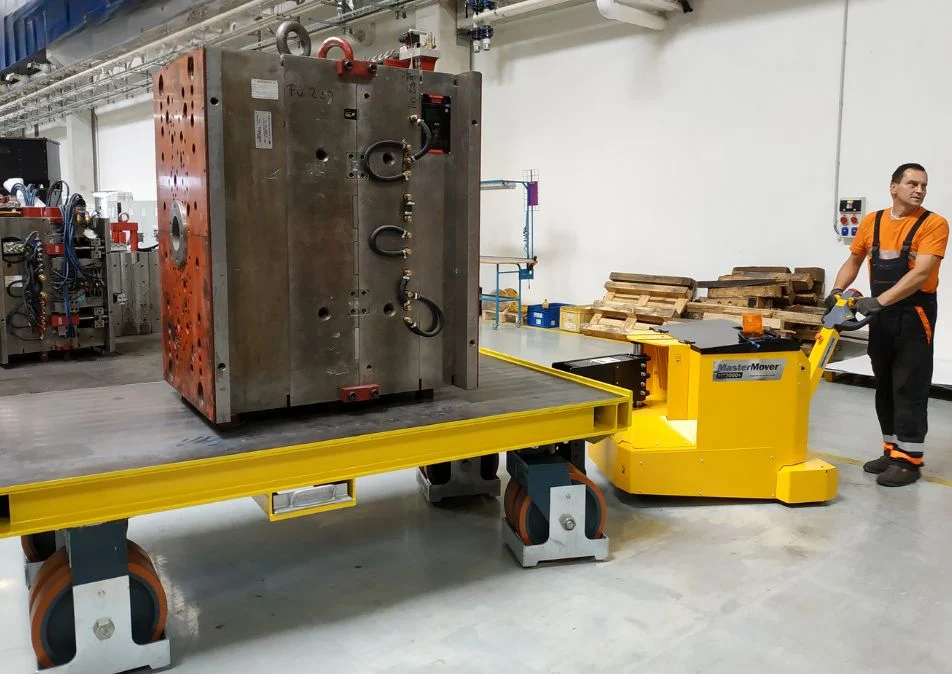
Injection Molding Machine Changeovers
Transfers injection molds between storage areas and injection molding machines during mold changes.
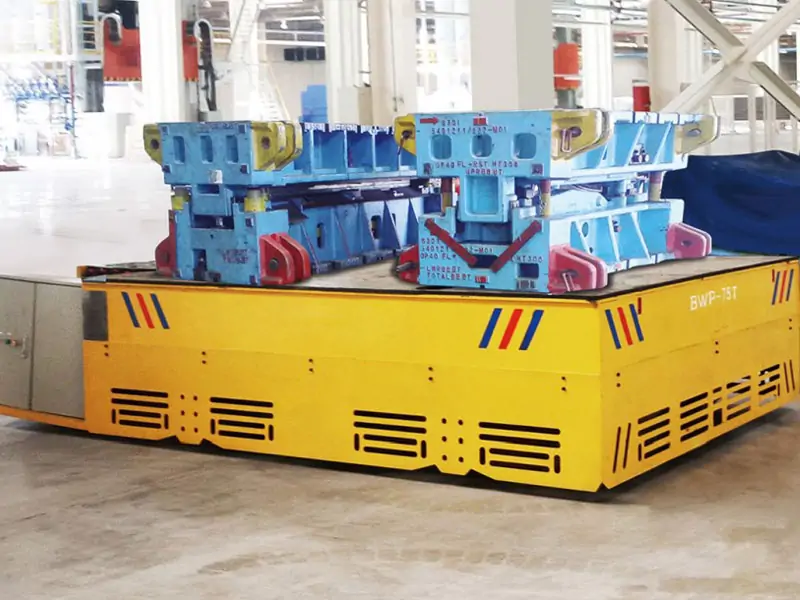
Stamping Die Transport
Moves heavy stamping dies between storage racks, stamping presses, and production stations.
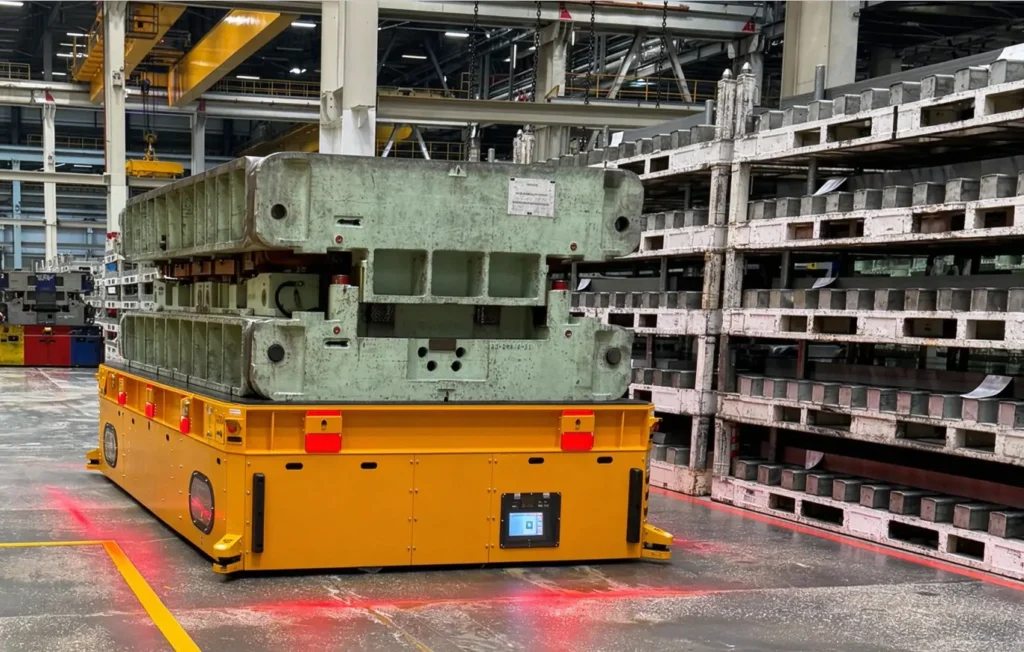
Mold Warehouse Handling
Transports molds between storage locations, inventory areas, and dispatch zones.
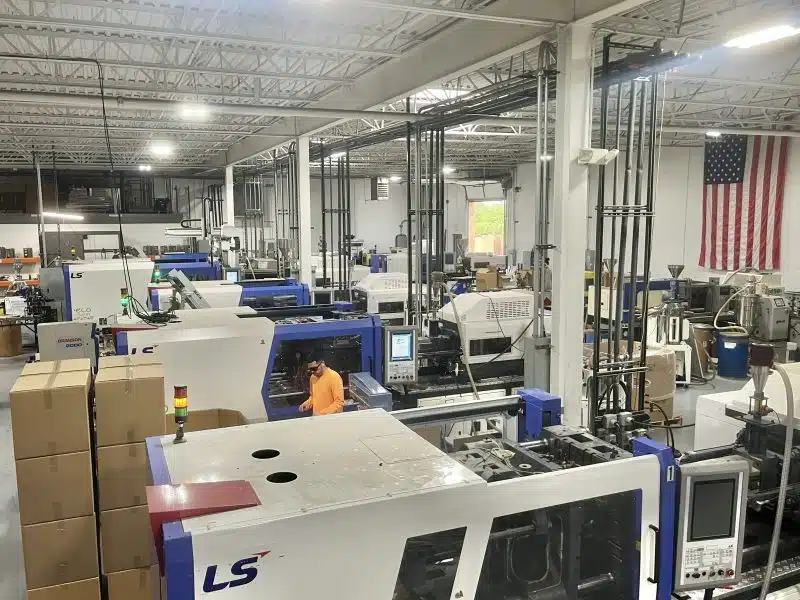
Mold Maintenance and Repair
Moves molds to maintenance benches, repair stations, and inspection areas for servicing.
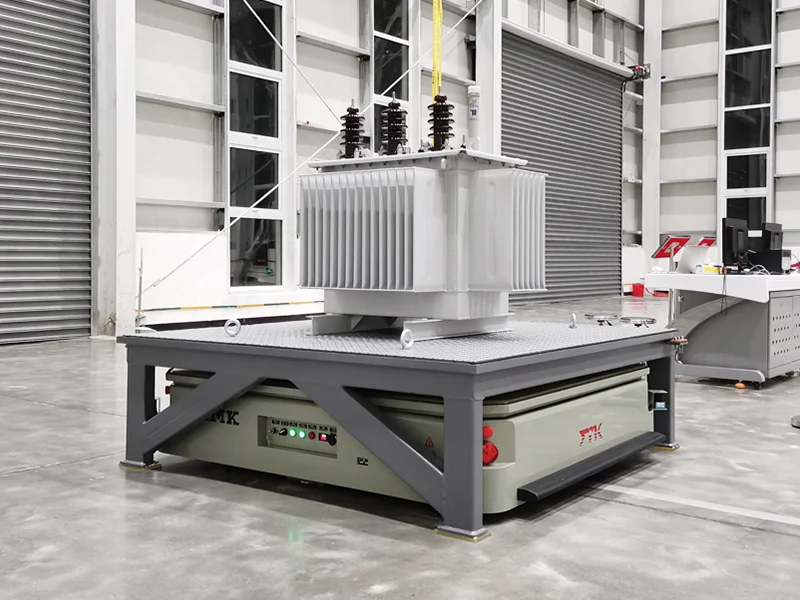
Mold Loading and Unloading
Positions molds near machine beds or designated loading points for installation and removal, with optional hydraulic lifting systems.
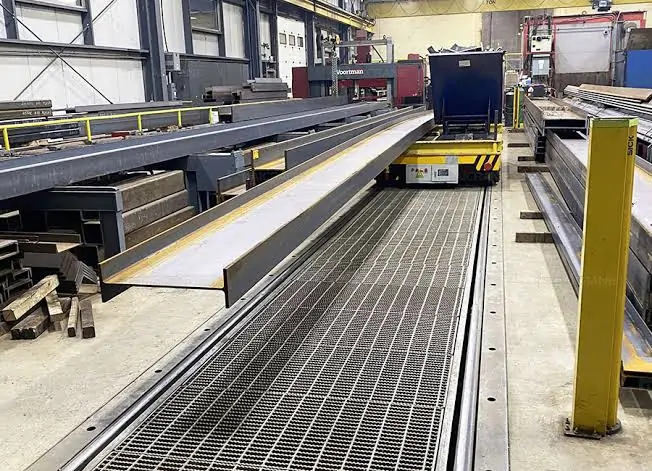
Inter-Workshop Mold Transfer
Moves molds between mold manufacturing, machining, assembly, and production workshops according to factory layout and transport requirements.
For more industry applications, see: Mold Transfer Cart & Die Handling Cart Guide for Industry
Mold Transfer Cart Specifications
| Item | Specifications |
|---|---|
| Rated Load Capacity | 1–150 t, customizable |
| Safety Factor | 1.2 |
| Platform Dimensions (L × W) | 2000–12000 × 1500–4000 mm, customizable |
| Cart Height | 900 mm |
| Applicable Floor Types | Cement, epoxy, and asphalt floors |
| Maximum Climbing Slope | 2° |
| Control Method | Wireless remote control and wired pendant |
| Travel Speed | 0–20 m/min, stepless speed regulation |
| Wheel Type | Press-fit solid rubber wheels |
| Number of Wheels | 8 |
| Braking System | Electromagnetic brake |
| Power Supply | Maintenance-free lead-acid battery |
| Battery Operating Time | Approximately 3 hours per full charge |
| Charging System | Automatic charging |
| Steering System | Hydraulic steering |
| Steering Control | Electric push-button control |
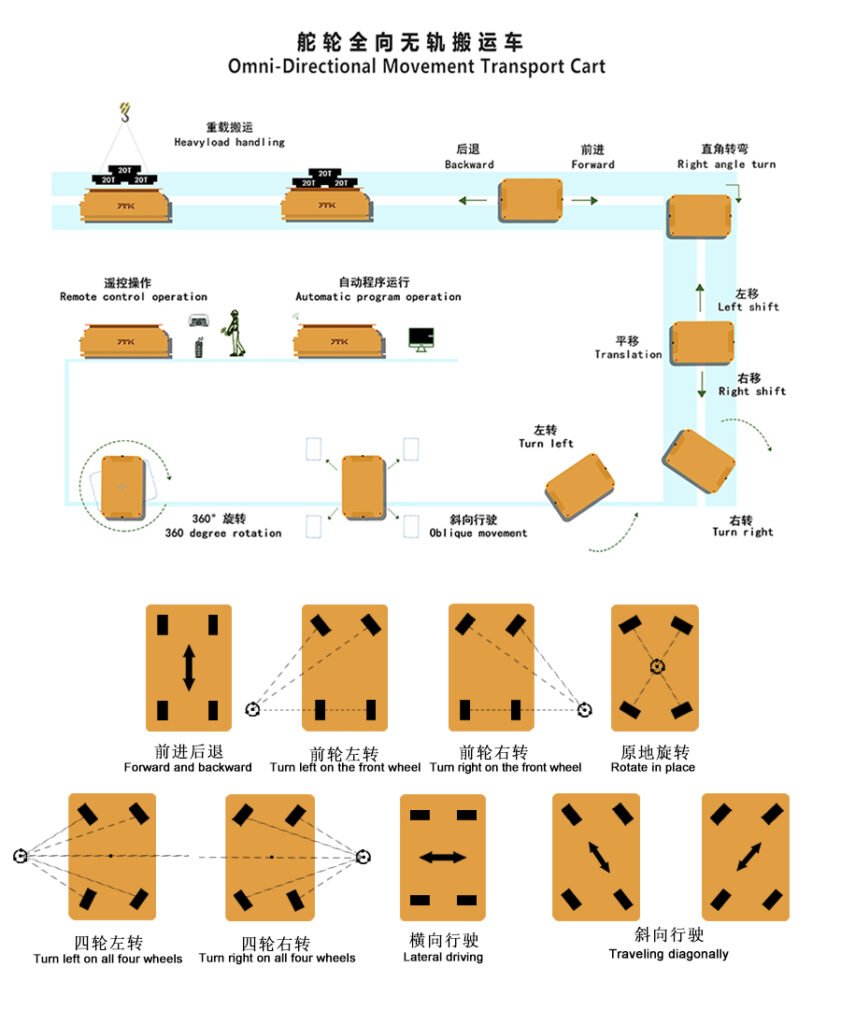
| Travel Modes | Forward, reverse, 360° rotation, and turning while moving |
| Floor-Level Compensation | Mechanical automatic adjustment |
| Safety Devices | Audible and visual alarms, emergency stop button, laser obstacle detection |
| Electrical Protection | Overvoltage, undervoltage, and overcurrent protection |
| Cart Color | Customizable |
Note: Load capacity and platform dimensions can be customized to suit mold weight, dimensions, and operating conditions. Final specifications require engineering confirmation.
How to Choose
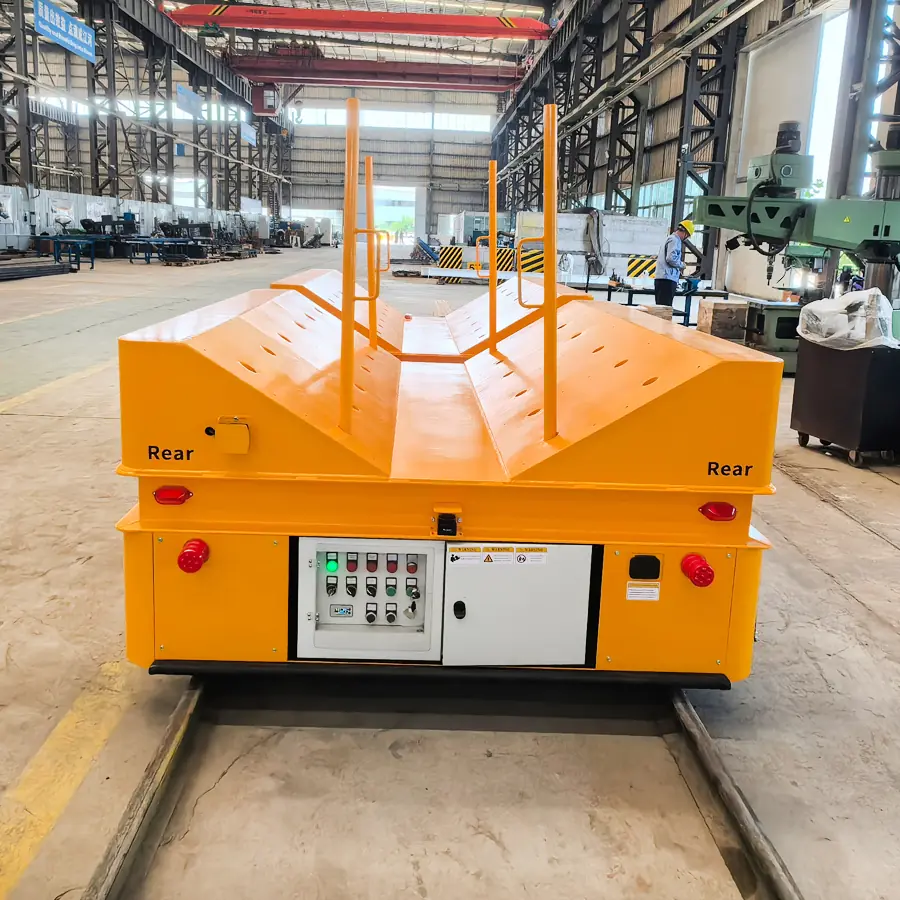
- Choose a rail-mounted mold transfer cart when molds travel repeatedly between fixed locations and the factory can accommodate a dedicated track system.
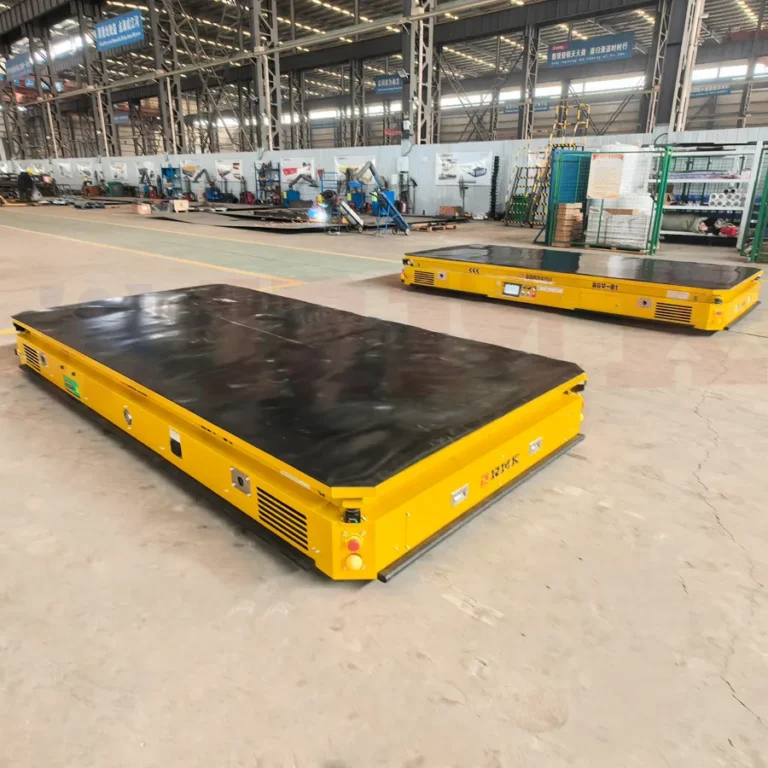
- Choose a trackless mold transfer cart when molds need to move between multiple workstations or the factory layout requires flexible routing. Check floor load capacity, slope, turning clearance, and aisle width before selecting the cart.
RMK customizes both types according to mold weight, platform dimensions, travel distance, positioning accuracy, power supply, and machine docking requirements.
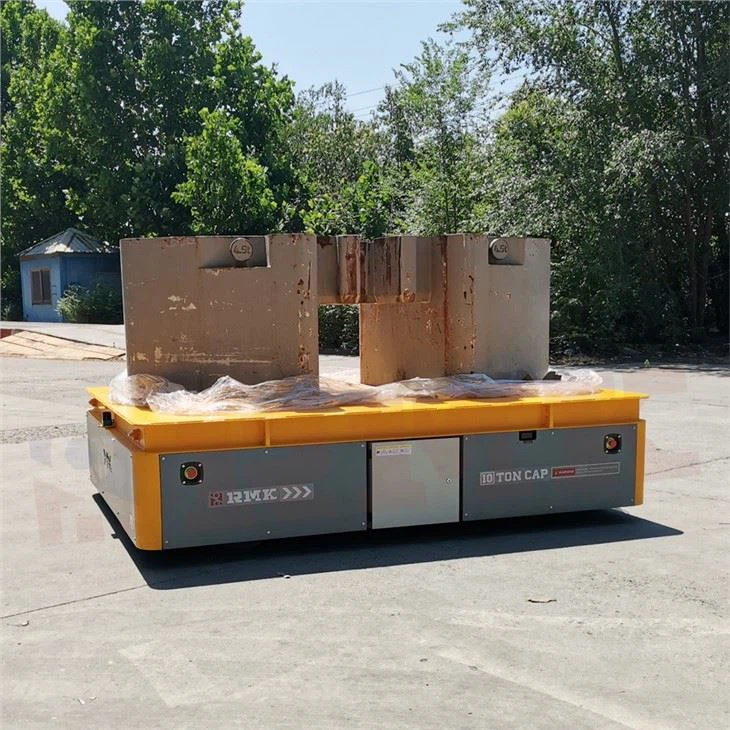
Types of mold transfer cart
Cases
Mold Transfer Cart Customization Options
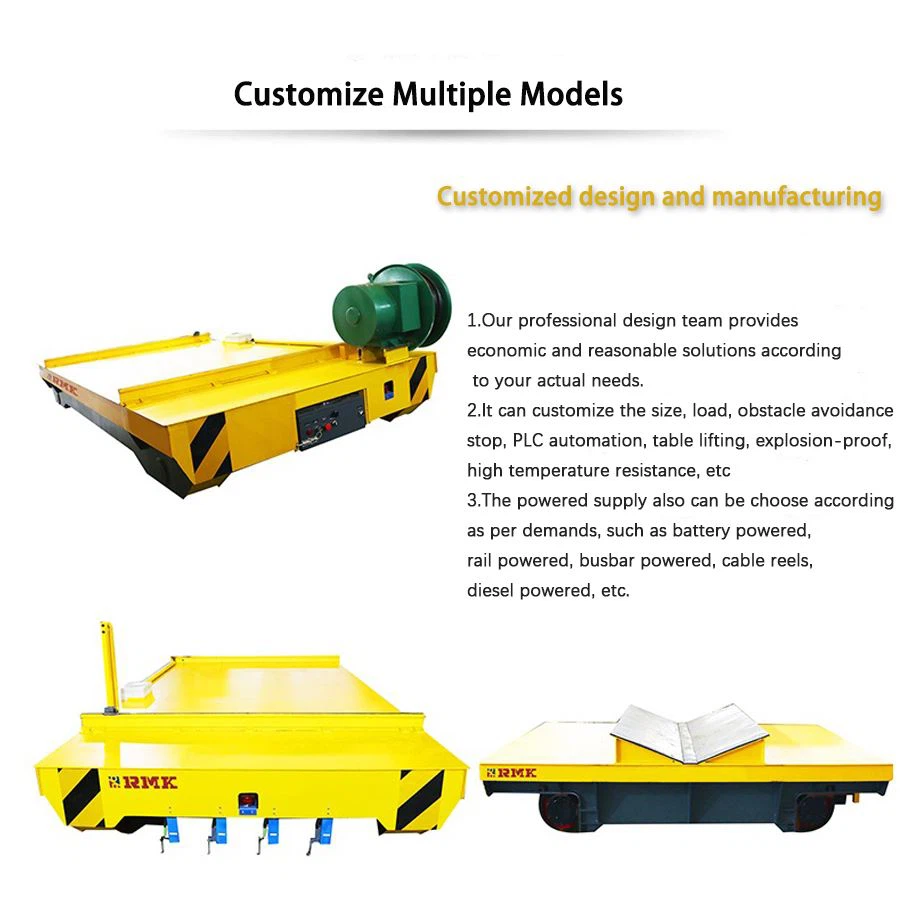
RMK customizes mold transfer carts to match mold dimensions, load capacity, factory layout, and handling requirements. Key options include platform design, lifting and positioning systems, power supply, travel mode, control system, and safety devices.
- Load Capacity: 1–500 tons for standard heavy-duty models; custom designs up to 1,500 tons.
- Platform Dimensions: Custom length, width, height, and mold support layout.
- Lifting System: Hydraulic or scissor lift; stroke customized to the required docking height.
- Positioning System: Mold guides, locating pins, positioning sensors, or automatic docking systems.
- Power Supply: Battery, low-voltage rail, cable reel, or other suitable power configurations.
- Control System: Wired pendant, wireless remote control, or PLC-based automatic control.
- Travel and Steering: Rail-mounted or trackless travel, with steering options selected according to route layout.
- Safety Devices: Emergency stop, audible and visual alarms, obstacle detection, and other project-specific protection devices.
Final specifications and available options are determined by mold weight, dimensions, center of gravity, travel route, floor conditions, and operating requirements.
For information on customization options and scope, see: Custom Transfer Cart: Complete Guide to Design and Customization
How to Select a Mold Transfer Cart
Selecting a mold transfer cart requires checking mold specifications, factory layout, transport frequency, and machine loading requirements.
- 1. Mold Weight and Dimensions: Confirm the maximum mold weight, length, width, height, and support points. Select a rated load above the maximum transport load, including any fixtures carried on the cart.
- 2. Center of Gravity: Identify the mold’s center of gravity and load distribution. An offset or elevated center of gravity affects platform stability, wheel loading, and turning performance.
- 3. Aisle Width and Turning Space: Measure aisle width, door openings, obstacles, and turning clearance. Choose a rail-mounted cart for fixed routes or a trackless cart when the layout requires flexible movement.
- 4. Travel Distance and Route: Check the distance between mold storage, maintenance areas, and production machines. Specify the route, floor condition, slopes, and required travel speed before selecting the drive and power supply.
- 5. Mold Change Frequency: Consider the number of transfers per shift, operating hours, and required changeover time. Frequent transfers may require faster travel, convenient controls, and a suitable battery capacity or continuous power supply.
- 6. Machine Docking Height: Measure the height difference between the cart platform and the machine bed, loading table, or storage rack. Specify the required lifting stroke and positioning accuracy where hydraulic lifting or precise docking is necessary.
- 7. Loading and Unloading Method: Confirm whether molds are loaded by crane, forklift, hydraulic lifting platform, or another mechanism. Match the cart platform, support structure, and restraints to the selected loading method.
- 8. Control and Safety Requirements: Select wired or wireless control, automatic positioning, emergency stops, audible and visual alarms, and obstacle detection according to the operating environment and project requirements.
Provide the mold weight and dimensions, center of gravity, transport route, aisle width, docking height, and daily transfer frequency. RMK can use these details to determine the appropriate load capacity, cart type, platform dimensions, power system, and optional functions.
For detailed selection recommendations, see: How to Choose the Right Mold Transfer Cart for Your Factory
Mold Transfer Cart Manufacturer and Supplier
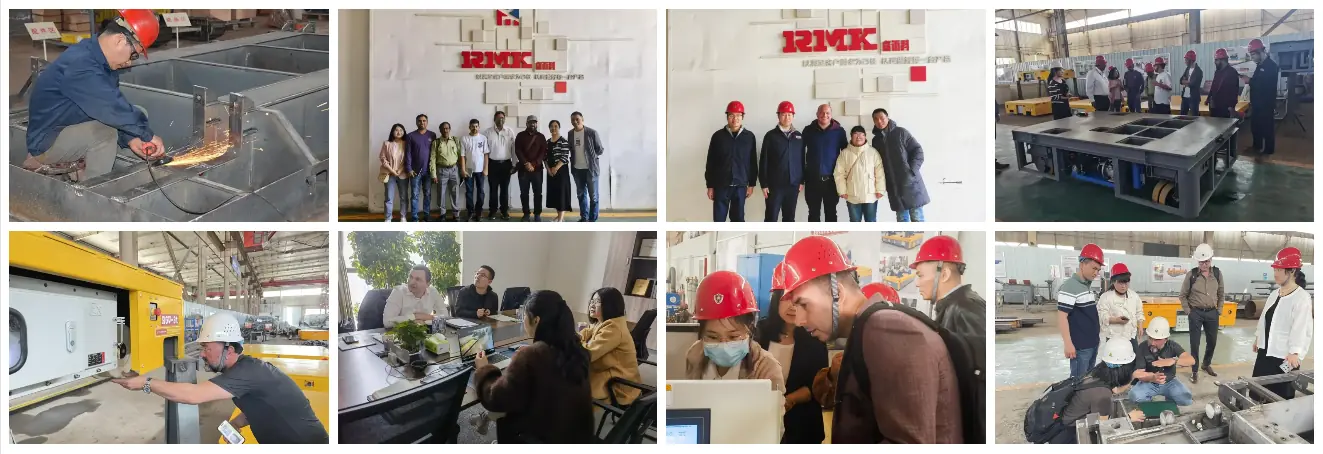
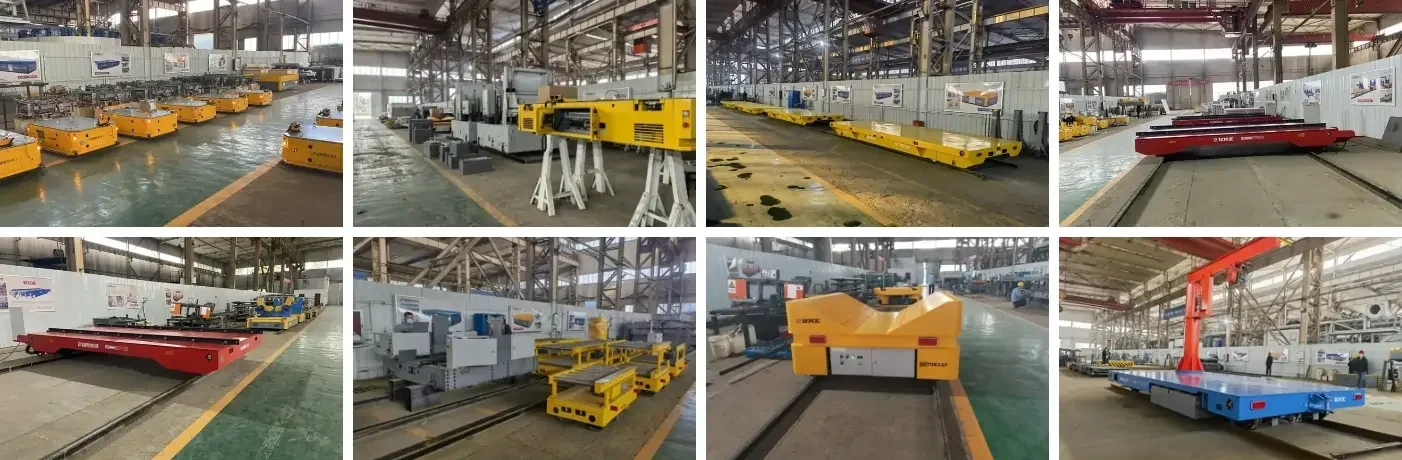
REMARKABLE manufactures and supplies mold transfer carts for injection molding, metal stamping, and mold handling operations. Our engineering team customizes cart capacity, platform dimensions, travel mode, lifting systems, and control configurations to match specific mold specifications and factory layouts. We support export projects with equipment configuration, technical documentation, and installation, commissioning, operator training, and after-sales service according to project requirements and the agreed scope of supply.
Contact REMARKABLE to discuss your mold transfer requirements. Send us the mold weight, dimensions, transport route, and machine docking height to receive a suitable cart configuration and project quotation.
Customized Intelligent Material Handling Solutions
To ensure that a customized transfer cart fits your needs perfectly, please provide the following details:
- Load Capacity: _____ tons (1~500 ton)
- Table Size: _____ × _____ mm/m (e.g., 1500×3000)
- Power Options:
- ☐ Lead-acid ☐ Lithium-ion ☐ Other: _____
- ☐ Cable: _____V/_____A
- ☐ Standard 380V/50Hz/3-phase
- Cargo Details:
- Type: _____ (e.g., steel coils, machinery)
- Special Needs: _____ (e.g., anti-slip, corrosion-proof)
- Optional Features:
- ☐ Emergency stop ☐ Anti-collision sensors
- ☐ Rail guides ☐ Lifting mechanism ☐ Remote control
Get a Quote Now
FAQ
What is a mold transfer cart?
A mold transfer cart is an industrial transport vehicle used to move injection molds, stamping dies, and heavy tooling between storage areas, production machines, and maintenance stations. It is also known as a mold transport cart, mold handling cart, or die transfer cart.
How much weight can a mold transfer cart carry?
Mold transfer cart capacity depends on the mold weight, dimensions, center of gravity, and handling conditions. RMK offers standard heavy-duty transfer carts rated from 1 to 500 tons, with custom designs available for loads up to 1,500 tons.
What is the difference between rail-mounted and trackless mold transfer carts?
Rail-mounted mold transfer carts follow fixed tracks and suit repetitive transfers between designated stations. Trackless mold transfer carts travel on suitable factory floors and offer more flexible routing between machines, storage areas, and maintenance stations.
What power supply options are available for mold transfer carts?
Mold transfer carts can use battery power, low-voltage rail power, cable reels, or other suitable power systems. The choice depends on travel distance, operating frequency, route layout, charging arrangements, and site conditions.
Can a mold transfer cart lift and position molds?
Yes. A mold transfer cart can be equipped with hydraulic lifting or scissor-lift systems to raise molds to the required loading height. Positioning sensors, locating fixtures, or automatic docking systems are available for applications requiring controlled mold alignment.
Can a mold transfer cart be customized for different mold sizes?
Yes. RMK customizes mold transfer carts according to mold weight, length, width, height, and center of gravity. Platform dimensions, support structures, travel speed, steering, lifting stroke, power supply, and control systems can be specified for each project.
What safety features are available on a mold transfer cart?
Available safety devices include emergency stops, audible and visual alarms, obstacle detection, and other application-specific protection systems. The final configuration depends on the cart design, operating environment, and project requirements.
How do I choose the right mold transfer cart manufacturer?
Choose a manufacturer that can assess mold specifications, factory layout, travel routes, loading methods, and machine docking requirements. Check its engineering and customization capabilities, manufacturing experience, technical documentation, export support, installation services, and after-sales arrangements before placing an order.
Mold Transfer Cart Manufacturer
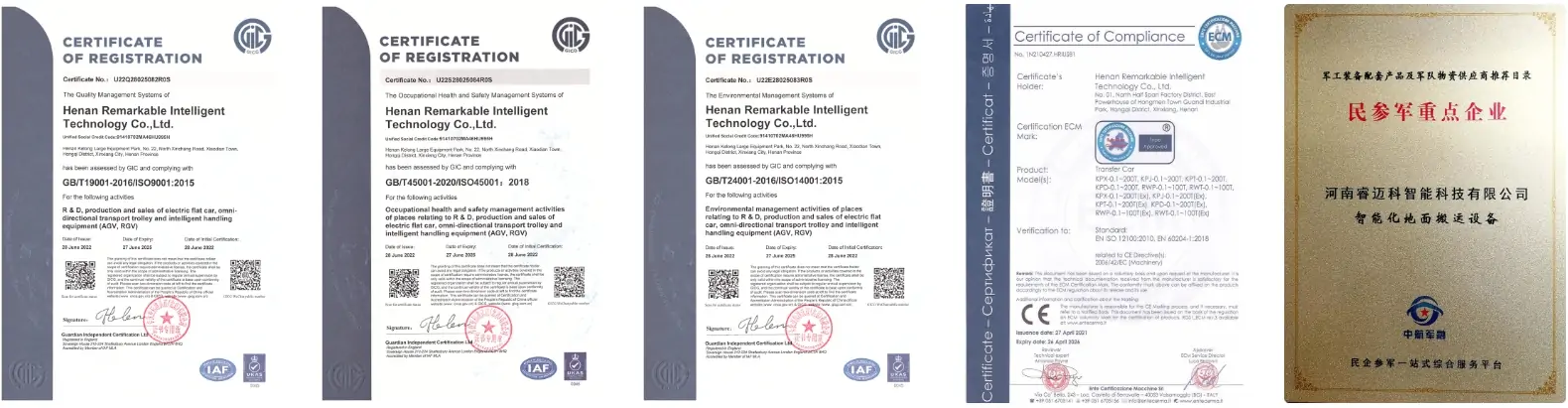
Certification