
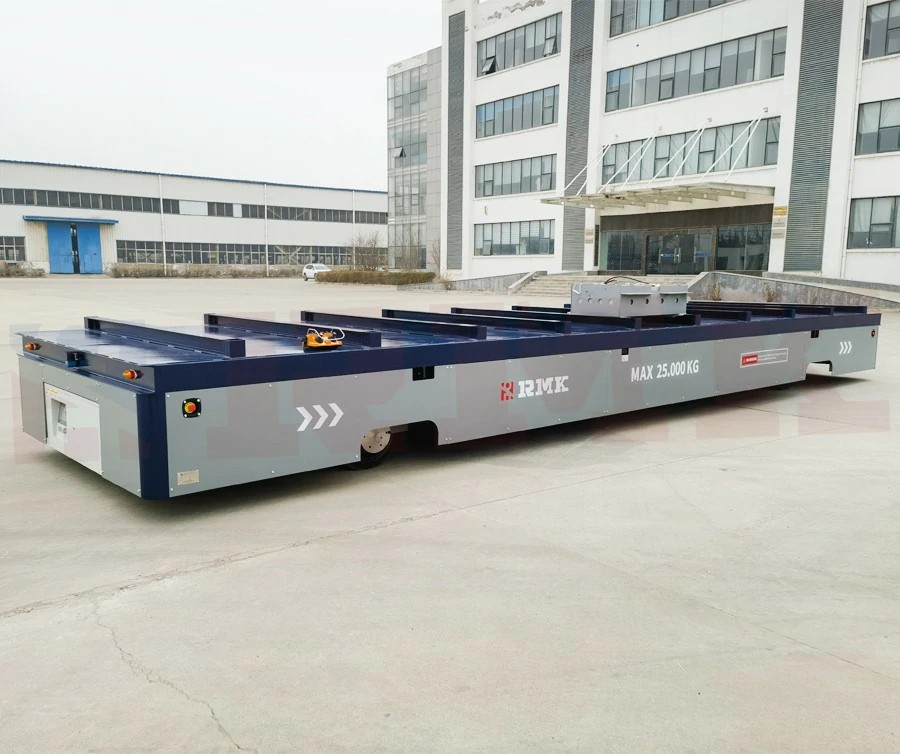
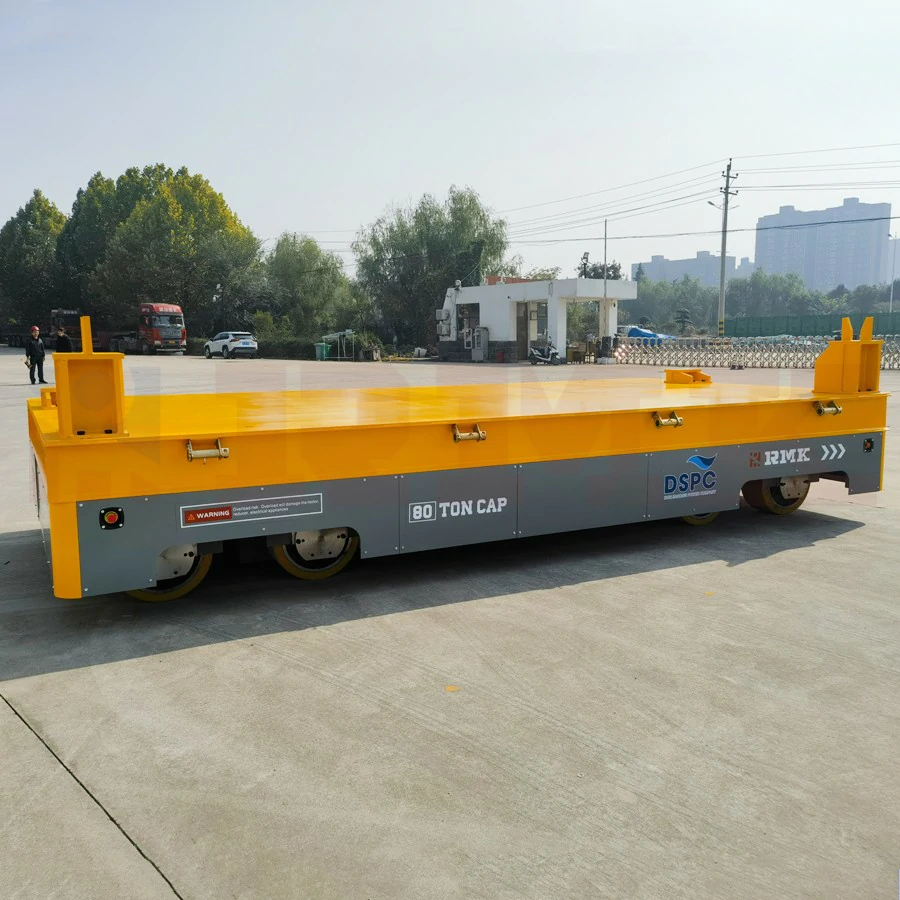

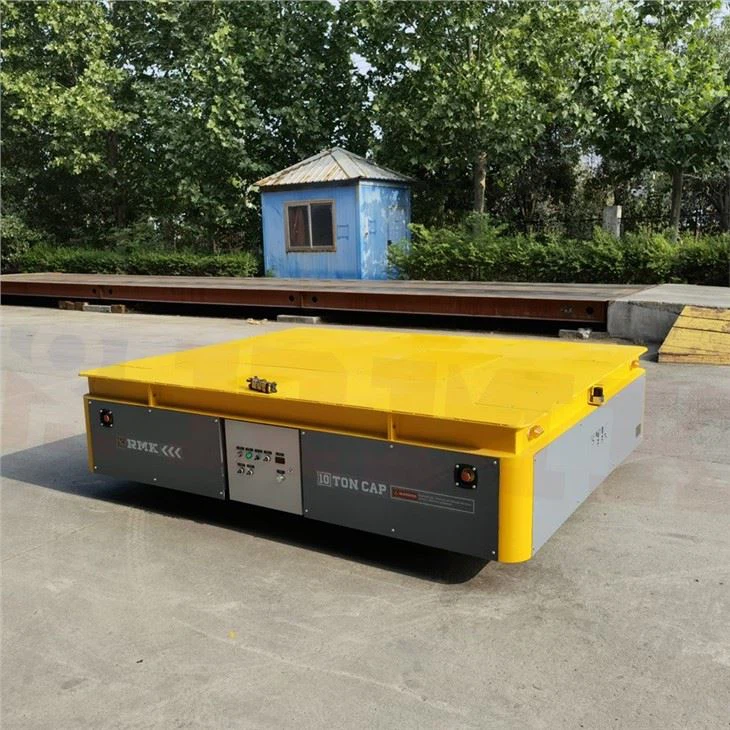
REMARKABLE electric trackless transfer carts move heavy loads across suitable factory floors without fixed rails. These battery-powered carts transport molds, steel components, machinery, and oversized workpieces between workshops, warehouses, and production stations.
Load capacity, platform size, battery system, wheels, steering, and controls are configured for the load and site conditions. Choose direct operator control for flexible transfer tasks, or discuss a separately engineered automated model when programmed transport is required.
- Rated capacity: 1–500 tons across custom models
- Power: lead-acid or lithium battery
- Wheels: polyurethane or solid rubber
- Steering: differential, hydraulic, or omnidirectional
- Operator controls: wired pendant or wireless remote
What Is an Electric Trackless Transfer Cart?
An Electric Trackless Transfer Cart, also known as a trackless transfer trolley, battery-powered transfer cart, steerable transfer cart, or rail-free transfer cart, is an industrial material handling vehicle that transports heavy loads on floor surfaces without fixed rails. It uses an electric drive system and steerable wheels to move materials between workstations, production lines, warehouses, and assembly areas.
Powered by rechargeable batteries, the cart operates independently of fixed rail infrastructure. Rated load capacities can range from 1 to 500 tons across customized models. Wheel type, steering system, platform dimensions, and control method are selected according to load characteristics, floor conditions, turning space, and transport frequency.
REMARKABLE designs electric trackless transfer carts for applications involving molds, steel structures, machinery, and other heavy industrial components. Configuration options include lead-acid or lithium batteries, polyurethane-coated wheels or solid rubber tires, and different steering and control systems to suit the site layout and handling requirements.
For the wider product range, see trackless transfer carts.
How Does an Electric Trackless Transfer Cart Work?
An electric trackless transfer cart uses a battery-powered drive system, steerable wheels, and an operator or control system to transport loads across factory floors without fixed rails.
1. Load Placement
Position the workpiece on the platform using a suitable loading device. Check the load center of gravity, weight distribution, and rated capacity before movement to prevent instability or excessive wheel loading.
2. Battery Power and Drive
The battery supplies electrical power to the drive motors. The motors transmit torque through gear reducers to the drive wheels, moving the cart along the designated route.
3. Steering and Navigation
The operator controls travel direction and speed through a wired pendant or wireless remote. Depending on the configuration, the cart may use differential steering, hydraulic steering, or an automatic navigation system to follow the assigned path.
4. Positioning and Unloading
The cart decelerates and stops at the designated workstation. Apply the braking system, confirm the cart is stationary, and unload the workpiece using the appropriate lifting or handling equipment.
Read more about how a trackless transfer cart works.
Electric Trackless Transfer Cart Specifications
| Parameter | Reference Configuration |
|---|---|
| Rated Load Capacity | 1–500 tons across customized models; final rating is model-specific |
| Platform Size | Length and width selected for the workpiece and loading method |
| Platform Height | 470–1,000 mm reference range; specified by model |
| Battery Type | Lead-acid or lithium battery |
| Battery Voltage | 24–72 V reference range; selected for the drive system |
| Runtime and Charging | Specified for battery capacity, load, duty cycle, and charging schedule |
| Travel Speed | 0–25 m/min reference range; adjusted to the route and load |
| Drive System | Electric motor and gear reducer |
| Wheel Type | Polyurethane wheels or solid rubber tires; other options subject to assessment |
| Steering | Differential, hydraulic or omnidirectional, depending on model |
| Operator Controls | Wired pendant or wireless remote control |
| Braking | Electromagnetic brake configuration selected for the application |
| Safety Options | Emergency stop, audible and visual alarms, obstacle detection and safety bumpers |
| Automation Option | PLC-based control and AGV navigation for separately specified automated configurations |
| Optional Functions | Hydraulic lifting, rotating platform or automatic charging for suitable designs |
These are reference configurations across a custom product range, not simultaneous specifications for every cart. The final equipment specification must confirm rated capacity, platform dimensions, voltage, speed, battery performance, and safety functions for the selected load and site.
Advantages
Rail-Free Routes
Move between multiple transfer points without installing fixed rails. Routes remain subject to floor suitability, clearance, and safe operating procedures.
Heavy Load Handling
Configure the chassis, wheels, and load platform around workpiece weight, center of gravity, and weight distribution.
Flexible Steering
Select differential, hydraulic, or omnidirectional steering to suit aisle width and the space available for turning and positioning.
Battery-Powered Drive
Rechargeable batteries supply the electric drive system without a trailing power cable during normal movement.
Custom Load Platforms
Match platform dimensions and fixtures to molds, machinery, steel structures, or coil supports.
Configurable Safety
Specify emergency stops, warning lights, audible alarms, obstacle detection, and safety bumpers for the operating environment.
Applications
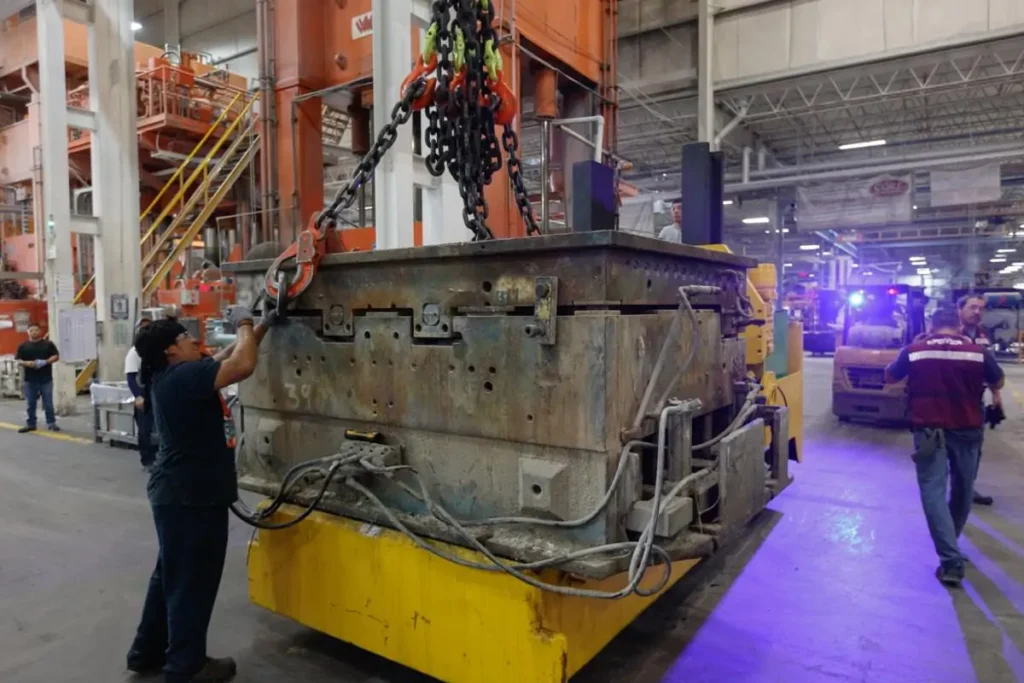
Mold and Die Handling
Move injection molds, stamping dies, and heavy tooling between storage, maintenance, and production stations. Include fixture weight and load support in the capacity calculation.
Steel and Metal Processing
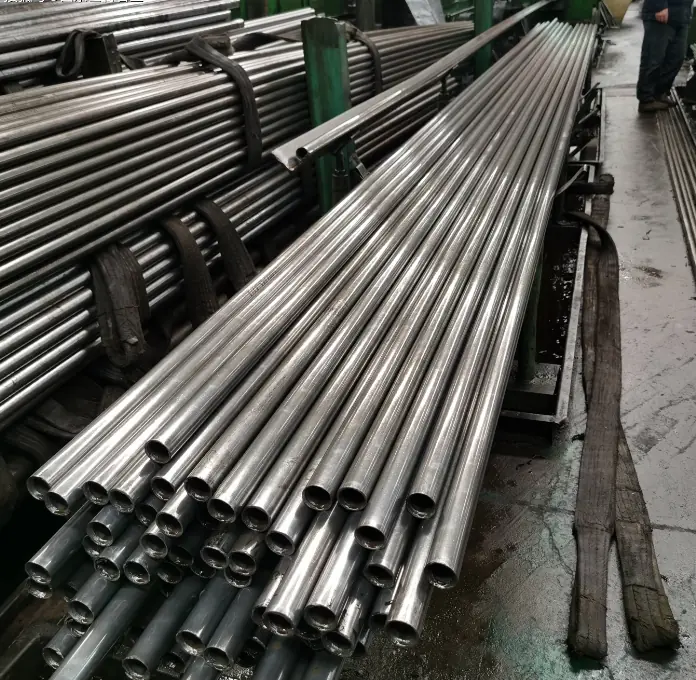
Transport plates, steel coils, billets, and fabricated components. Coils and cylindrical loads require suitable supports and restraint.

Heavy Equipment Manufacturing
Transfer machine bases, steel structures, and large equipment components between fabrication and assembly areas.

Warehouses and Logistics
Move heavy goods and industrial materials between storage zones and loading points on suitable travel surfaces.
Assembly Lines
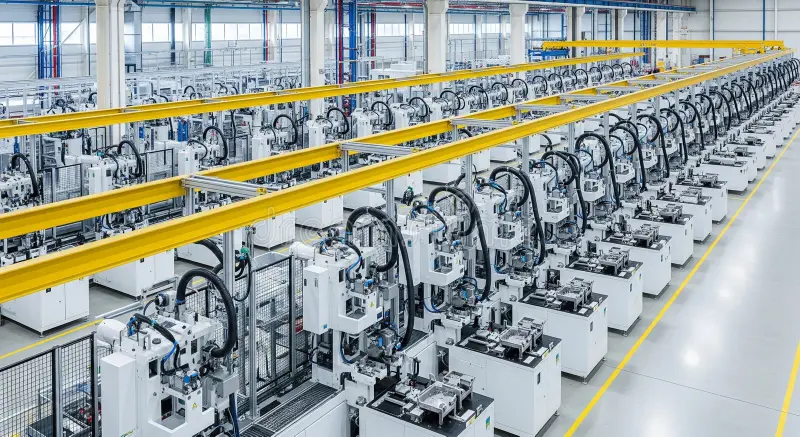
Position workpieces between assembly stations according to the production sequence, loading method, and available clearance.
Manufacturing Workshops
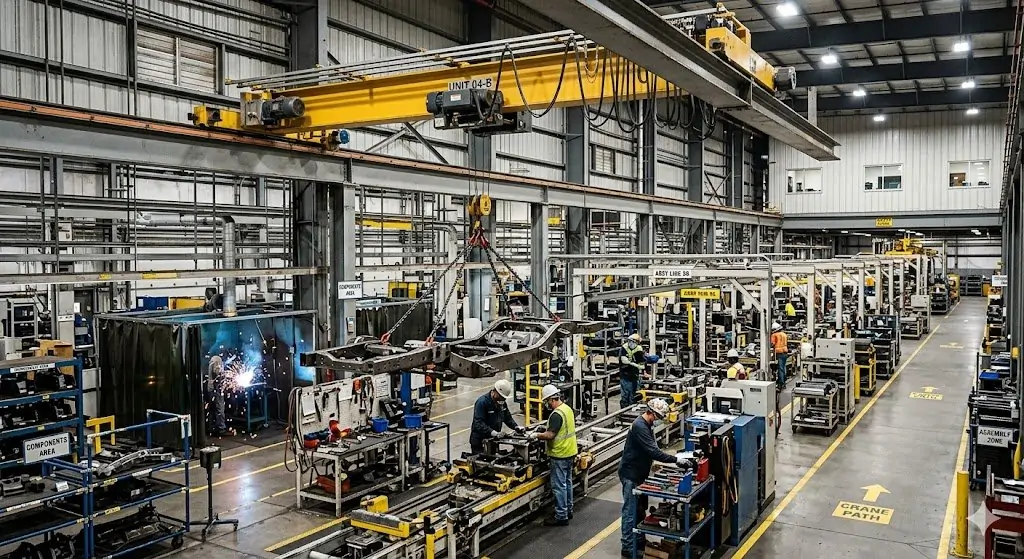
Connect machining, inspection, testing, and storage areas when multiple destinations require flexible transport routes.
Trackless Transfer Cart vs. Rail Transfer Cart
Electric rail transfer carts run along fixed steel rails, requiring rail installation and a defined travel path. Electric trackless transfer carts use wheels to travel across suitable floor surfaces without fixed rails, allowing routes to be adjusted to the facility layout.
| Selection Factor | Electric Trackless Transfer Cart | Rail Transfer Cart |
|---|---|---|
| Travel Route | Operator-controlled movement across suitable floor surfaces | Defined route along installed rails |
| Infrastructure | Requires an assessed floor and adequate maneuvering space | Requires rail installation and suitable foundations |
| Turning and Positioning | Depends on steering configuration, cart size, and available space | Depends on the track layout and transfer arrangement |
| Load Capacity | Specified for chassis, wheels, floor, and load distribution | Specified for chassis, rail, foundations, and load distribution |
| Best Fit | Multiple transfer points or routes that need flexibility | Repetitive heavy transport along a fixed route |
| Automation | Optional AGV configuration requires navigation and safety assessment | Optional automatic operation along the rail route |
Rail transfer carts suit heavy loads and repetitive transport along fixed routes. Trackless transfer carts suit facilities that require flexible routing, multiple transfer points, or frequent layout changes. Selection should account for load capacity, floor conditions, transport frequency, and future changes to the facility layout.
Compare the full differences between trackless and rail transfer carts. For programmed, driverless movement, see heavy-duty AGV transfer carts.
How to Choose the Right Electric Trackless Transfer Cart
Selecting the right Electric Trackless Transfer Cart requires matching the cart configuration to the load, floor conditions, transport route, and operating cycle.
- Calculate the total load: include the workpiece, fixtures, and attachments; assess center of gravity and weight distribution.
- Match platform dimensions: check the load footprint, height, support points, loading method, and clearance.
- Assess floor loading: review floor load-bearing capacity, flatness, traction, joints, and gradients.
- Check turning space: provide aisle widths, route drawings, and transfer-point clearances. Confirm turning radius for the selected steering system.
- Define the operating cycle: specify route length, trips per shift, travel speed and working hours.
- Select the battery: match capacity and chemistry to runtime, charging intervals, charging time, and maintenance requirements.
- Specify controls and safety: consider operator visibility, shared traffic areas, stopping requirements, and the intended automation level.
REMARKABLE customizes load capacity, platform dimensions, battery systems, steering, and safety features to suit specific site conditions. Provide your load details and transport requirements to determine a suitable configuration.
For capacity selection, see how to choose transfer cart load capacity.
Project Examples
These published REMARKABLE projects show how trackless carts are configured for individual handling tasks. Project specifications apply to the named equipment.
Chemical Slurry Pump Handling
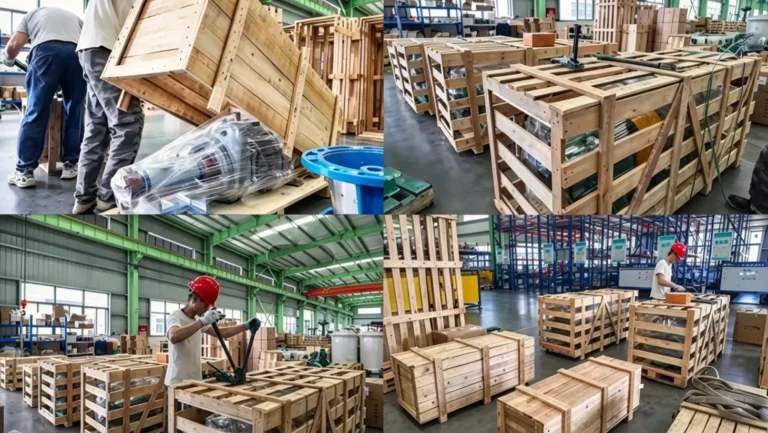
A published project uses a 12-ton battery-powered trackless cart with a 4000 × 2000 mm platform and wireless remote control to connect workshop handling areas.

Metal Material Handling in Saudi Arabia
The project documents ten 25-ton trackless material transfer carts for metal handling in Saudi Arabia.
Custom Configuration Options
REMARKABLE customizes electric trackless transfer carts to match load specifications, floor conditions, transport routes, and operating cycles.
- Load support: platform length, width, height, deck structure, and application-specific fixtures.
- Battery and drive: chemistry, voltage, battery capacity, motor power, gear reduction, and travel speed.
- Wheels and steering: tire material, wheel loading, and steering configuration matched to floor and route conditions.
- Controls: wired pendant, wireless remote, or separately specified PLC and AGV integration.
- Safety and optional functions: warning devices, obstacle detection, lifting, rotating platforms, and charging options appropriate to the selected design.
Each cart is engineered to the specified load, route layout, and operating conditions. Contact REMARKABLE with your project requirements for a customized configuration.
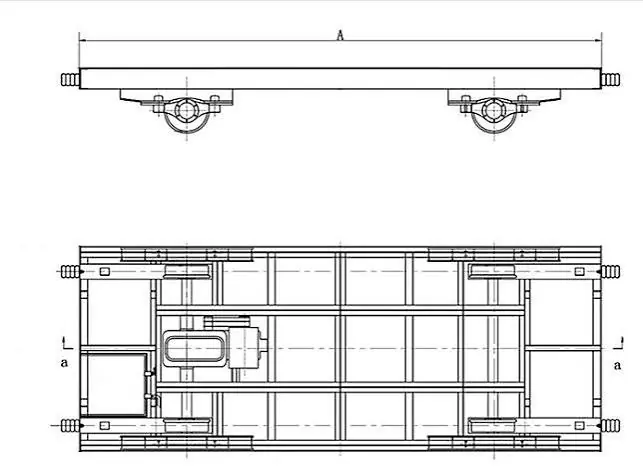
See the transfer cart design and customization guide or send your project requirements.
Electric Trackless Transfer Cart Manufacturer and Supplier
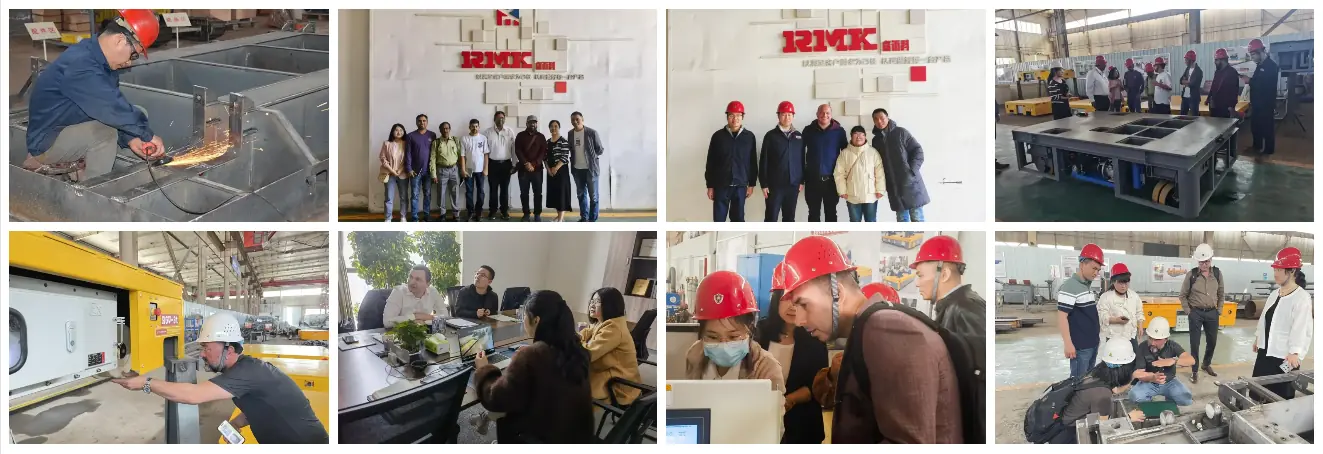
REMARKABLE (Henan Remarkable Intelligent Technology Co., Ltd.) manufactures and supplies transfer carts for industrial material handling. The engineering configuration is based on the load, transport route, and working environment.
Provide load specifications and a route layout so the team can discuss the platform, drive, steering, battery, and safety configuration for your application. Read about project support and service or request a configuration and quotation.
Customized Intelligent Material Handling Solutions
To ensure that a customized transfer cart fits your needs perfectly, please provide the following details:
- Load Capacity: _____ tons (1~500 ton)
- Table Size: _____ × _____ mm/m (e.g., 1500×3000)
- Power Options:
- ☐ Lead-acid ☐ Lithium-ion ☐ Other: _____
- ☐ Cable: _____V/_____A
- ☐ Standard 380V/50Hz/3-phase
- Cargo Details:
- Type: _____ (e.g., steel coils, machinery)
- Special Needs: _____ (e.g., anti-slip, corrosion-proof)
- Optional Features:
- ☐ Emergency stop ☐ Anti-collision sensors
- ☐ Rail guides ☐ Lifting mechanism ☐ Remote control
Get a Quote Now
FAQ
What is an electric trackless transfer cart?
An electric trackless transfer cart is a battery-powered industrial vehicle that carries heavy loads across suitable floor surfaces without fixed rails. Motor-driven wheels and a steering system allow an operator to move materials between workstations, storage areas, and production lines.
How much weight can it carry?
REMARKABLE offers a reference capacity range of 1–500 tons across customized models. Each cart has its own rated capacity; the whole range does not apply to a single model. Confirm workpiece weight, fixtures, center of gravity, wheel loading, and floor capacity before selecting the rating.
How does the battery-powered drive work?
The onboard battery supplies power to electric motors. Gear reducers transmit motor torque to the wheels, while a wired pendant or wireless remote controls travel speed and direction. Drive power, steering, and braking are selected for the load and operating route.
What is the difference between trackless and rail transfer carts?
A trackless transfer cart runs on wheels over suitable floor surfaces and allows operator-controlled routes between multiple locations. A rail transfer cart follows installed steel rails. Selection depends on load, floor conditions, route flexibility and transport frequency, rather than a universal capacity limit for either type.
Can it operate on uneven floors or slopes?
Floor suitability must be assessed for the selected cart and load. Joints, uneven surfaces, gradients and reduced traction affect wheel loading, stability and drive performance. Provide the route survey and gradient information so the manufacturer can assess wheel, drive and braking requirements.
How long does it run on one charge?
Runtime is specified for the chosen battery pack and operating cycle. Load, travel distance, trips per shift, floor conditions, and auxiliary functions affect energy use. Confirm the required working hours, charging intervals, and charging time in the project specification rather than assuming one runtime for every model.
Can the cart be customized?
Yes. Load capacity, platform dimensions, battery system, wheels, steering, drive, controls, and safety devices can be configured for the project. Hydraulic lifting, rotating platforms, and automatic charging are optional for suitable designs. Automatic navigation requires a separately specified AGV configuration.
What information is needed for a quotation?
Provide maximum load weight including fixtures, workpiece dimensions, center of gravity, loading method, route length, aisle width, turning space, floor conditions, gradients, and trips per shift. Include battery and charging requirements, desired controls, and safety features so the engineering team can propose a suitable configuration.