

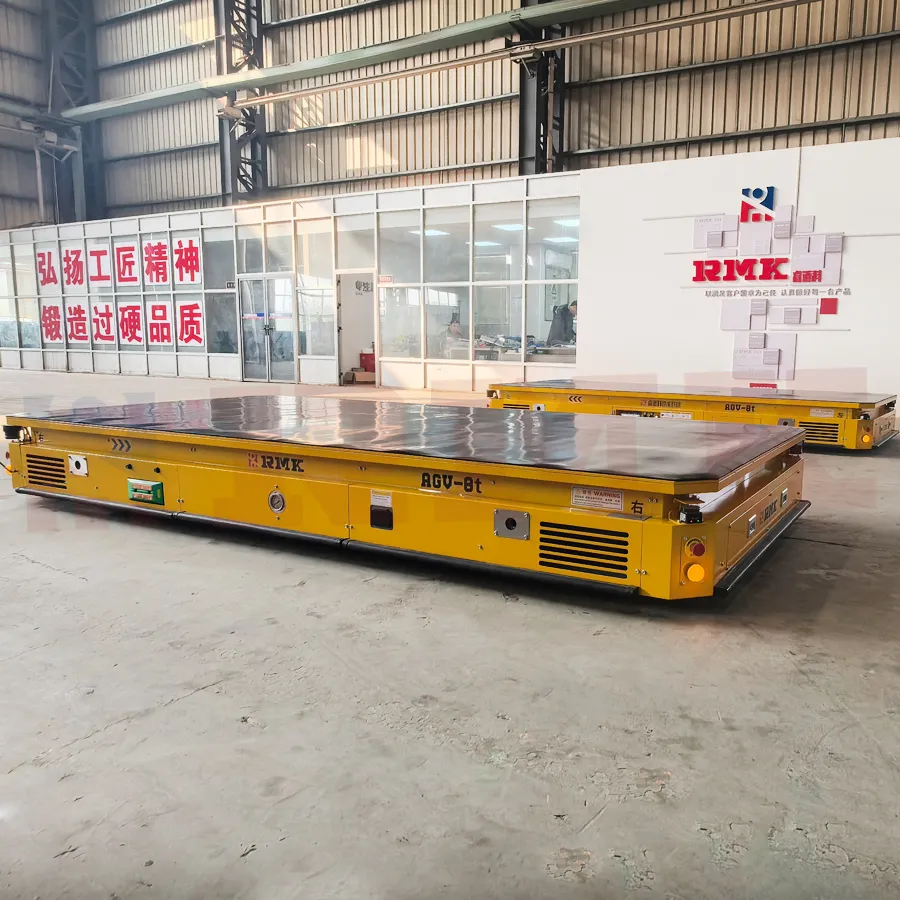
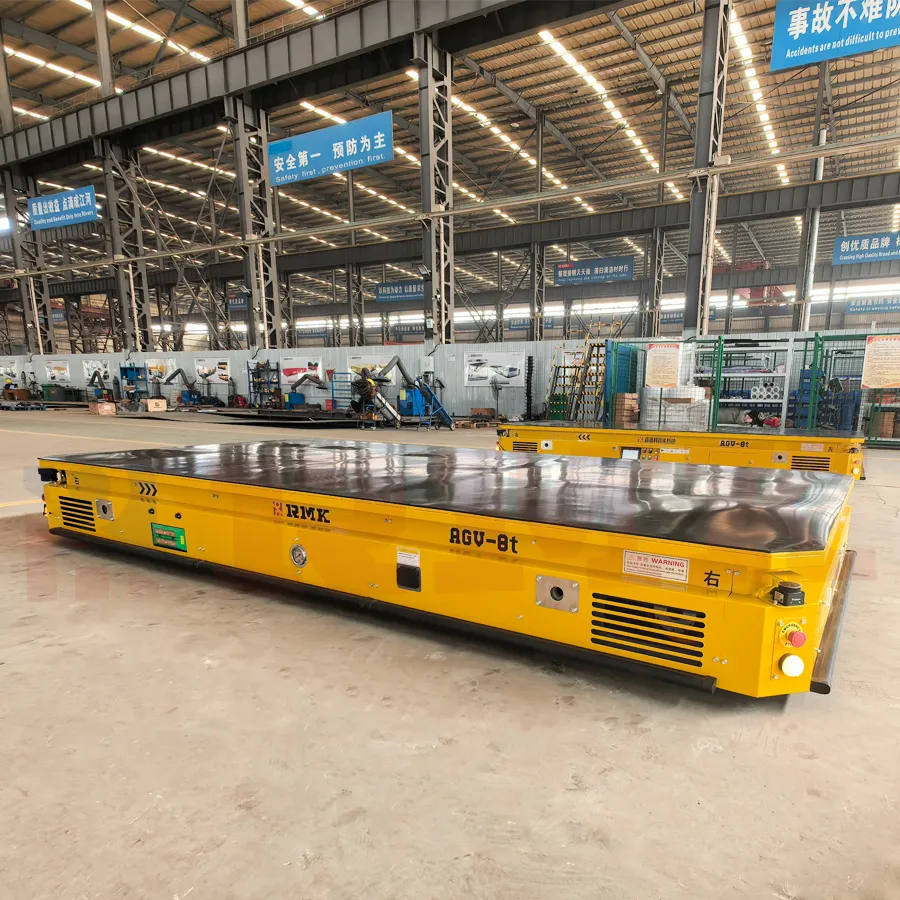
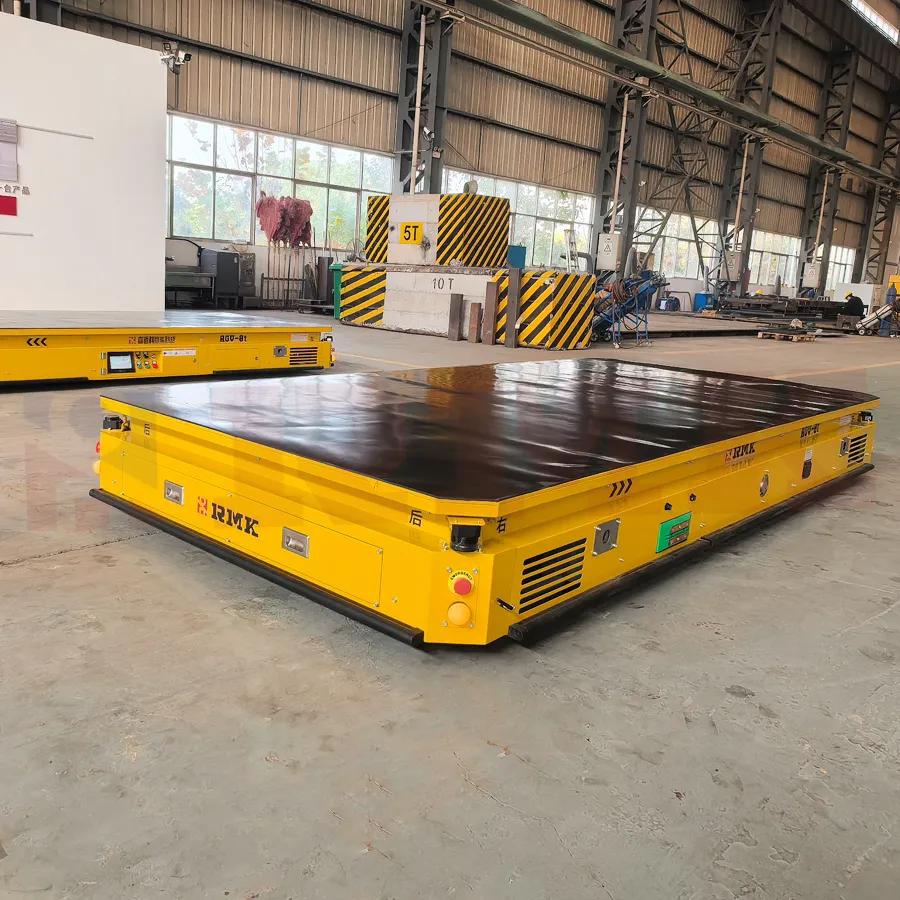
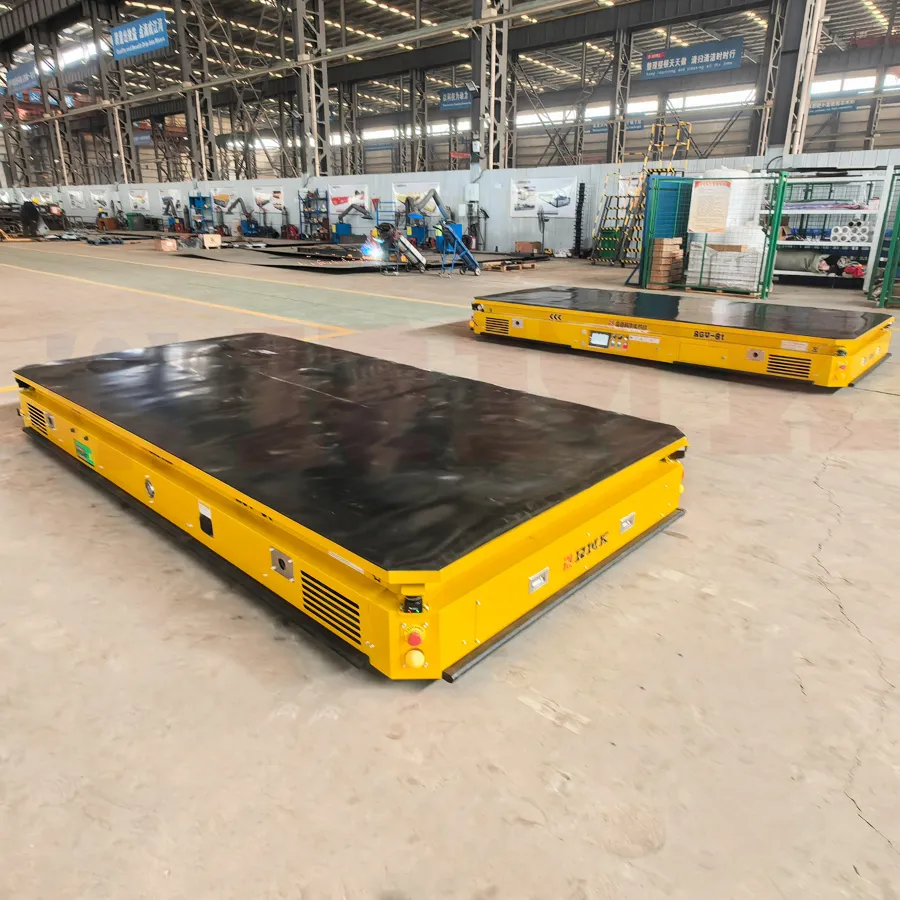
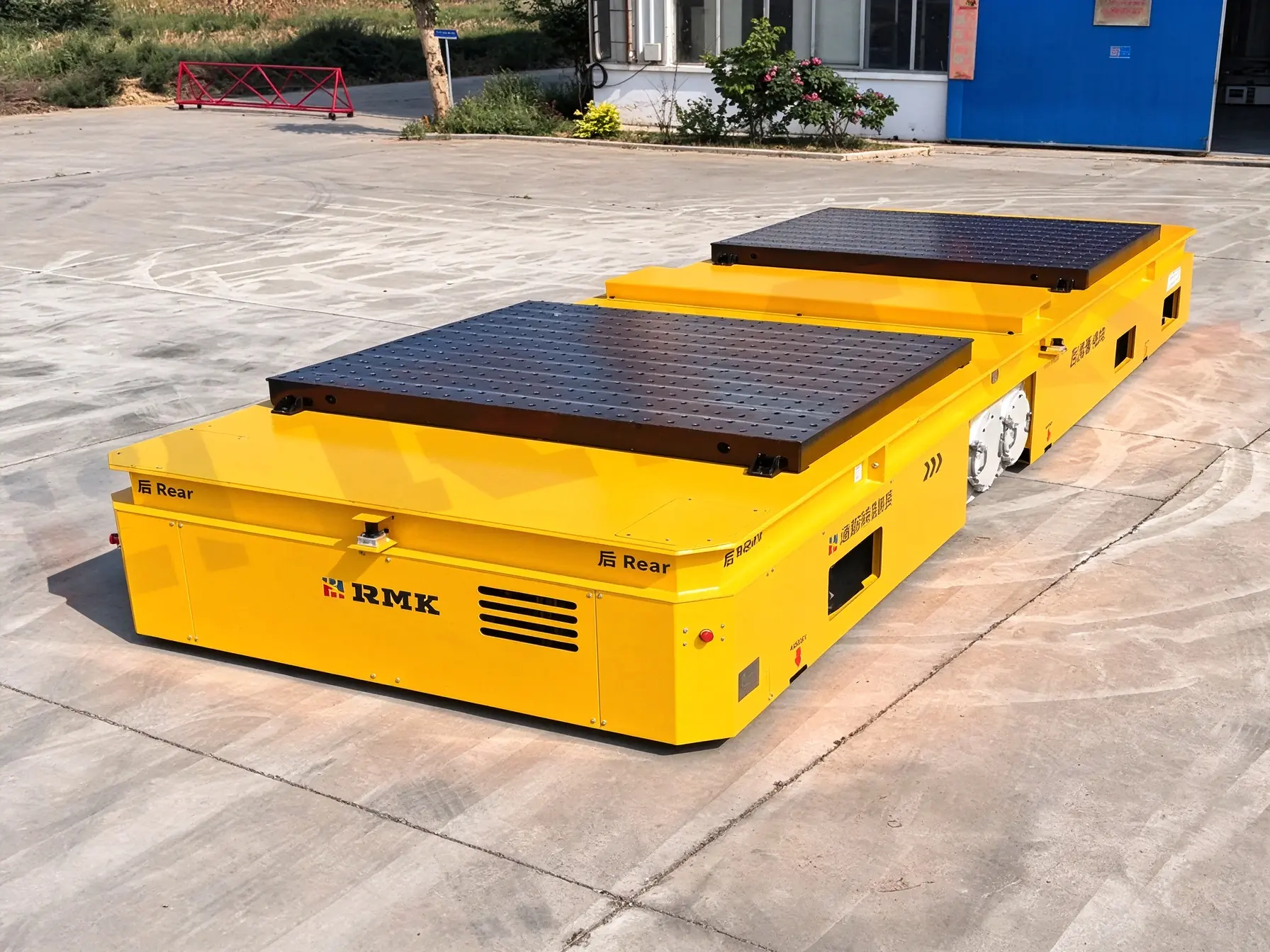
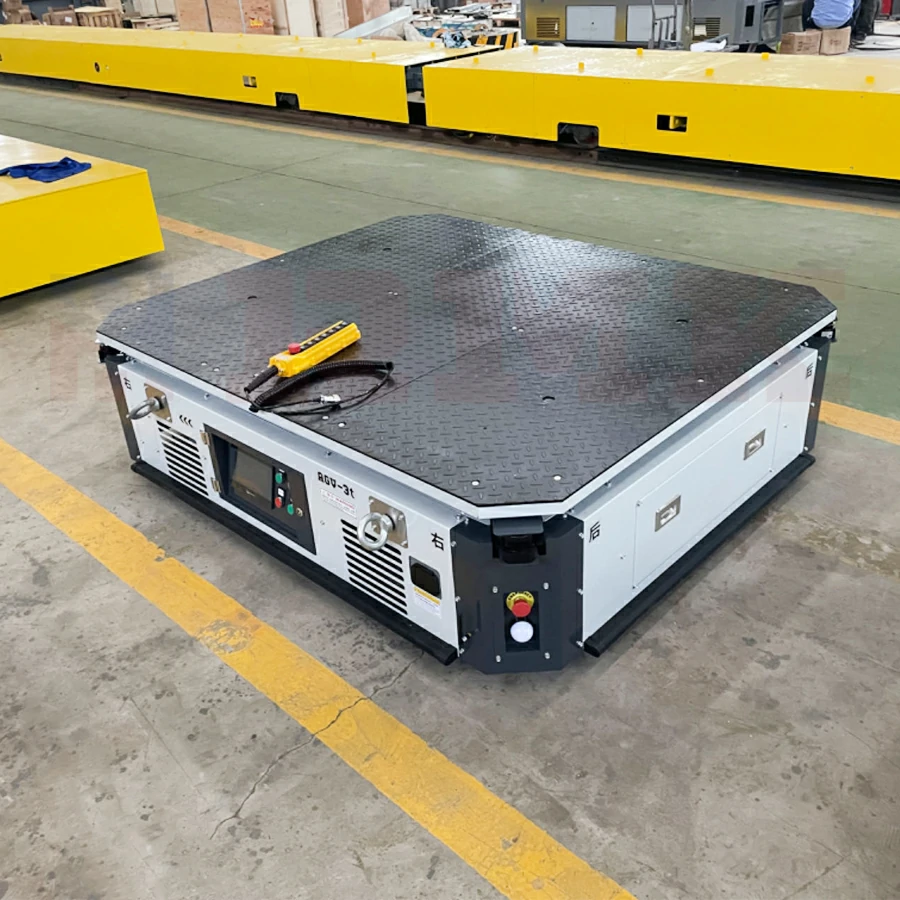
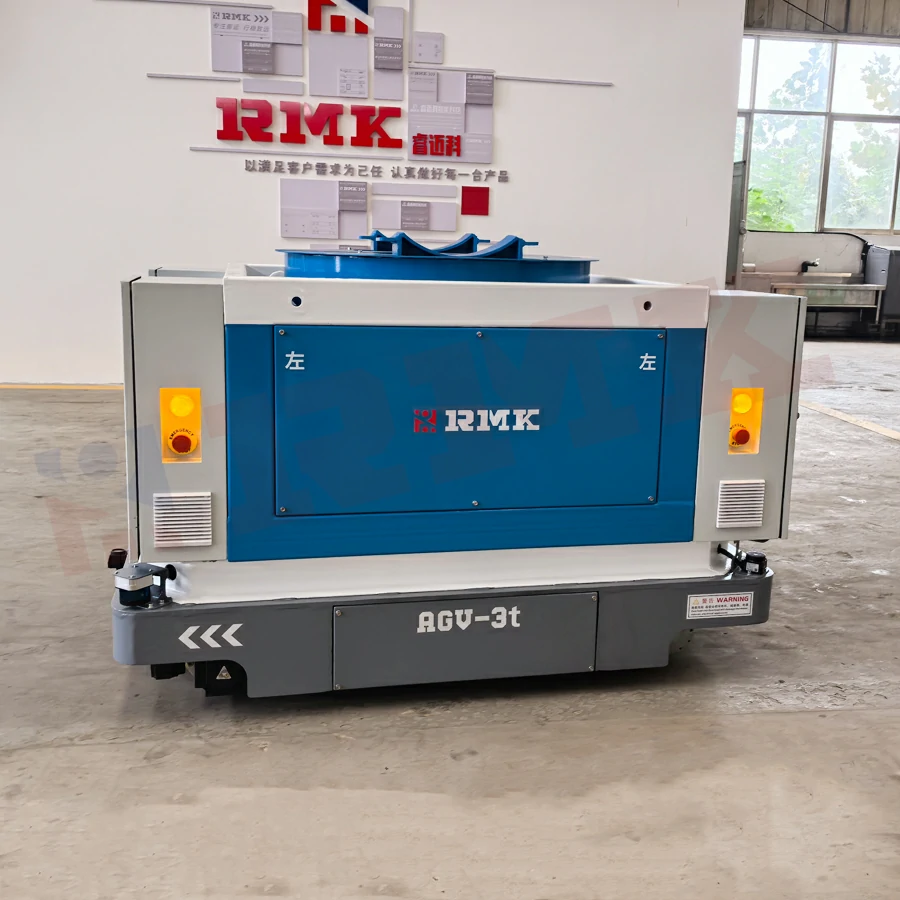
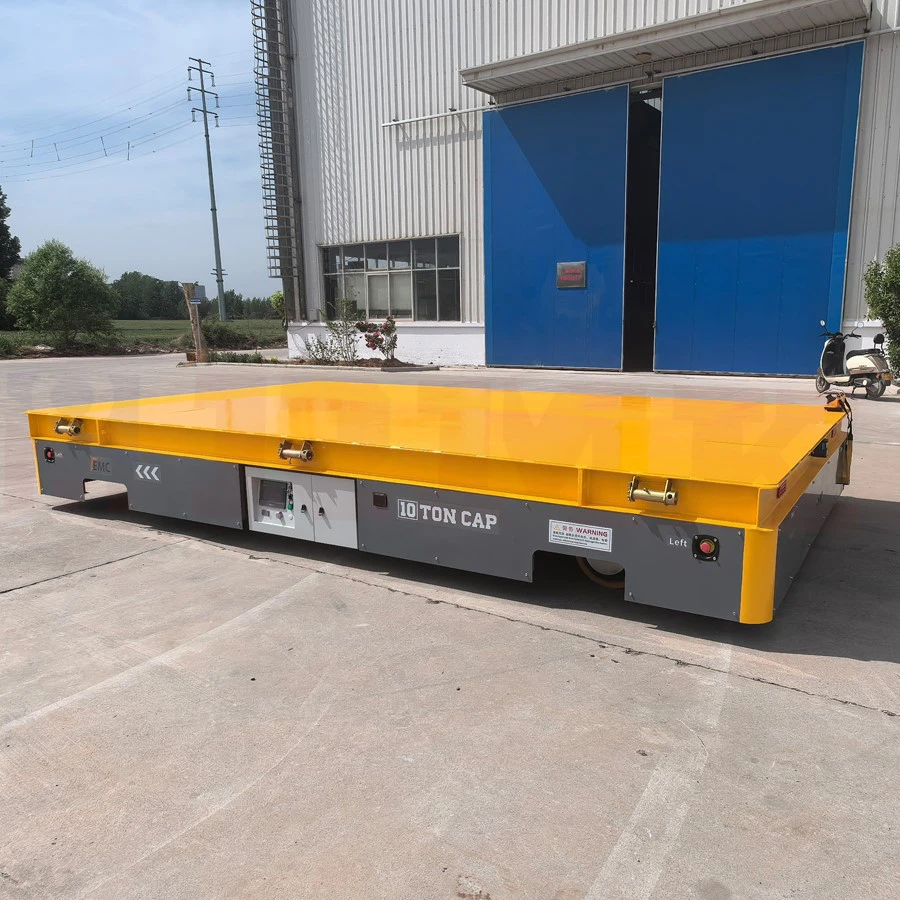
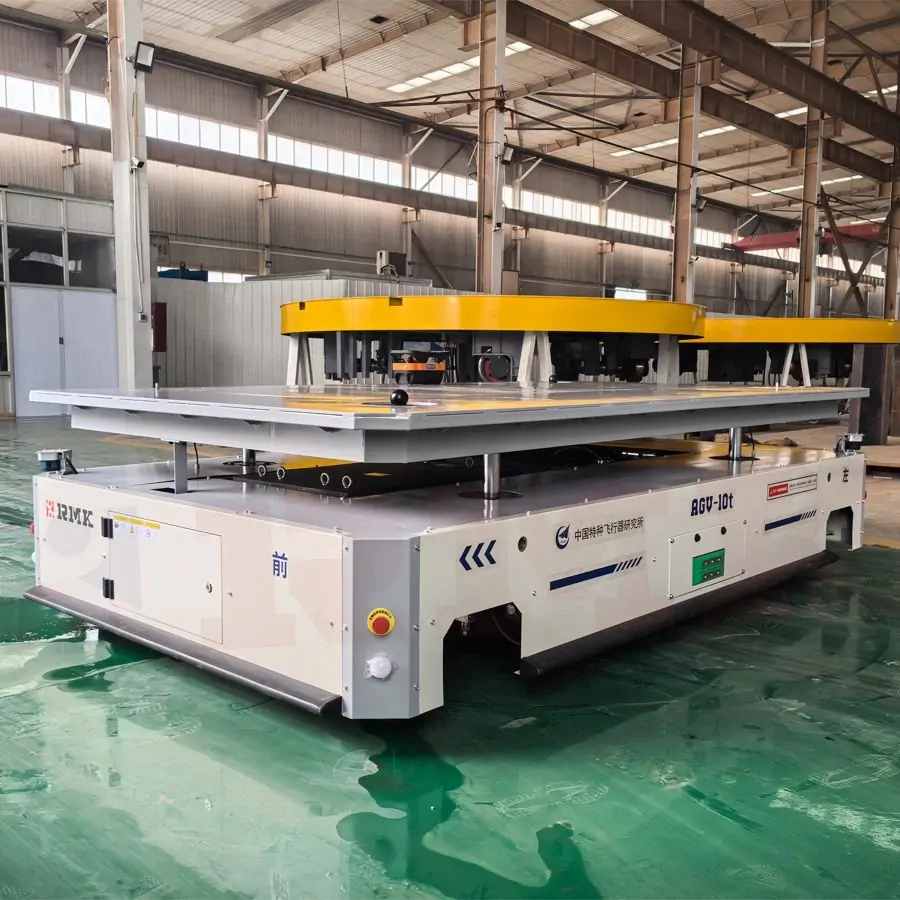
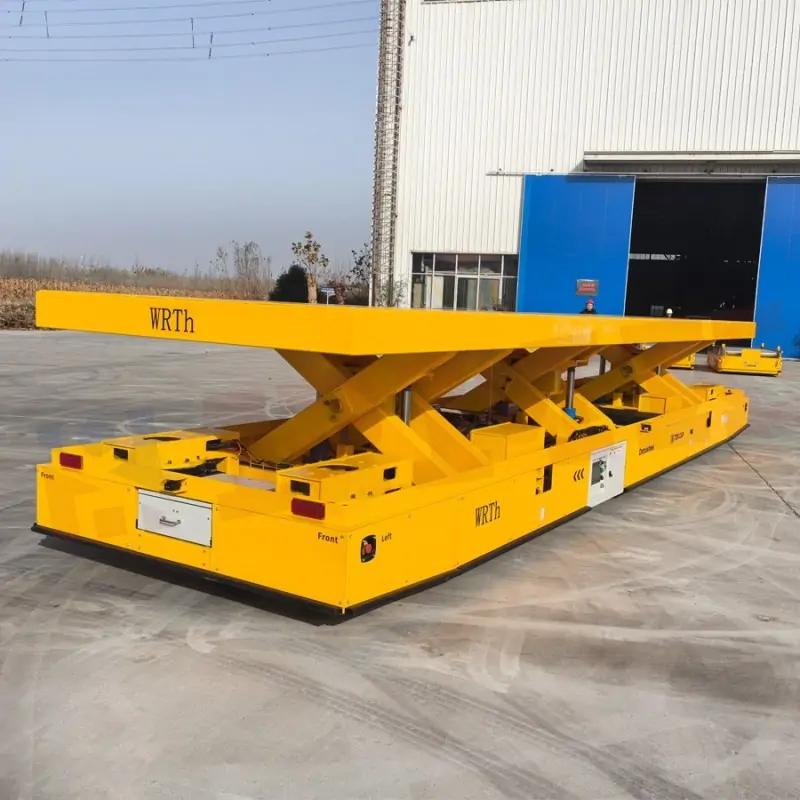
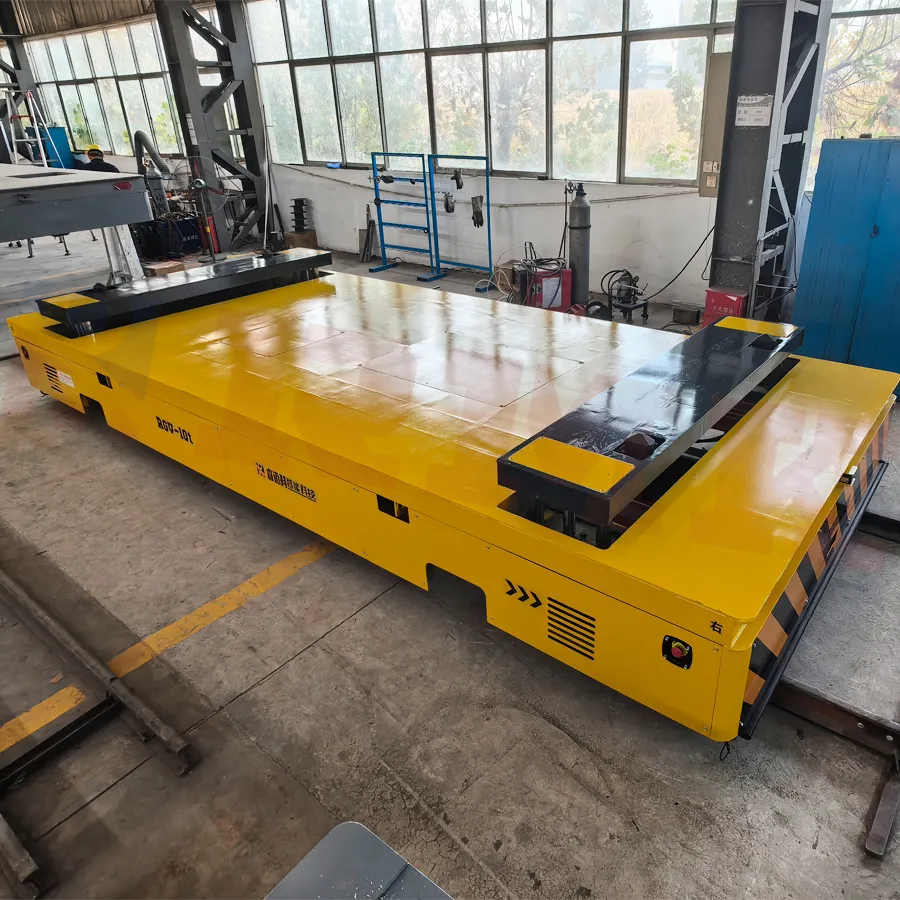
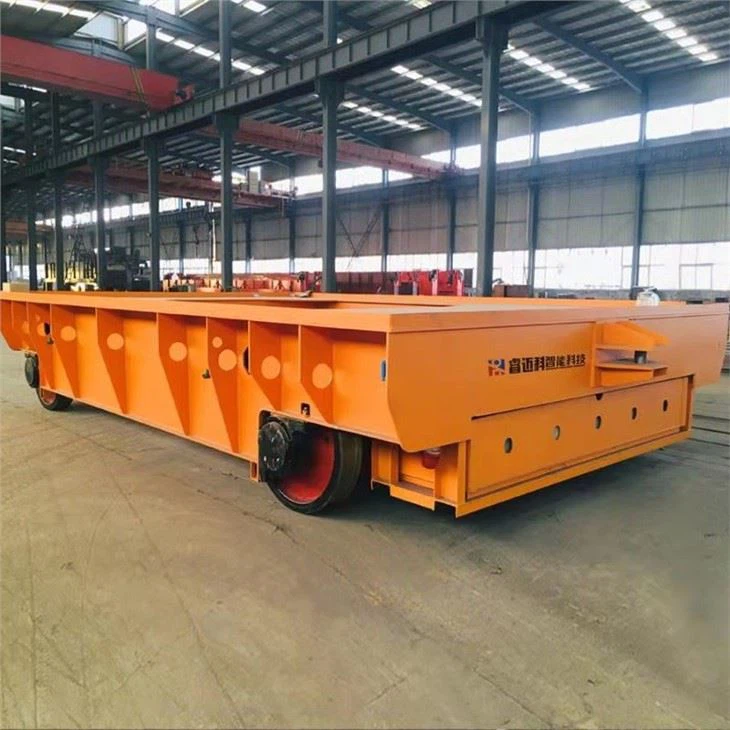
The automatic trackless transfer cart, also known as an AGV transfer cart, is an intelligent heavy-duty material handling device based on AGV technology. This 8-tonne lifting capacity AGV cart manufactured by REMARKABLE employs a laser navigation system, eliminating the need for track or magnetic strip installation to achieve autonomous navigation, path planning, and precise positioning. It supports multi-directional movement and high-precision docking, featuring a platform lifting function that enables flexible integration with production lines and workstations. Widely deployed in smart factories, heavy manufacturing, and automated production lines.
REMARKABLE offers customization services covering load capacity, platform design, control modes, and functional modules to meet diverse operational requirements.
- Load Capacity: 8 Tons
- Dimensions: 3500 × 1700 × 400 mm
- Lifting Stroke: Hydraulic lifting, 100 mm
- Power Supply: Lithium iron phosphate battery
- Speed: 0–25 m/min (stepless speed regulation)
- Custom: Custom production available, including additional components, etc.
Product Overview
An automatic trackless transfer cart, also known as an AGV transfer cart or automated trackless transfer cart, is a battery-powered industrial vehicle designed to move heavy materials between workstations without fixed rails. It uses laser SLAM navigation to map the working environment, determine its position, and follow programmed routes for automated material handling in factories, workshops, and production facilities.
This 8-ton trackless transfer cart features a 3500 × 1700 mm platform, a travel speed of 0–25 m/min, and a LiFePO4 battery power system. Its automatic navigation system supports autonomous movement, while the 100 mm hydraulic lifting platform handles loading and height alignment at workstations. The cart is suitable for heavy-duty material handling and material transport between production areas.
Automatic Trackless Transfer Cart for Automated Material Handling
An automatic trackless transfer cart operates without fixed rails or magnetic guide strips. Its Laser SLAM navigation system scans the surrounding environment, builds a map, and identifies the cart’s position. Based on the assigned transport task, the AGV transfer cart plans its travel route and moves independently between designated locations.
In factory material handling, the cart can transport workpieces, components, and heavy loads between production lines, workstations, and storage areas. Routes can be adjusted to suit changes in the factory layout without installing new rails, making the trackless transfer cart suitable for flexible automated material transport.
- Rail-Free Travel: Moves directly on suitable factory floors without fixed tracks or magnetic strips.
- Laser SLAM Navigation: Uses environmental scanning for mapping and real-time positioning.
- Automatic Route Planning: Plans travel paths according to assigned transport tasks.
- Workstation Docking: Travels to designated loading, unloading, and production stations.
- Factory Integration: Supports material transfer between production lines, workstations, and storage areas.
How Does an Automatic Trackless Transfer Cart Work?

Laser SLAM Navigation
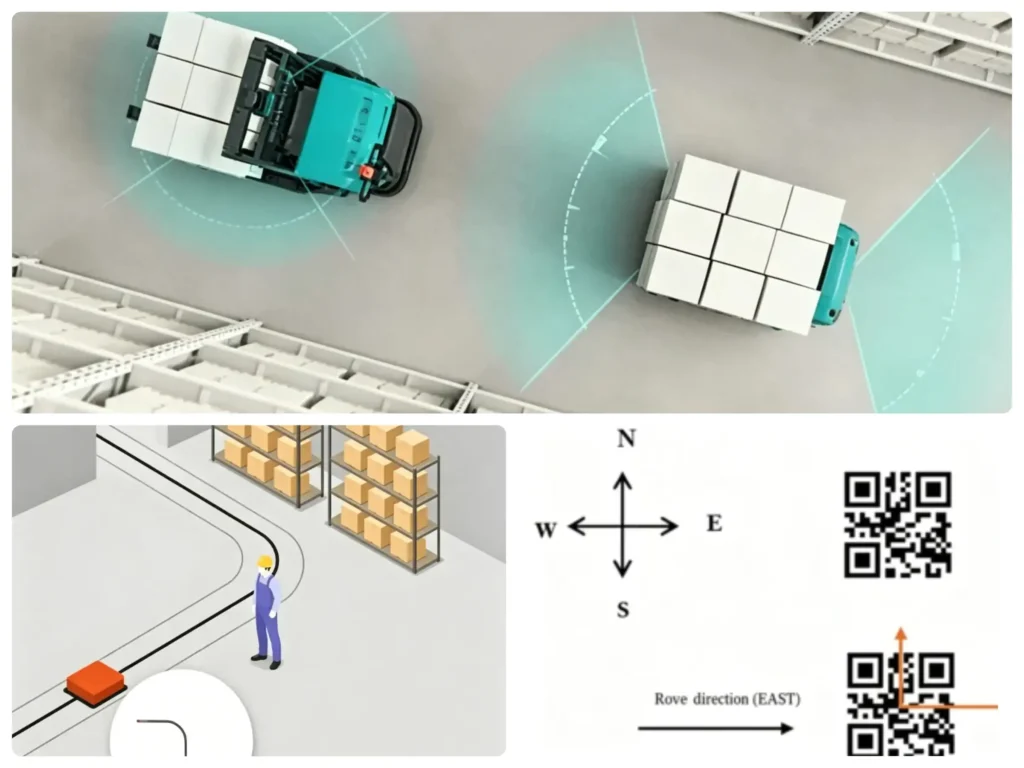
The laser SLAM navigation system scans the surrounding environment and collects spatial data to build a map. The control system uses the map to locate the cart and calculate its travel route. The cart updates its position during operation and changes its route when obstacles or changes in the travel area are detected. Trackless navigation requires no fixed rails or magnetic strips.
Autonomous Path Planning
The control system receives a transport command and identifies the pickup point and destination. The cart calculates the route, starts moving, and detects obstacles along the way. When an obstacle blocks the planned path, the system calculates another route. The cart stops at the assigned position for loading or unloading.
Omnidirectional Movement
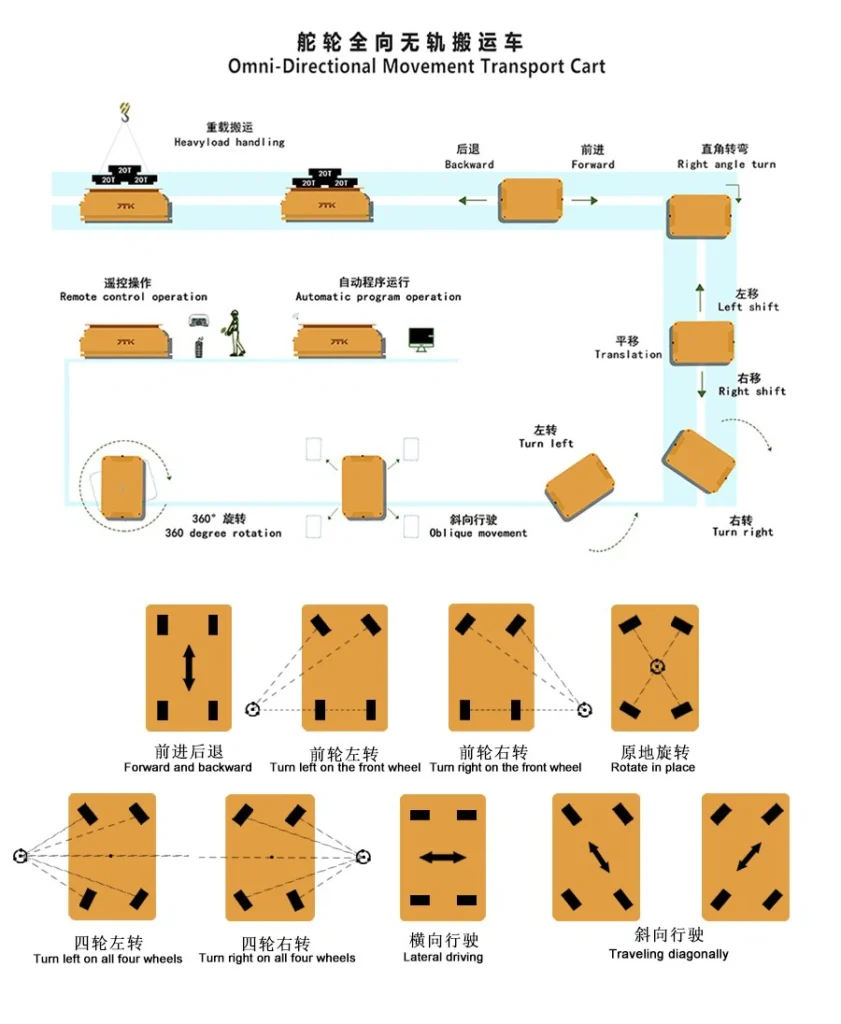
The omnidirectional transfer cart uses a steering wheel system for movement in multiple directions. Available movement modes include:
- Forward and backward
- Lateral movement
- Diagonal movement
- In-place rotation
The multidirectional transfer cart can travel sideways, move diagonally, and rotate within its own footprint. These steering functions are also used in a steerable transfer cart for workshop transport.
Automatic Docking and Positioning
The positioning system guides the cart to the assigned workstation. Positioning accuracy is ±20 mm under specified operating conditions. During docking, the cart aligns its platform with the loading or unloading position. The 100 mm hydraulic lifting platform adjusts the platform height to match the production line or workstation. This hydraulic lifting transfer cart configuration is used for height alignment during material transfer.
Specifications
The following table lists the main specifications of the 8-ton automatic trackless transfer cart.
| Parameter | Specification |
|---|---|
| Load Capacity | 8 tons |
| Platform Size | 3500 × 1700 mm |
| Platform Height | 400 mm |
| Travel Speed | 0–25 m/min |
| Power Supply | LiFePO4 Battery |
| Navigation System | Laser SLAM |
| Positioning Accuracy | ±20 mm |
| Lifting Height | 100 mm |
| Lifting Type | Hydraulic |
| Operating Time | 4 hours |
Note: Specifications refer to the 8-ton configuration. Final parameters are subject to the confirmed equipment design.
Trackless Transfer Cart Capacity and Custom Configurations
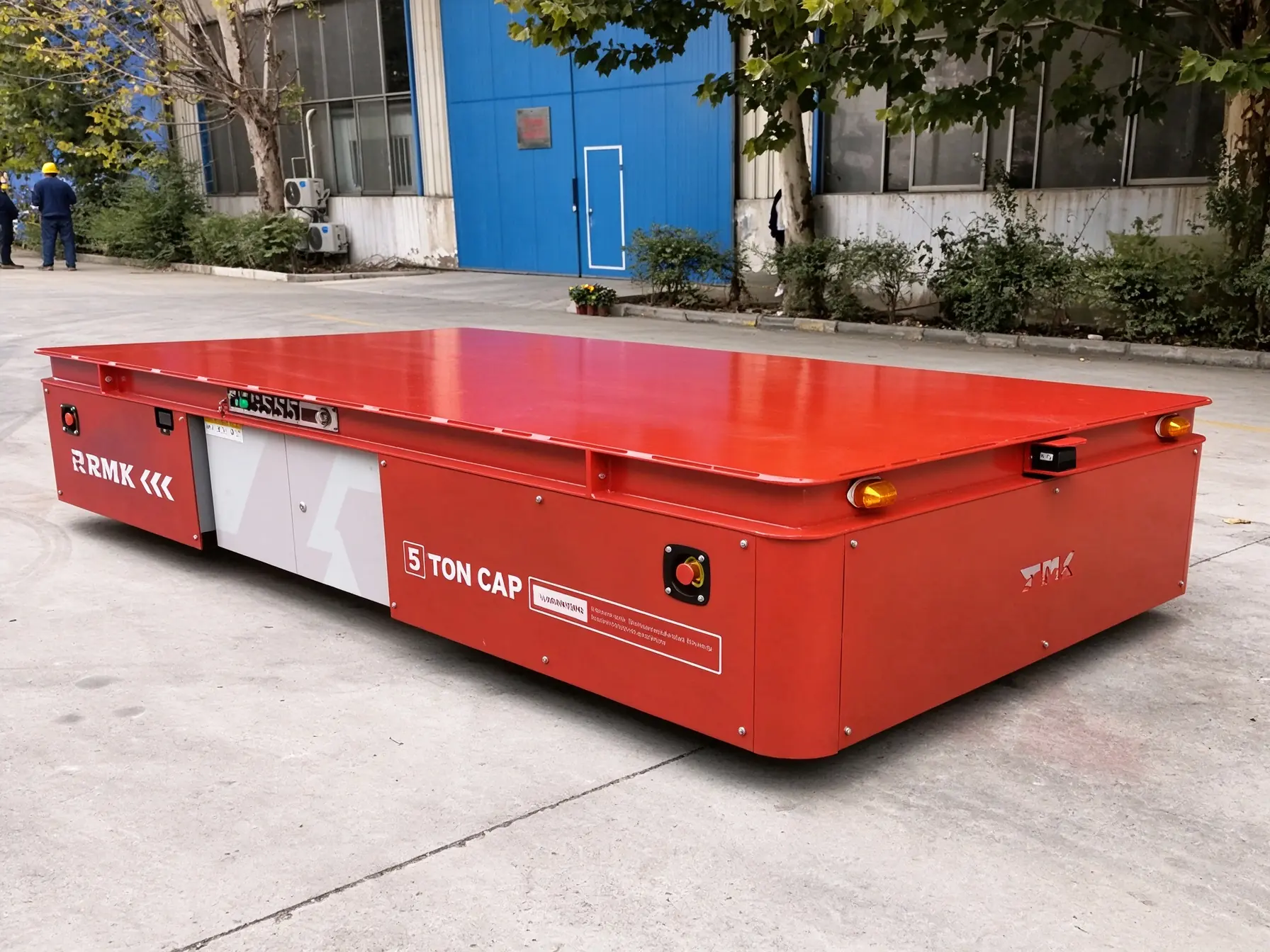
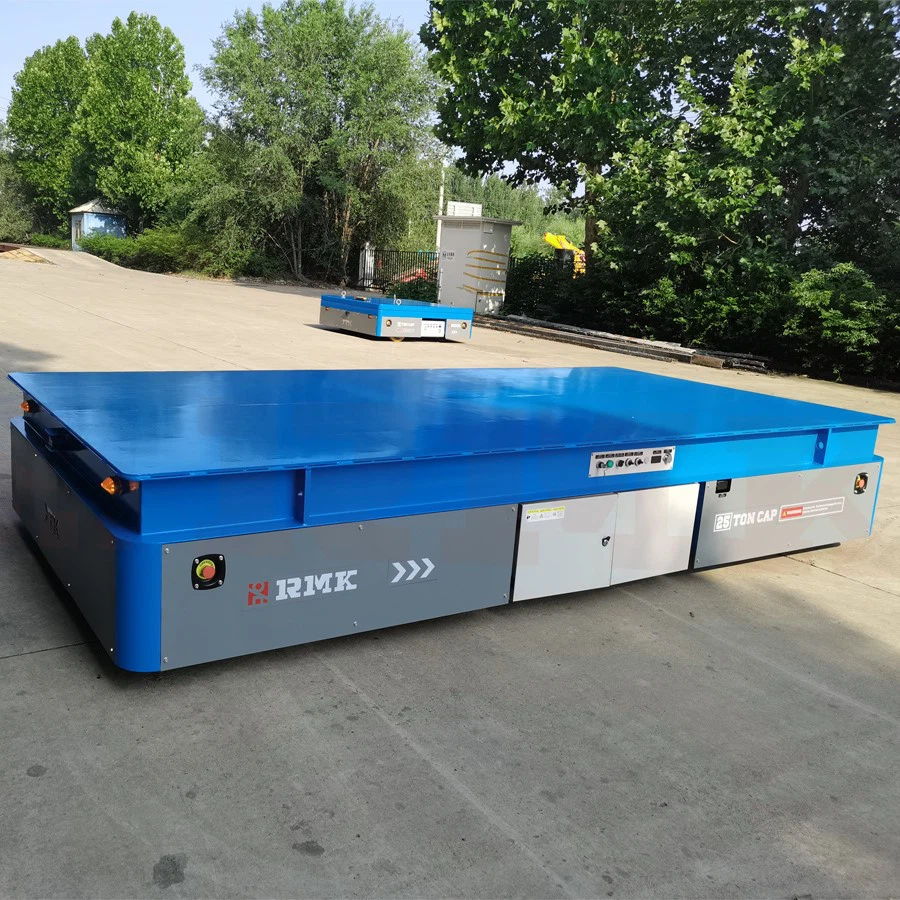
RMK offers trackless transfer carts with load capacities from 5 to 100 tons. The 8-ton automatic AGV is one configuration in this range. Other models use different power, drive, steering, and control systems according to the transport requirements.
Customization Options
- Load Capacity: 5–100 tons, selected according to the weight and dimensions of the transported materials.
- Platform Size: Customized length, width, platform height, and structural design.
- Battery System: Battery type and capacity selected according to operating hours, travel distance, and charging conditions.
- Drive System: Motor arrangement and drive configuration selected according to load and operating conditions.
- Steering System: Steering method and movement modes selected according to aisle width, turning space, and travel routes.
- Travel Speed: Operating speed configured according to transport distance and production cycle.
- Lifting Mechanism: Lifting type, platform structure, and lifting height configured according to loading and docking requirements.
- Control Mode: Manual control, wireless remote control, or automatic operation.
- Navigation System: Laser SLAM or other navigation methods selected according to the automation requirements.
- Safety Devices: Obstacle detection, emergency stop, safety edges, and audible or visual alarms selected according to the working environment.
RMK configures each trackless transfer cart according to load capacity, factory layout, floor conditions, transport routes, and operating requirements. Contact RMK with your load details and operating conditions for a project-specific design.
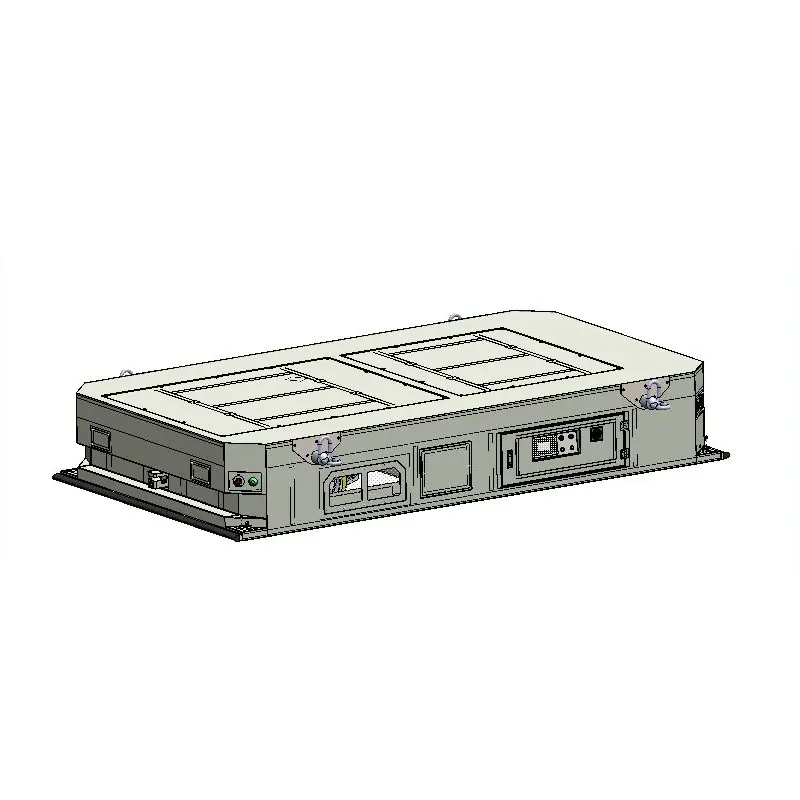
Systems of the Automatic Trackless Transfer Cart
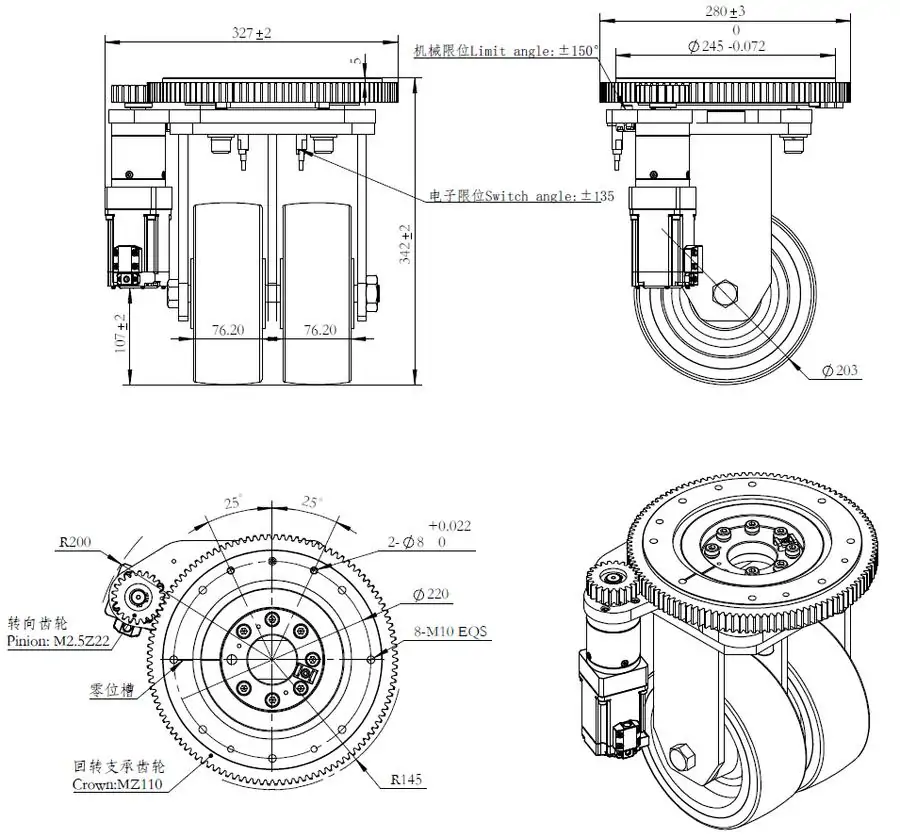
Drive and Steering System
The drive system consists of electric drive motors, steering wheels, and caster wheels. The electric transfer cart supports forward, reverse, lateral, and diagonal movement, as well as turning and in-place rotation. The omnidirectional transfer cart configuration is used for transporting heavy loads through factory workshops.
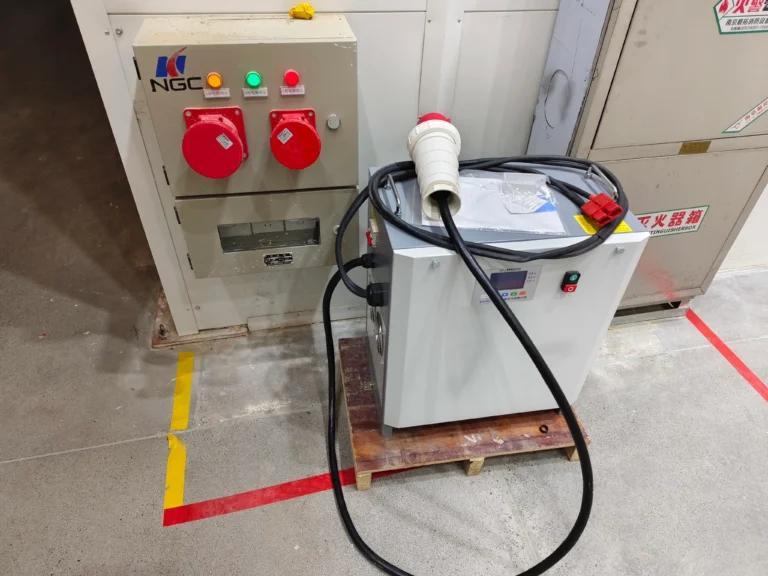
Battery Power System
The cart uses a LiFePO4 battery to supply power to the drive motors and control system. Operating time is approximately 4 hours per charge. Battery capacity and charging configuration can be selected according to operating hours, travel distance, and charging conditions. Other battery options are available for different battery powered transfer cart and lithium battery transfer cart configurations.
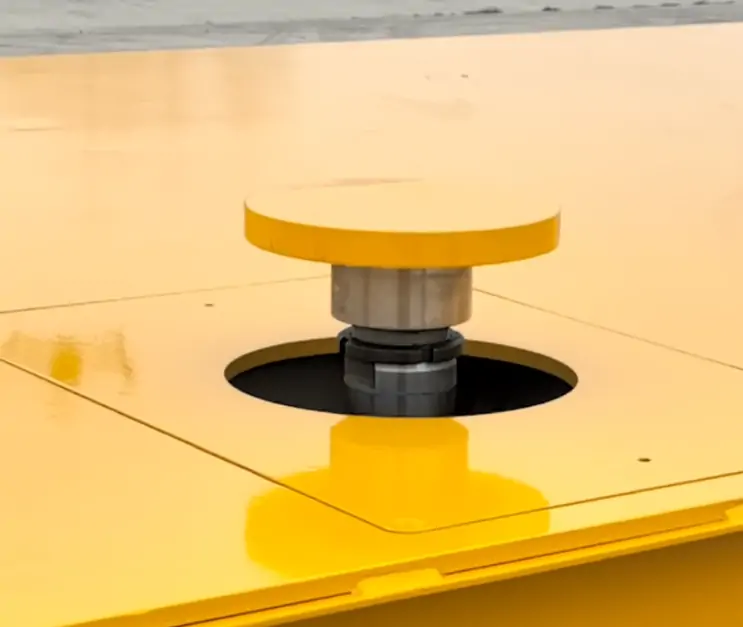
Hydraulic Lifting System
The hydraulic lifting system raises the full platform by 100 mm. It is used to align the cart platform with production lines, workstations, and loading equipment. The hydraulic lifting transfer cart configuration supports height adjustment during material loading, unloading, and equipment docking.
Navigation and Control System
The control system uses Laser SLAM for automatic navigation and route execution. Operators can assign transport tasks through an industrial tablet or use wireless and wired remote controls for manual operation. Automatic and remote control modes are available according to the equipment configuration.
Safety Protection System
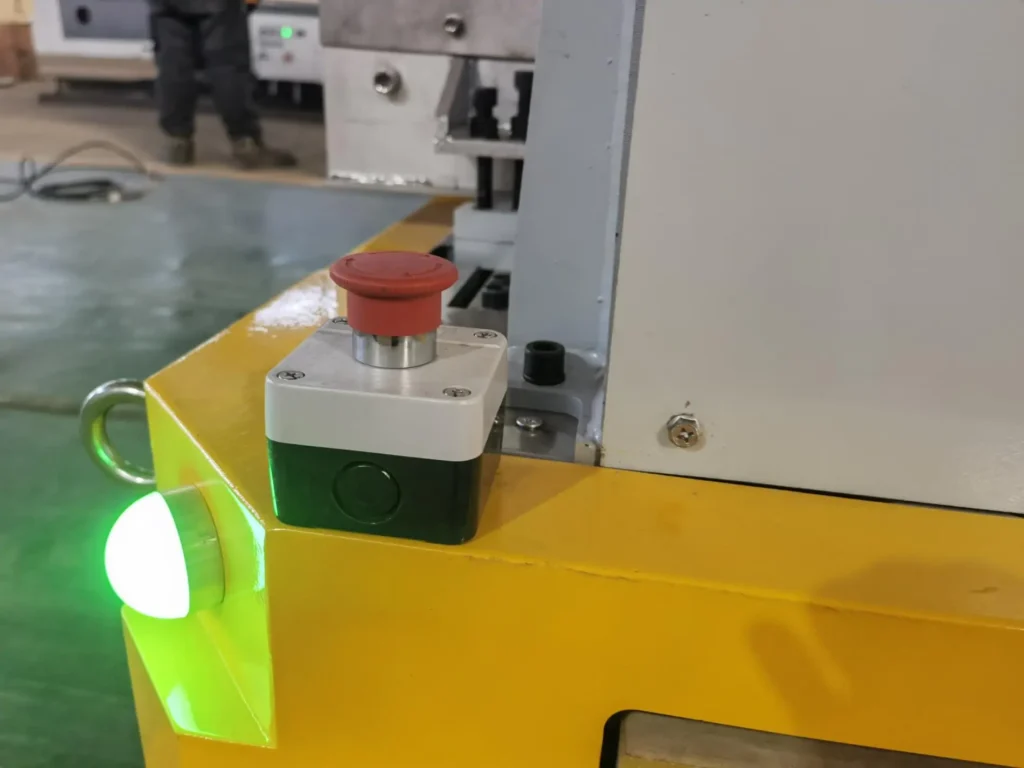
The cart can be equipped with the following safety devices:
- Laser obstacle avoidance: Detects obstacles along the travel path.
- Emergency stop: Stops cart movement when activated.
- Safety edge: Triggers a stop when the edge contacts an obstacle.
- Audible and visual alarm: Signals cart movement and operating status.
Safety device configurations are selected according to the working environm
Automatic vs Manual Trackless Transfer Cart
Automatic and manual trackless transfer carts differ in navigation, route control, and workstation operation. The automatic type uses a navigation system for programmed transport tasks, while the manual type relies on operator control.
| Item | Automatic Trackless Transfer Cart | Manual Trackless Transfer Cart |
|---|---|---|
| Navigation | Laser SLAM | Operator control |
| Route Planning | Automatic | Manual |
| Obstacle Detection | Available through the configured detection system | Depends on configuration and operator control |
| Docking | Automatic positioning | Operator-controlled positioning |
| Production Line Integration | Suitable for automated material handling systems | Limited automation |
| Typical Use | Automated material handling | General material transport |
- An automatic trackless transfer cart is suitable for repeated transport routes, scheduled material movement, and production lines with automated handling requirements.
- A manual trackless transfer cart is used for transport tasks that require direct operator control or frequent changes in movement direction and destination.
The choice depends on the transport process, route frequency, factory layout, and required level of automation.
Trackless Transfer Cart vs Rail Transfer Cart
Trackless transfer carts and rail transfer carts are used for industrial material transport, but they differ in travel routes and installation requirements. A trackless transfer cart travels directly on the factory floor, while a rail transfer cart follows a fixed track.
| Item | Trackless Transfer Cart | Rail Transfer Cart |
|---|---|---|
| Travel Route | Flexible | Fixed |
| Rail Installation | Not required | Required |
| Route Changes | Easier to adjust | Requires rail modifications |
| Floor Requirement | Suitable floor condition required | Rail foundation and installation required |
| Best For | Flexible factory transport | Fixed transport routes |
- A trackless transfer cart is suitable for factories with changing transport routes, multiple workstations, or flexible material handling requirements.
- A rail transfer cart is commonly used for repeated transport along fixed routes, especially in production areas with established material flow.
The choice depends on route layout, floor condition, load capacity, travel frequency, and automation requirements.
Applications
Automotive Manufacturing
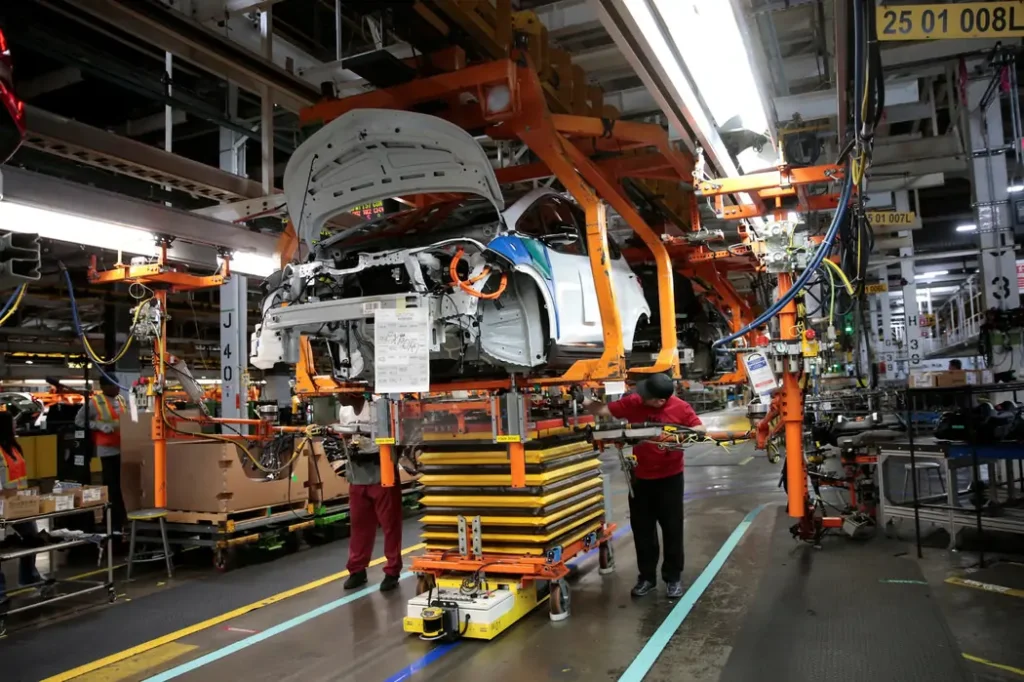
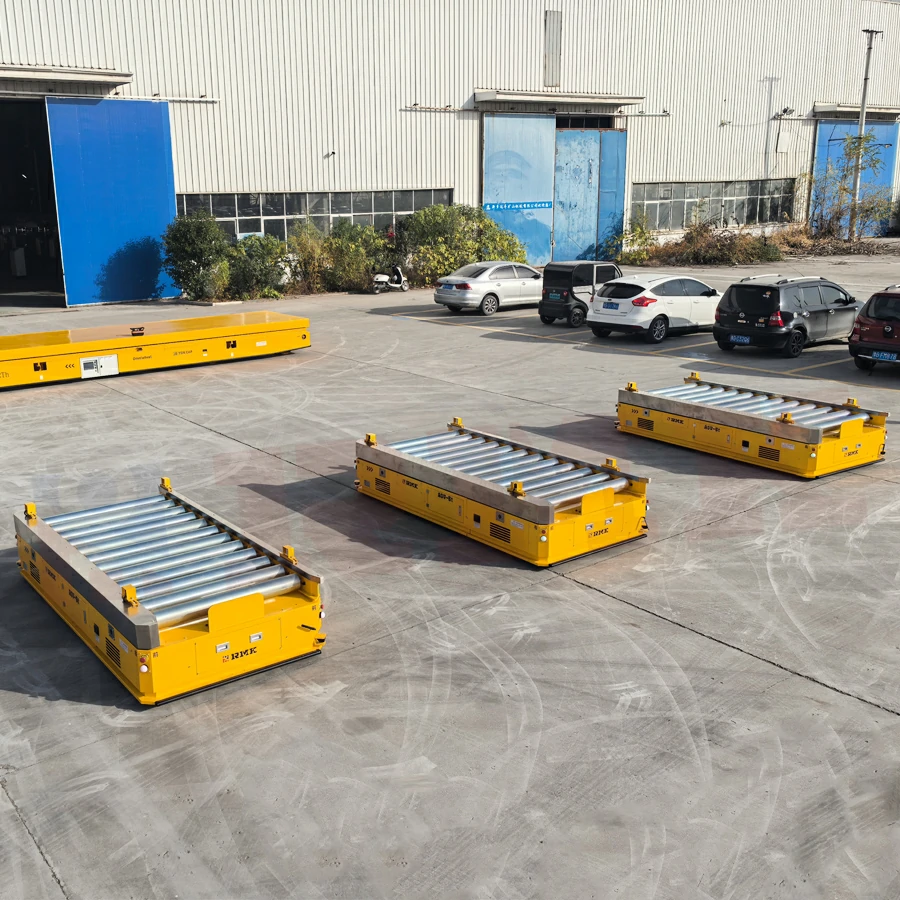
An automatic trackless transfer cart moves engines, vehicle body components, and molds between assembly stations, machining areas, and production lines. It is used for automotive material handling in automotive plants.
Heavy Equipment Manufacturing
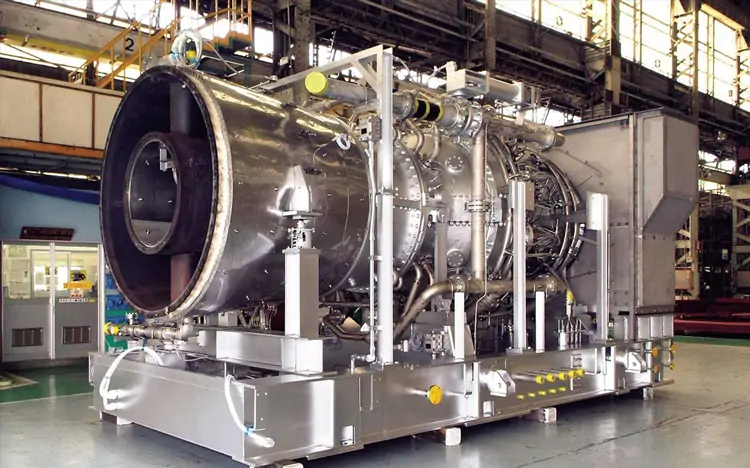
The cart transports machinery, structural components, and large workpieces between machining areas, assembly stations, and storage locations. It is used for heavy equipment transport in machinery manufacturing workshops.
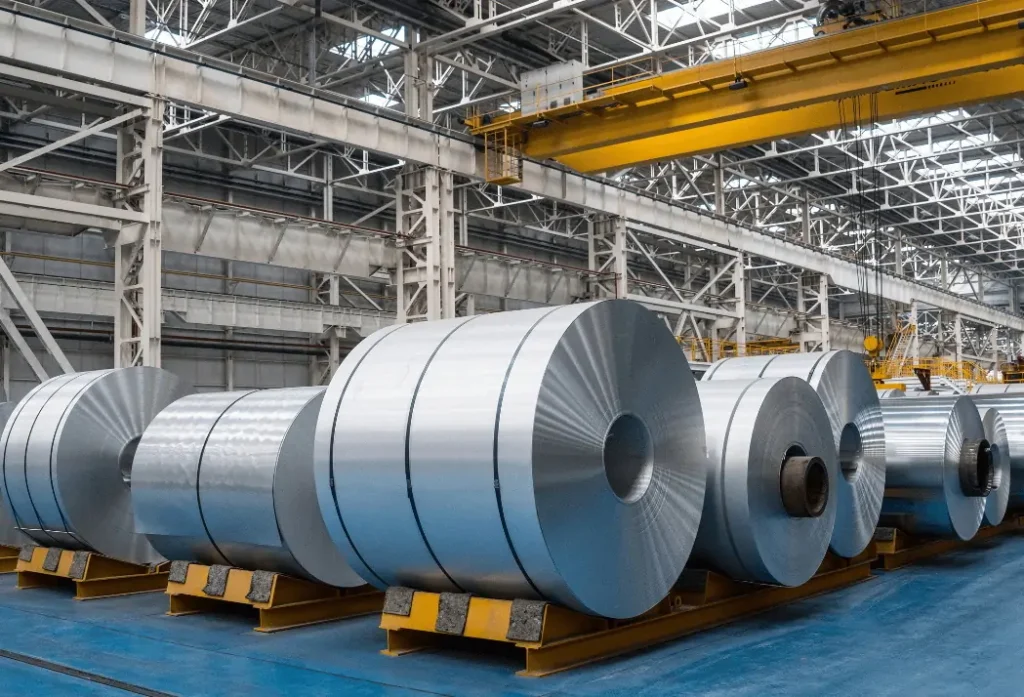
Steel and Metal Manufacturing
The cart moves heavy metal components, fabricated steel structures, and metal products between processing areas and workstations. It is used for heavy material handling in steel fabrication and metalworking facilities.
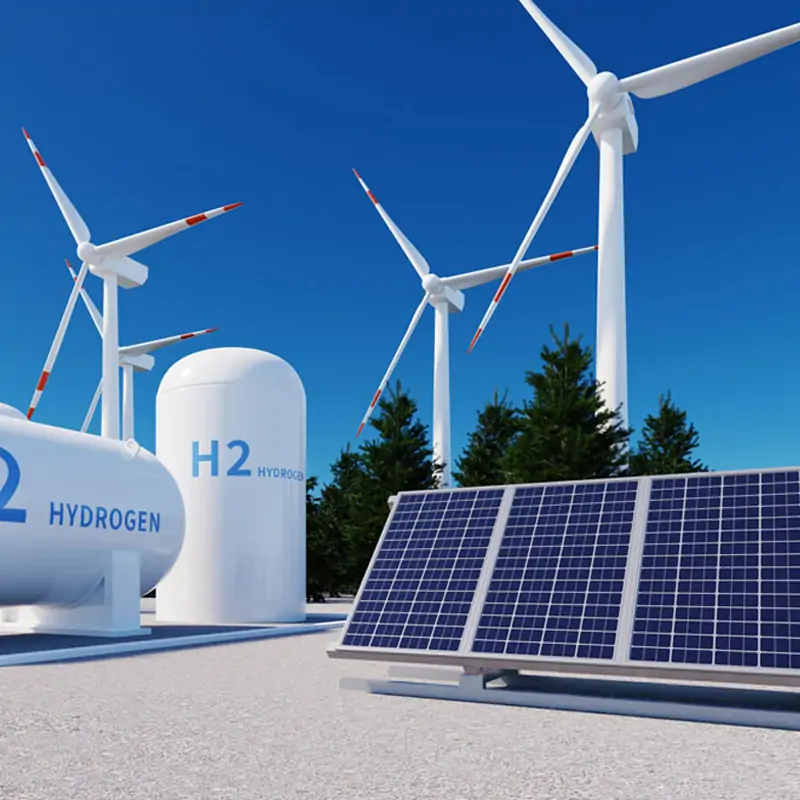
New Energy Equipment Manufacturing
The cart transports battery-related equipment, battery modules, electrical cabinets, and power equipment between assembly areas, testing stations, and production lines.
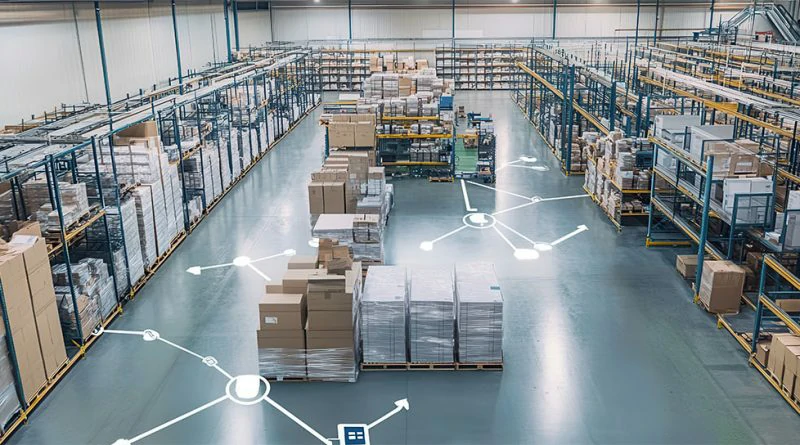
Warehousing and Production Logistics
The cart moves raw materials and components from warehouse storage areas to production lines, transfers work-in-process materials between workstations, and carries finished products back to storage areas. These routes form part of warehouse material handling and automated material transport.
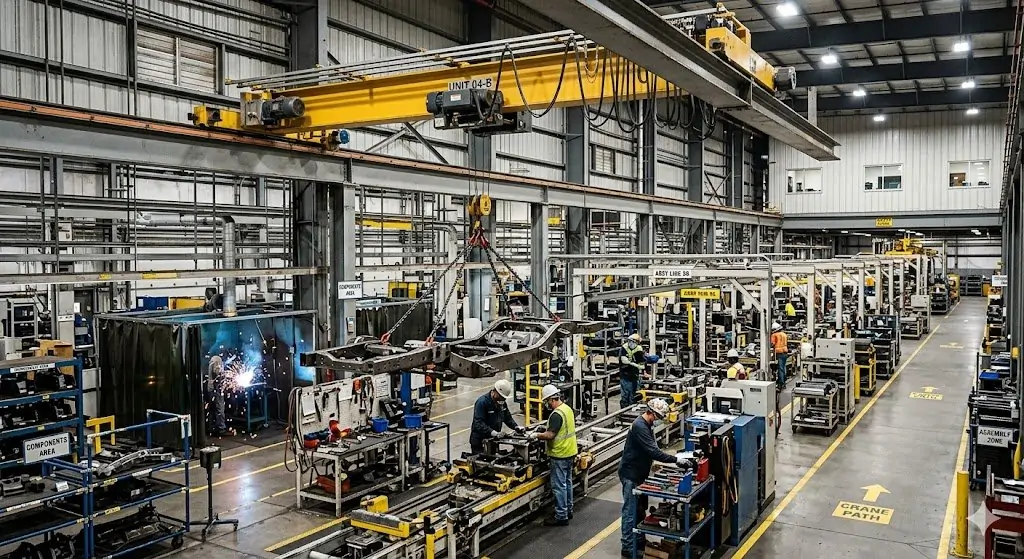
Industrial Machinery and Component Assembly
The cart carries machine bases, equipment housings, motor assemblies, and other large components between machining, assembly, and inspection stations. It is used for factory material handling where workpieces move between multiple production stages.
Cases
Information Required for Trackless Transfer Cart Customization
To configure an automatic trackless transfer cart, RMK needs the following project information:
1. Load and Material Information
- Load Capacity: Provide the maximum weight of each load to be transported.
- Material Type: Specify the material, workpiece, or equipment carried by the transfer cart.
- Material Dimensions: Provide the length, width, height, and shape of the transported materials.
2. Platform Requirements
- Platform Dimensions: Specify the required platform length, width, and height.
- Lifting Requirement: State whether the cart needs a hydraulic lifting platform and the required lifting height.
3. Travel Route and Floor Conditions
- Travel Distance: Provide the distance between loading, unloading, and workstation positions.
- Route Layout: Share the factory layout, travel paths, turning points, and docking locations.
- Floor Condition: Describe the floor material, flatness, slope, joints, and other surface conditions.
4. Operating Requirements
- Required Speed: Specify the expected travel speed and transport cycle.
- Working Hours: Provide the daily operating hours and expected operating cycles.
- Battery Requirement: State the preferred battery type, operating time per charge, and charging conditions.
5. Navigation, Docking, and Safety
- Navigation Requirement: Specify whether the cart requires manual control, remote control, or automatic navigation such as Laser SLAM.
- Docking Position: Identify the loading and unloading positions and required positioning accuracy.
- Safety Requirements: List required safety devices, such as laser obstacle detection, emergency stop, safety edges, and audible or visual alarms.
Send your load capacity, platform dimensions, route layout, and working conditions to RMK for a trackless transfer cart configuration.
Automatic Trackless Transfer Cart Manufacturer
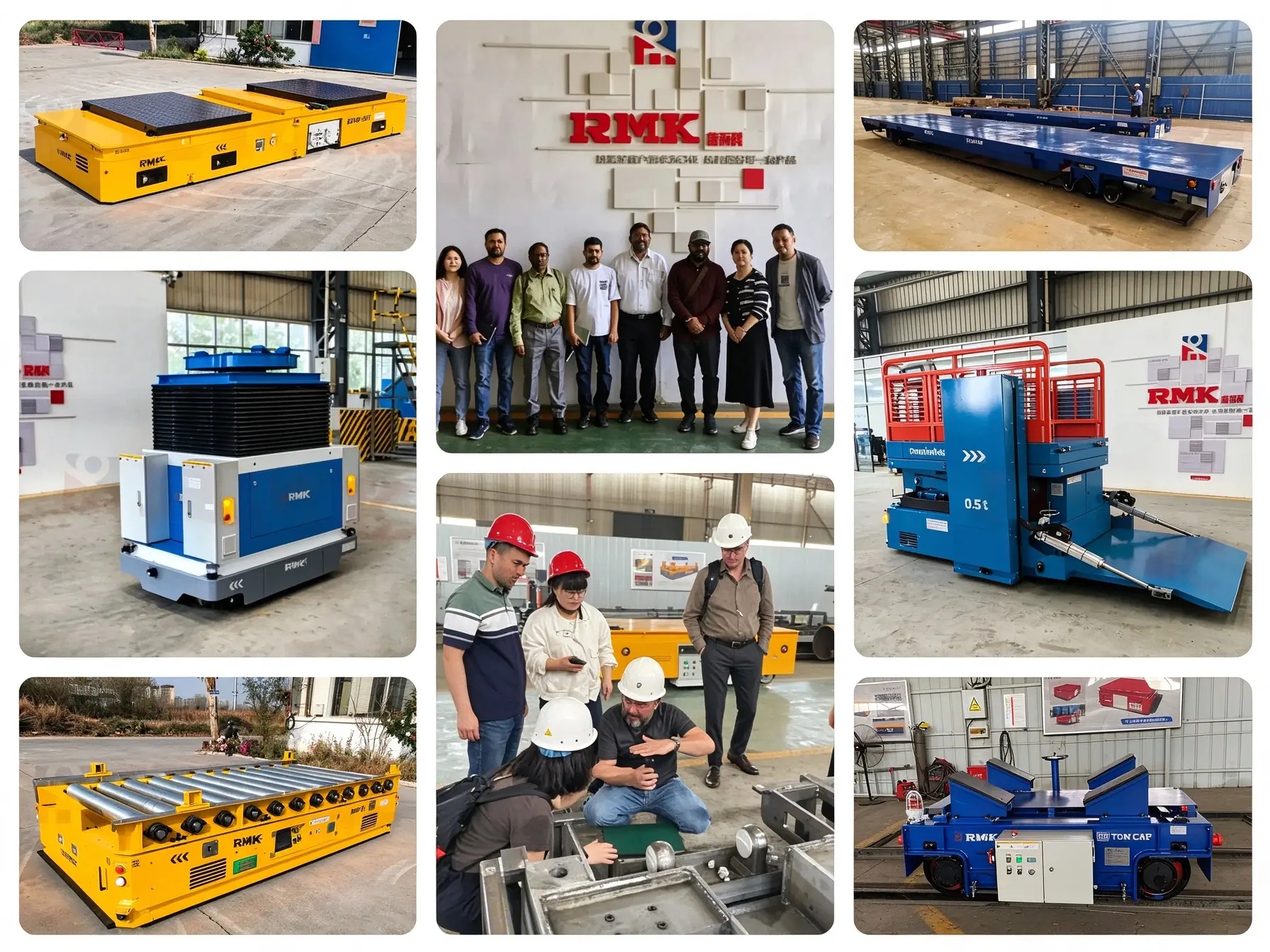
REMARKABLE manufactures automatic trackless transfer carts for heavy-duty material handling in factories, workshops, and production facilities. Available configurations cover different load capacities, platform dimensions, drive systems, steering methods, and navigation requirements.
Henan REMARKABLE Intelligent Technology Co., Ltd. has an experienced engineering team and in-house manufacturing, machining, and assembly capabilities. The company holds CE certification, ISO management system certifications, and national product patents. We supplies transfer carts to overseas markets and provides technical drawings, production testing, installation guidance, and after-sales support. Send your load capacity, platform dimensions, route layout, and working conditions to us for equipment selection and configuration.
FAQ
What is an automatic trackless transfer cart?
An automatic trackless transfer cart is a battery-powered AGV that transports materials without fixed rails. It uses an automatic navigation system to travel between designated locations in industrial facilities.
How does an automatic trackless transfer cart navigate?
An automatic trackless transfer cart uses Laser SLAM to scan its surroundings, build an environmental map, determine its position, and plan travel routes between assigned destinations.
Does an automatic trackless transfer cart need rails?
No. An automatic trackless transfer cart travels directly on the factory floor without fixed rails. The floor needs suitable flatness, load-bearing capacity, and surface conditions for cart operation.
What is the difference between a trackless transfer cart and an AGV?
Trackless describes the cart’s rail-free travel method, while AGV refers to automated guided vehicle operation. A trackless transfer cart can use manual or automatic control, depending on its configuration.
How much weight can an automatic trackless transfer cart carry?
The automatic trackless transfer cart featured on this page has an 8-ton capacity. Other trackless transfer carts range from 5 to 100 tons, with automation configurations selected separately according to project requirements.
What battery is used in an automatic trackless transfer cart?
The 8-ton automatic configuration uses a LiFePO4 battery. Battery capacity and operating time are selected according to travel distance, daily working hours, load conditions, and charging arrangements.
Can a trackless transfer cart connect with a production line?
Yes. A trackless transfer cart can use a hydraulic lifting platform and automatic docking to align with production lines, workstations, and loading equipment for material transfer.
How is an automatic trackless transfer cart customized?
Customization covers load capacity, platform dimensions, battery system, navigation, drive and steering systems, lifting mechanism, control mode, and safety devices according to factory layout and operating conditions.
Related Articles

Customized Intelligent Material Handling Solutions
To ensure that a customized transfer cart fits your needs perfectly, please provide the following details:
- Load Capacity: _____ tons (1~500 ton)
- Table Size: _____ × _____ mm/m (e.g., 1500×3000)
- Power Options:
- ☐ Lead-acid ☐ Lithium-ion ☐ Other: _____
- ☐ Cable: _____V/_____A
- ☐ Standard 380V/50Hz/3-phase
- Cargo Details:
- Type: _____ (e.g., steel coils, machinery)
- Special Needs: _____ (e.g., anti-slip, corrosion-proof)
- Optional Features:
- ☐ Emergency stop ☐ Anti-collision sensors
- ☐ Rail guides ☐ Lifting mechanism ☐ Remote control