目次
はじめに
在工厂车间内搬运50吨变压器、钢结构或大型机器,需要的不仅仅是简单的运输车辆。重型搬运台车利用电动驱动系统沿轨道或指定路线移动这些负载。电机、减速机、车轮、电源、控制系统和制动器在每个运输周期中协同工作。.
本文探讨台车如何启动、移动、改变速度和方向以及停止,重点介绍各系统背后的工作原理。这有助于买方了解搬运台车如何处理重载,以及何种设备配置适合其工况。.
有关重型搬运台车的详细介绍,请参阅文章: “什么是重型搬运台车?”
重载转运车是如何工作的?
重型搬运台车主要包括五个部分:动力系统、驱动系统、车轮机构、控制系统和制动系统。每个系统在物料运输过程中执行特定功能。.
步骤1 — 电源
电源为驱动电机和控制系统提供电力。重型搬运台车通常采用三种供电方式。.
- 电池供电:适用于灵活和多区域运输。.
- 低压轨道供电:适用于固定路线和连续运行。.
- 电缆卷筒供电:适用于行程有限的固定路线。.
电力进入电气柜,并分配给驱动系统和辅助设备。.
步骤2 — 电机和减速机
电机产生驱动力。减速机降低电机转速并增大输出扭矩。.
扭矩通过传动轴传递至驱动轮。.
电机 → 减速机 → 传动轴 → 驱动轮
电机和减速机的选型取决于负载能力、行驶速度、车轮布置和工作频率。.
步骤3 — 车轮和轨道
对于轨道式搬运台车,驱动轮沿固定轨道运行并产生牵引力。从动轮支撑台车车架并分散负载。.
车轴、轴承和轴承座将车轮组件连接至车架,并支撑稳定行驶。.
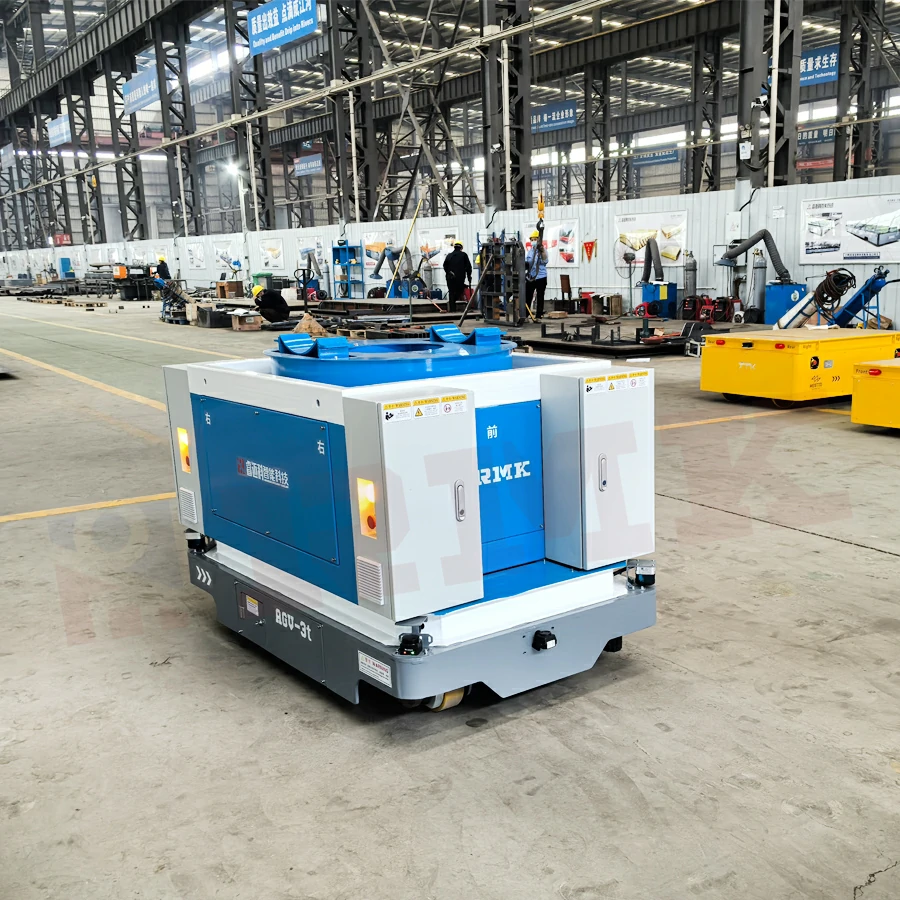
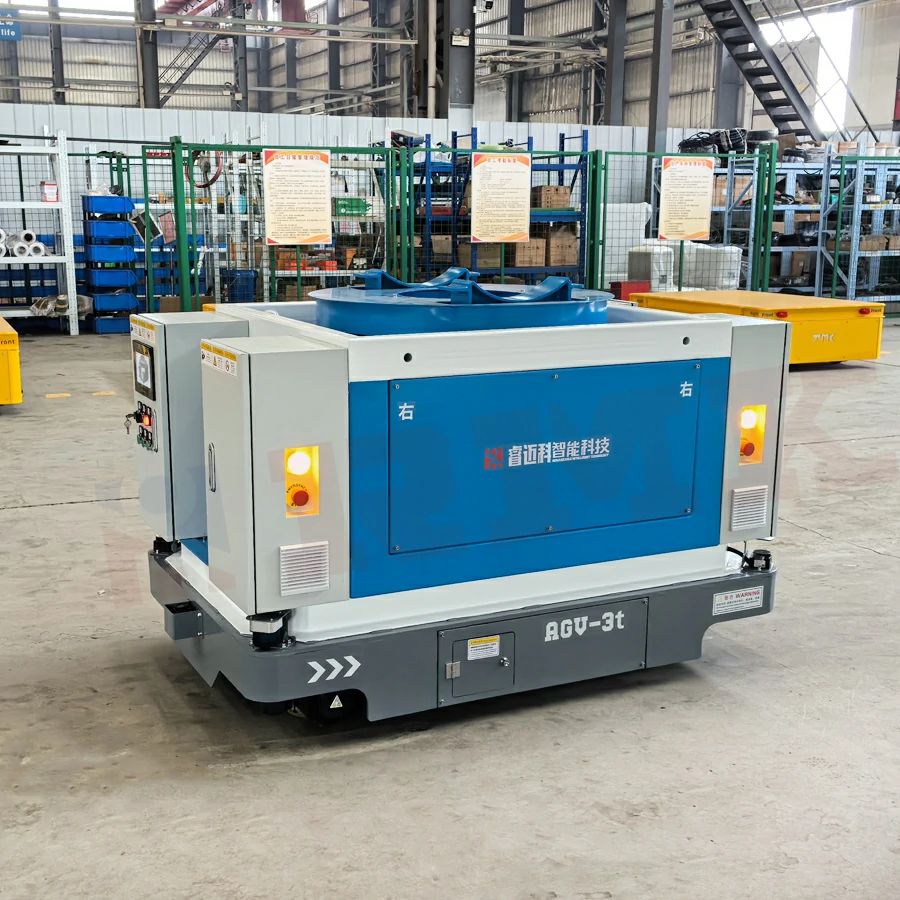
对于无轨型号,车轮系统直接在合适的混凝土或工业地坪上运行,无需固定轨道。.
步骤4 — 控制系统
控制系统管理主要行驶功能:
- 启动和停止
- 前进和后退
- 走行速度
- 急停
- 手动或遥控操作
可使用无线遥控器或手持操作盒进行手动控制。对于自动化生产线,可加装PLC和变频器。.
步骤5 — 制动系统
制动系统控制减速和停止。电磁制动器通常与驱动系统配合使用。.
当发出停止指令时,电机降低或停止输出,制动器将台车保持在原位。.
紧急制动和停止要求取决于台车负载、速度、路线和工作环境。.
重型搬运台车操作流程
重型搬运台车遵循从运行前检查到装卸和返回的固定操作顺序。.
- 运行前检查:运行前检查电源、轨道、负载、制动器和安全装置。清除轨道上的任何障碍物,并核对负载是否在额定能力范围内。.
- 电源连接:连接所选电源。视情况检查电池电量、低压变压器运行或电缆卷筒动作。.
- 控制指令:使用无线遥控器或手持操作盒选择启动、前进或后退。PLC处理控制信号。.
- 电机启动和速度控制:电机驱动减速机,减速机降低转速并增大扭矩。变频器控制行驶速度为0–25 m/min。.
- 轨道行驶:驱动轮在钢轨上产生牵引力。从动轮支撑台车并保持平衡,使其移动至目标工位。.
- 定位和停止:接近目标位置时,操作员或定位传感器触发减速。电机停止,制动器将台车保持在预设位置。.
- 装卸:使用叉车、起重设备或液压升降平台装卸物料。液压平台可调节高度以对接工位。.
- 返回或待机:台车返回起点或进入下一个工作循环。长时间停机时,断开电源并施加驻车制动。.
操作流程涵盖检查、电源连接、行驶控制、定位、装卸以及返回或待机。.
轨道式重型搬运台车如何工作?
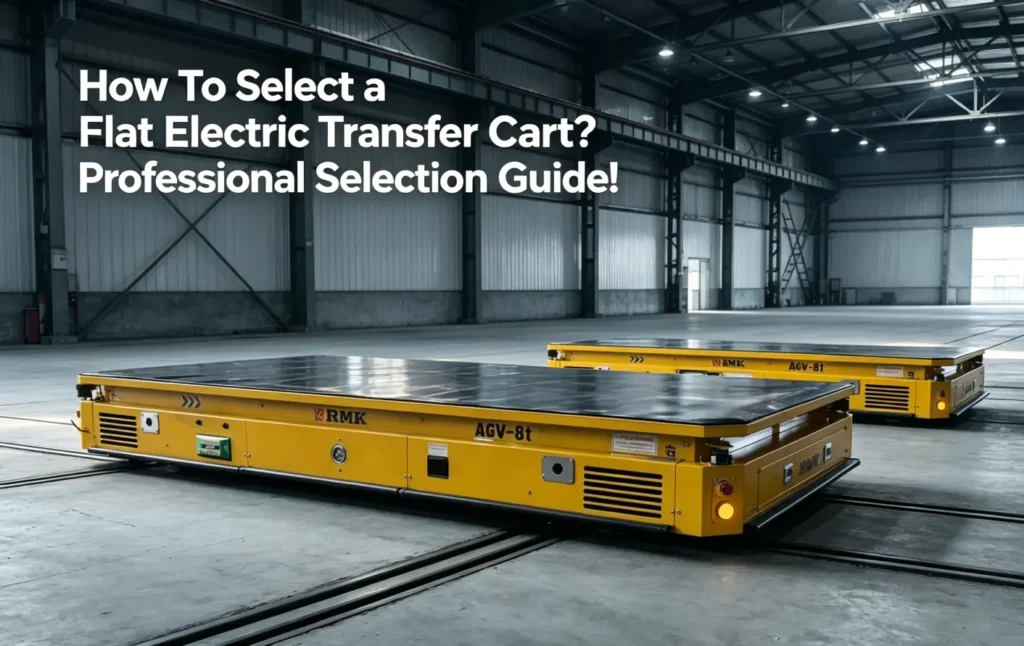
A 轨道式重型搬运台车 在固定钢轨上运行。轨道引导台车沿固定路线行驶,驱动系统移动负载。.
- Rail-Guided Travel: Steel wheels run on the rails and keep the cart on the track. Wheel and axle design depends on the load, platform size, and rail layout.
- Drive and Traction: The motor drives the gearbox. The gearbox increases output torque and transfers it to the drive wheels. The wheels generate traction and move the cart forward or backward.
- Control and Positioning: The control system manages start, stop, speed, and direction. Limit switches, proximity sensors, encoders, and PLC control can be used for fixed stopping points and automatic operation.
- Braking and Stopping: The braking system slows and stops the cart. Electromagnetic brakes are commonly used. Emergency stops and anti-collision devices can be added.
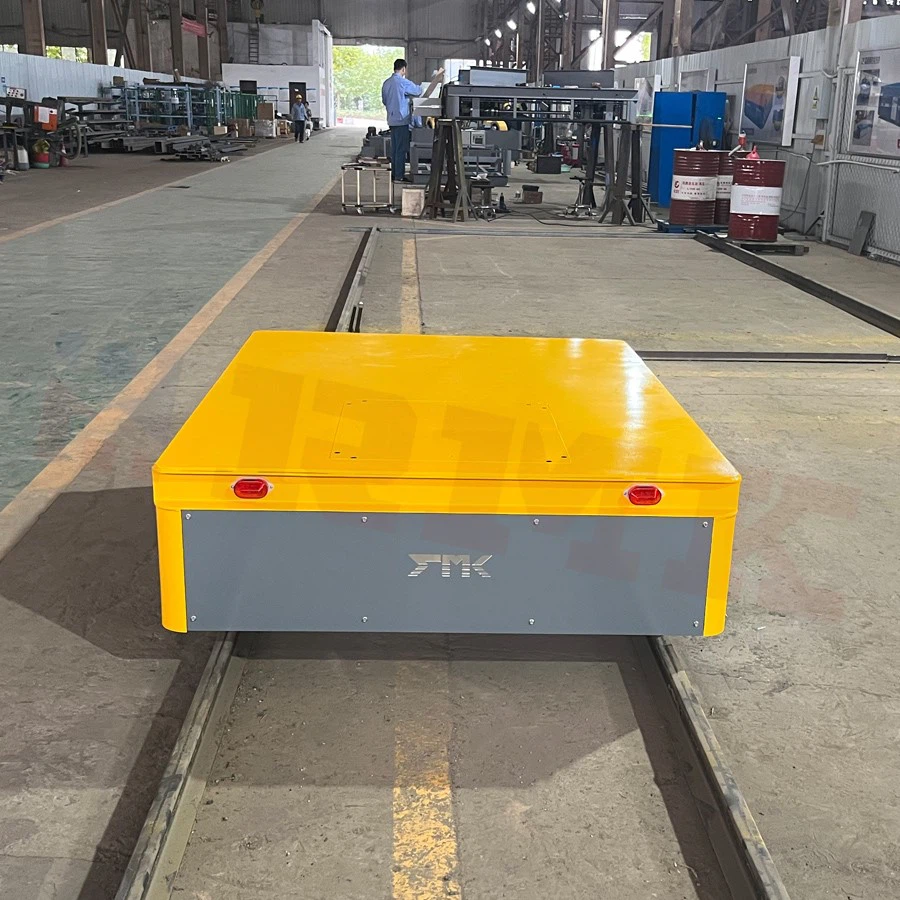
Rail Heavy Duty Transfer Carts are used for repeated heavy-load transport between fixed work areas. They move heavy loads by converting motor power into driving force through the drive system. The motor provides torque, the gearbox increases output force, and the wheels transfer the power to move the cart with the load.
Motor Torque and Gear Reduction
Heavy loads require high torque at low travel speeds. The gearbox reduces motor speed while increasing output torque, allowing the cart to start smoothly and transport heavy materials steadily.
The drive system is selected according to the load weight, travel speed, wheel size, and operating conditions.
Wheel System and Load Distribution
The wheels transfer the driving force to the rail or floor surface while supporting the total load. Multiple wheels and proper axle spacing help distribute the load evenly and reduce stress on the cart structure.
For oversized materials, the platform can be customized with different lengths, widths, and support designs.
For example, a 30-meter-long Rail-Guided Vehicle (RGV) can be designed for transporting extra-long steel pipes and similar materials.
Factors Affecting Movement Performance
| Factor | Impact on Movement |
|---|---|
| 負荷容量 | Determines required motor torque and drive strength |
| 移動速度 | Affects motor and gearbox selection |
| Wheel Design | Influences traction and load support |
| 動作条件 | Affects wheel wear and drive performance |
重型搬运台车如何控制速度和方向?
The speed and travel direction of a Heavy Duty Transfer Cart are controlled by the electrical control system, which regulates motor operation during movement.
- Speed Control: A variable frequency drive (VFD) adjusts the motor speed during starting, running, and stopping. Smooth acceleration and deceleration help reduce impact on the cart structure, wheels, and transported load.
- Forward and Reverse: The control system changes the motor rotation direction to move the cart forward or backward. Operators can select the travel direction through a pendant controller or wireless remote.
Heavy Duty Transfer Carts are available with manual, remote, or automatic control options. For automated operation, PLC control and sensors can be added to manage travel commands and movement processes.
电源如何影响搬运台车运行?
Different power supplies suit different operating conditions.
| 電源 | 申し込み |
|---|---|
| 充電システム | Flexible routes and multi-area transport |
| Low-Voltage Rail | Fixed routes and frequent operation |
| Cable Reel | Fixed routes and short-to-medium travel distances |
Battery capacity, cable length, rail layout, and operating frequency should be considered when selecting the power system.
重型搬运台车如何停止?
A Heavy Duty Transfer Cart uses the braking and control systems to stop the vehicle.
Normal Braking: The control system reduces the motor speed and activates the brake when the cart reaches the stopping point.
Emergency Stop: An emergency stop button immediately cuts the drive command. The braking system then stops and holds the cart.
Anti-Collision Protection: Sensors, buffers, warning lights, and alarms can be added to reduce collision risks.
The safety configuration depends on the operating environment, travel route, and automation level.
哪些部件构成搬运台车并使其工作?
A Heavy Duty Transfer Cart consists of several systems that work together to move and control heavy loads.
| 部件 | Main Function |
|---|---|
| Frame | Welded steel structure that supports the load and holds the main components. |
| モーター | Provides driving power for the cart. AC or DC motors can be used according to the cart design. |
| Speed Reducer | Reduces motor speed and increases output torque for heavy-load travel. |
| 電源 | Provides electricity through batteries, cable reels, low-voltage rails, or other suitable systems. |
| 制御システム | Controls starting, stopping, direction, speed, and other travel functions through the control cabinet, PLC, or inverter. |
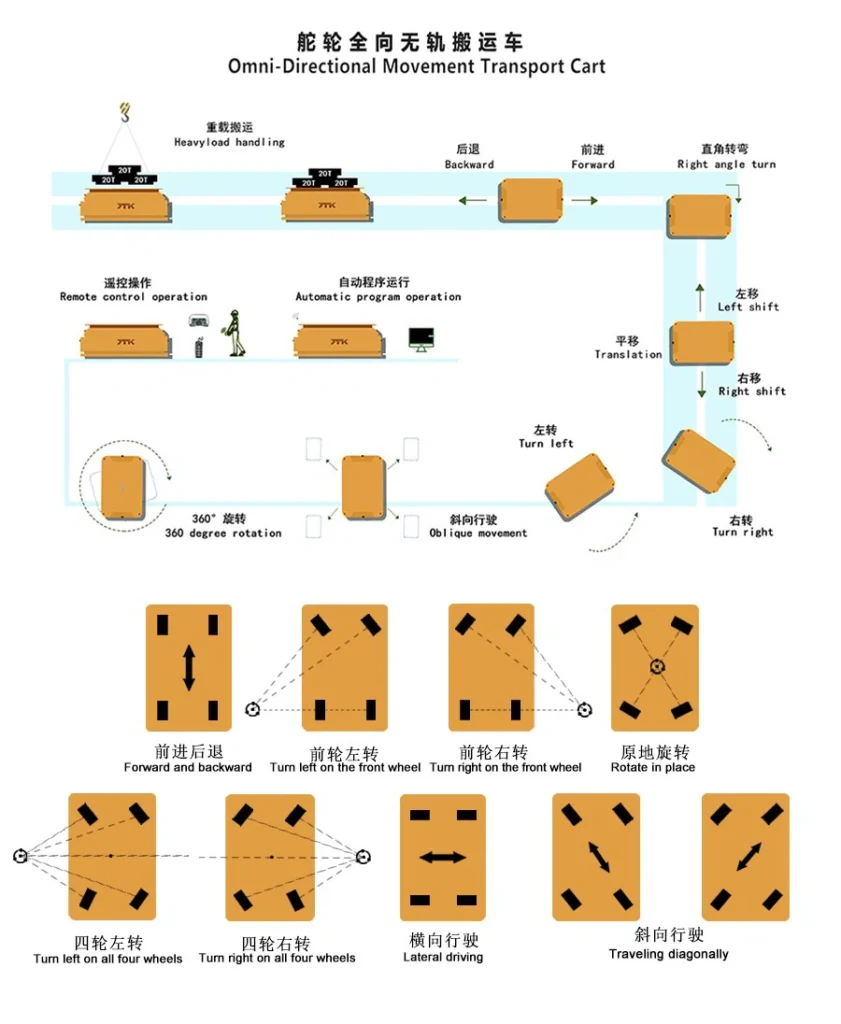
| 车轮 | Support the cart and transfer driving force to the ground or rails. Rail carts use steel rail wheels, while trackless carts use wheels with steering systems. |
| ブレーキシステム | Controls deceleration and stops the cart. Electromagnetic or mechanical brakes can be used. |
| 警告灯、バッファーバンパー、リミットスイッチ、緊急停止ボタン | Include emergency stops, warning lights, alarms, buffers, limit switches, and anti-collision devices. |
The component configuration is selected according to load capacity, travel route, power supply, operating frequency, and automation requirements.
For details on the classification and applications of transfer cart wheels, see the article: “Types of Wheels for Transfer Carts”
Maintenance and usage precautions for the power supply are critical for transfer carts, as they affect the equipment’s operational efficiency and costs. For details, see:
- バッテリー搬送カートのバッテリー管理
- How to Solve the Problem of Transfer Trolley Batteries Not Lasting as Long in Winter?
Proper safety configurations and regular maintenance schedules for transfer carts not only ensure more efficient material handling operations but also extend the equipment’s service life. For more information, read: 电池供电转运车维护指南:日常检查与电池保养
哪些因素影响重型搬运台车性能?
Several factors affect how a Heavy Duty Transfer Cart runs and handles loads.
| Factor | Main Effect |
|---|---|
| 負荷容量 | Determines frame, motor, wheels, and braking requirements. |
| Travel Distance | Affects power supply and battery capacity. |
| 移動速度 | Affects motor and gearbox selection. |
| 路线 | Determines rail or trackless configuration. |
| Operating Frequency | Affects drive and cooling requirements. |
| 労働環境 | Affects motor, electrical, and safety configurations. |
| 自動化レベル | Determines PLC, sensors, positioning, and control systems. |
The cart configuration should match the load, route, operating conditions, and control requirements.
如何选择重型转运平车?
Choose the transfer cart according to the load, route, distance, working frequency, power supply, and site conditions.
- 1. Load Capacity — Check the maximum load weight and load dimensions.
- 2. Platform Size — Select the platform length and width according to the load size and support points.
- 3. Travel Route — Choose a rail or trackless cart based on the transport route and floor conditions.
- 4. Travel Distance — Check the distance between loading and unloading points.
- 5. Travel Speed — Select the running speed according to the transport cycle and site requirements.
- 6. Power Supply — Choose battery power, low-voltage rail power, or cable reel power according to the route and operating conditions.
- 7. Working Frequency — Consider the number of transport cycles and daily operating hours.
- 8. Working Environment — Check site conditions such as temperature, dust, water, and heat.
- 9. Control Method — Choose pendant control, wireless remote control, PLC control, or automatic control based on the operating method.
- 10. Safety Requirements — Specify brakes, emergency stops, alarms, buffers, and anti-collision devices according to the site.
For a custom Heavy Duty Transfer Cart, provide the load weight, load dimensions, travel distance, route, operating frequency, power supply, and working environment to the manufacturer.
結論
A Heavy Duty Transfer Cart uses the power supply, motor, gearbox, wheels, control system, and braking system to move heavy loads along a fixed or designated route. Load capacity, platform size, travel distance, power supply, route, and working conditions determine the cart configuration.
リマーカブル provides Heavy Duty Transfer Carts for different load capacities and operating conditions, with customized platforms, drive systems, power supplies, and control systems. お問い合わせ with your load, route, and operating requirements for a suitable transfer cart solution.
電話番号: +86-18637369355
よくあるご質問
How does a Heavy Duty Transfer Cart work?
A Heavy Duty Transfer Cart uses an electric drive system to move heavy loads along rails or a designated route. The motor, gearbox, wheels, control system, and braking system work together during operation.
How does a transfer cart get power?
A transfer cart can use batteries, low-voltage rail power, or a cable reel. The power supply is selected according to the travel route, distance, and operating conditions.
How does a rail transfer cart move?
The motor drives the gearbox and drive wheels. Steel wheels run along fixed rails and move the cart along the designated route.
How does a transfer cart carry heavy loads?
The steel frame supports the load and distributes its weight across the wheel assemblies. Motor torque and gear reduction provide the force needed to move the loaded cart.
How is the speed of a Heavy Duty Transfer Cart controlled?
A variable frequency drive controls motor speed during travel. The control system can also manage acceleration, deceleration, and stopping.
How does a transfer cart stop?
The control system reduces or stops motor output, while the braking system stops and holds the cart. Emergency stop devices can be used when required.
Can a Heavy Duty Transfer Cart operate automatically?
Yes. PLC control, positioning sensors, limit switches, and other control devices can be integrated for automatic transport and positioning.
What factors affect transfer cart performance?
Load capacity, travel speed, route, travel distance, power supply, working frequency, floor or rail conditions, and working environment all affect transfer cart performance.