
Einleitung
Rail transfer carts are industrial vehicles that run on fixed tracks to transport heavy materials such as steel coils, molds, steel plates, and machine components. Based on their power supply systems, the main types include battery-powered rail transfer carts, cable-reel-powered rail transfer carts, and low-voltage-powered rail transfer carts. Each type uses a different method to supply electricity to the drive system.
This article introduces how these three types of rail transfer carts work and compares their power supply systems, operating characteristics, and limitations. It also explains how travel distance, load capacity, track layout, working frequency, and site conditions affect the choice of power system, helping you select a suitable rail transfer cart for your material handling needs.
Types of Rail Transfer Carts
Rail transfer carts are classified by their power supply systems. Battery-powered models use onboard batteries, cable-reel-powered models receive electricity through a traveling cable, and low-voltage-powered models draw power from conductive rails. The three systems differ in power transmission, installation requirements, operating distance, and maintenance.
Batteriebetriebener Schienen-Transferwagen
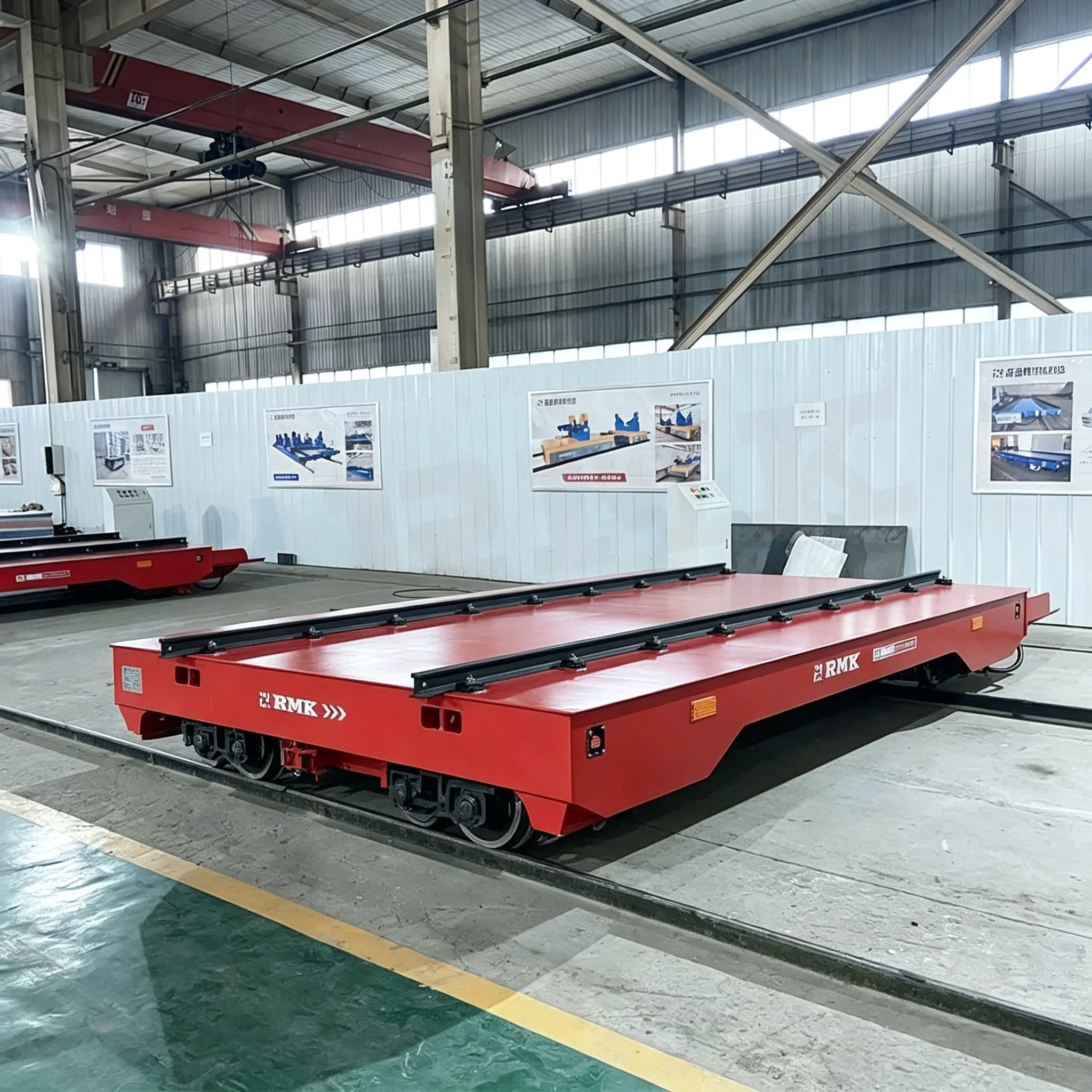
A battery-powered rail transfer cart uses an onboard battery pack to supply electricity to the drive motor and control system. The battery is installed on the cart and supplies power during operation. This design does not require a continuous external power cable or powered track along the travel route.
Operating Characteristics
- No external power cable or dedicated powered track along the route.
- Suitable for moving between multiple loading and unloading points.
- Operating time depends on battery capacity and actual power consumption.
- Charging can use manual connection or an automatic charging station, depending on configuration.
Power Supply and Working Principle
The battery pack supplies DC power to the electrical control system. When the operator sends a travel command, the controller operates the drive motor, which turns the wheels and moves the cart along the rails.
Common battery options include lead-acid and lithium-ion batteries. Battery voltage and capacity are selected according to load weight, travel distance, motor power, and operating frequency.
Limitations
Battery charging time, available operating hours, and battery maintenance need to be included in the production schedule. For multi-shift operation, battery capacity and charging arrangements must support the required working cycle.
Cable-Reel-Powered Rail Transfer Cart
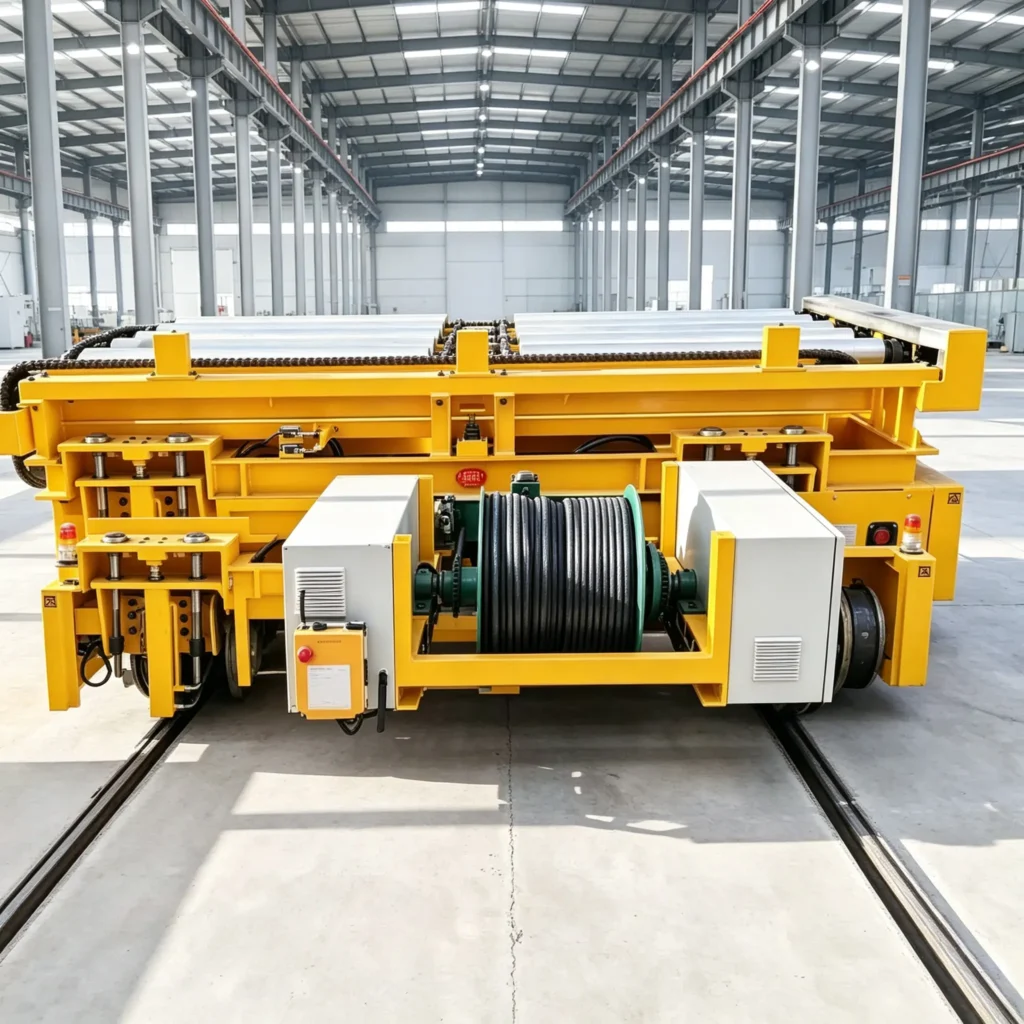
A cable-reel-powered rail transfer cart receives electricity from an external AC power source through a traveling cable connected to an onboard cable reel. As the cart moves along the track, the cable reel releases or retracts the cable according to the travel direction. The cable supplies power to the cart’s electrical control system and drive motor.
Operating Characteristics
- External power supports continuous operation without onboard battery charging.
- Suitable for fixed rail routes with an accessible power connection.
- Cable length and reel capacity determine the available travel distance.
- Cable tension and winding speed must match the cart’s running speed.
Power Supply and Working Principle
The external power supply delivers electricity through the traveling cable to the cart’s electrical control system and drive motor. As the cart moves away from the cable supply point, the reel releases the cable. As it moves toward that point, the reel winds the cable back onto the drum.
The main components include the power cable, cable reel, reel drive mechanism, electrical connections, and control system.
Limitations
Cable length, reel capacity, cable weight, and bending radius affect the operating range. The cable route also needs sufficient clearance to prevent tangling, abrasion, and interference with other equipment.
Low-Voltage-Powered Rail Transfer Cart
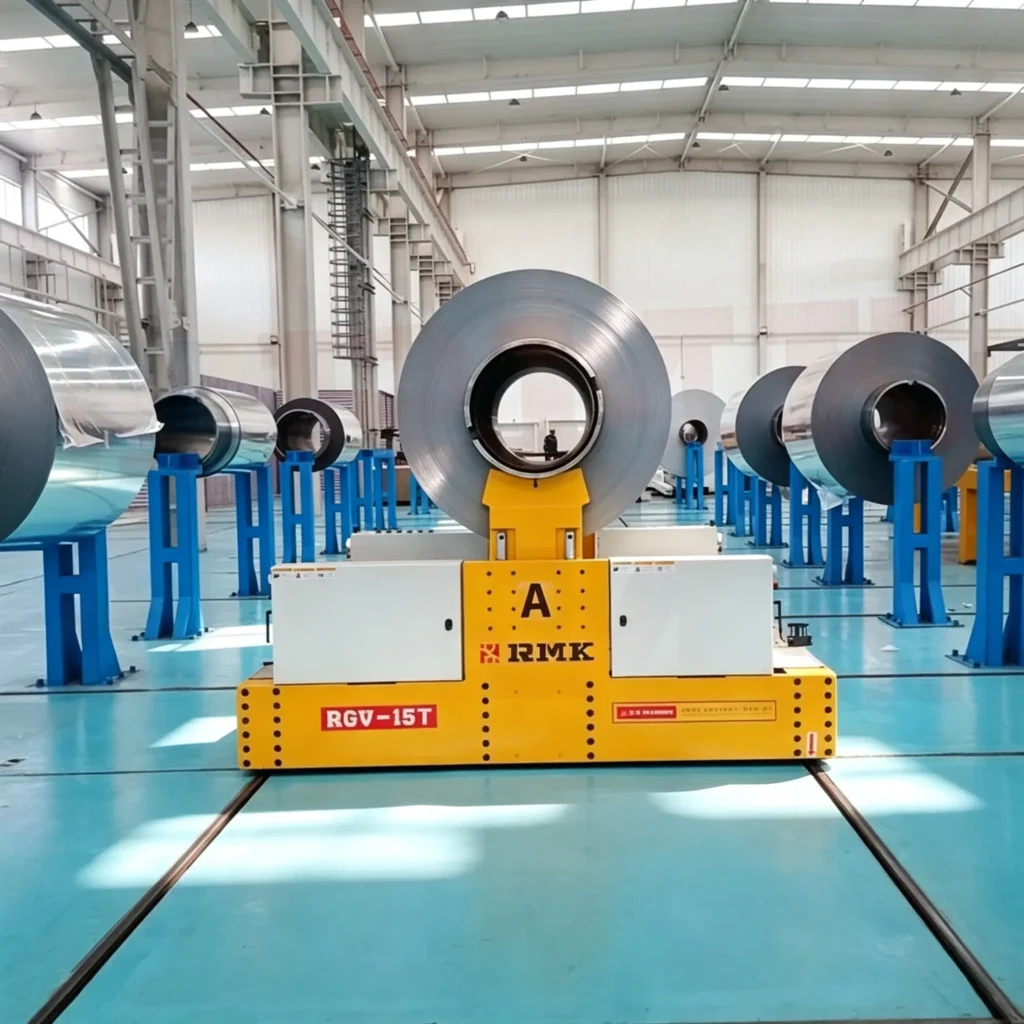
A low-voltage-powered rail transfer cart receives electricity through conductive rails installed along the travel route. An external AC supply passes through a transformer or voltage reduction system before supplying low-voltage power to the conductive rails. A current collector mounted on the cart transfers electricity from the rails to the onboard electrical system.
Operating Characteristics
- External track power supports continuous operation without onboard battery charging.
- No traveling power cable or cable reel is required.
- Suitable for fixed routes with dedicated power supply tracks.
- Route length depends on transformer capacity, conductor resistance, voltage drop, and electrical layout.
Power Supply and Working Principle
Electrical power is transmitted through the conductive rails. A current collector mounted underneath the cart maintains contact with the rails and transfers electricity to the onboard control system and drive motor. The motor then drives the wheels to move the cart.
The main components include a step-down transformer, conductive rails, insulation structure, current collector, and electrical control system.
Limitations
The conductive rails require proper insulation, electrical connections, and current collector alignment. Long-distance installations need voltage drop calculations and suitable power distribution arrangements.
Battery vs. Cable Reel vs. Low Voltage: Key Differences
Rail transfer carts differ mainly in their power supply systems, cable requirements, and installation conditions.
| Comparison Factor | Battery-Powered | Cable-Reel-Powered | Low-Voltage-Powered |
|---|---|---|---|
| Stromquelle | Onboard battery | External AC power | External low-voltage supply |
| Power Transmission | Battery to drive system | Traveling cable and reel | Conductive rail and current collector |
| Dauerbetrieb | Limited by battery capacity and charging | Supported by external power | Supported by external power |
| Laden | Battery charging required | No onboard battery charging | No onboard battery charging |
| Track Modification | No powered rail required | No powered rail required | Dedicated conductive rails required |
| Cable Management | Not required | Cable winding and retraction | No traveling cable |
| Routenflexibilität | Flexible within the fixed rail layout | Limited by cable length and reel capacity | Limited by powered track layout |
| Schwerpunkt Wartung | Battery and charger | Cable, reel and connections | Conductive rails, collector and insulation |
| Suitable Conditions | Routes requiring flexible operation | Fixed routes with cable management space | Routes with dedicated power infrastructure |
- Battery-powered rail transfer carts suit routes where external power infrastructure is difficult to install.
- Cable reel and low-voltage models are suitable for operations requiring continuous external power.
The final choice depends on travel distance, operating frequency, track layout, installation conditions, and maintenance requirements. Actual performance should be checked against the selected model’s technical specifications.
How to Choose the Right Type of Rail Transfer Cart
Selecting a rail transfer cart requires more than confirming its rated load capacity. Travel distance, track layout, operating frequency, power supply, and control requirements all affect the equipment design.
Travel Distance and Track Layout
Confirm the one-way travel distance, total track length, and route layout to determine battery capacity, cable reel length, or conductive rail requirements.
Load Capacity and Workpiece Dimensions
Select the rated load, platform dimensions, frame structure, and wheel configuration according to workpiece weight, size, and load distribution.
Operating Frequency and Working Shifts
Calculate transport cycles per hour, running time, and daily working shifts to determine battery capacity, charging arrangements, and continuous power requirements.
Power Supply and Installation Conditions
Check available voltage, existing track infrastructure, cable-routing space, electrical installation conditions, and the workshop environment.
Running Speed and Positioning Requirements
Determine the required running speed, stopping accuracy, control method, and whether the cart needs PLC control or automatic integration with production equipment.
Maintenance and Operating Costs
Compare battery replacement, cable-reel maintenance, conductive-rail inspection, energy consumption, and spare-parts costs over the equipment’s service life.
Which Type of Rail Transfer Cart Is Suitable for Different Applications?
The suitable power type for a rail transfer cart depends on the transport route, load, operating frequency, and available power supply. The following examples show how different working conditions affect the selection of battery, cable reel, and low-voltage-powered models.
| Anwendungsszenario | Recommended Power Type | Auswahlkriterien |
|---|---|---|
| Flexible material handling between multiple workstations | Battery-Powered | Check travel distance, route layout, battery capacity, and charging time. |
| Fixed transport routes with frequent operation | Cable-Reel-Powered | Check cable length, reel capacity, cable routing, and power supply access. |
| Repetitive transportation along dedicated tracks | Low-Voltage-Powered | Check conductive rail layout, power distribution, transformer capacity, and track installation. |
| Heavy-duty steel coil transportation | Battery, Cable Reel, or Low Voltage | Evaluate rated load, platform structure, load distribution, travel distance, and operating frequency. |
| Mold transfer between production areas | Battery or Cable Reel | Consider route layout, transport cycles, charging arrangements, and cable management space. |
| Continuous material transfer in industrial workshops | Cable Reel or Low Voltage | Check external power availability, operating hours, route length, and maintenance access. |
Application Selection Notes
- Battery-powered models suit routes where the cart needs to move between workstations without a trailing power cable or powered track.
- Cable-reel-powered models suit fixed routes where external AC power is available and the cable can be managed along the travel path.
- Low-voltage-powered models suit dedicated routes where conductive rails and a fixed power supply system can be installed.
Heavy materials such as steel coils, molds, and machine components do not require one specific power type. The final configuration should be selected after reviewing the load, transport distance, track layout, operating schedule, and workshop power conditions. RMK can assess these project details before recommending a suitable rail transfer cart.
Schlussfolgerung
Rail transfer carts are available with battery, cable reel, and low-voltage power supply systems. Each type suits different track layouts, operating schedules, and site conditions. The right choice should be based on load capacity, travel distance, working frequency, and available power infrastructure.
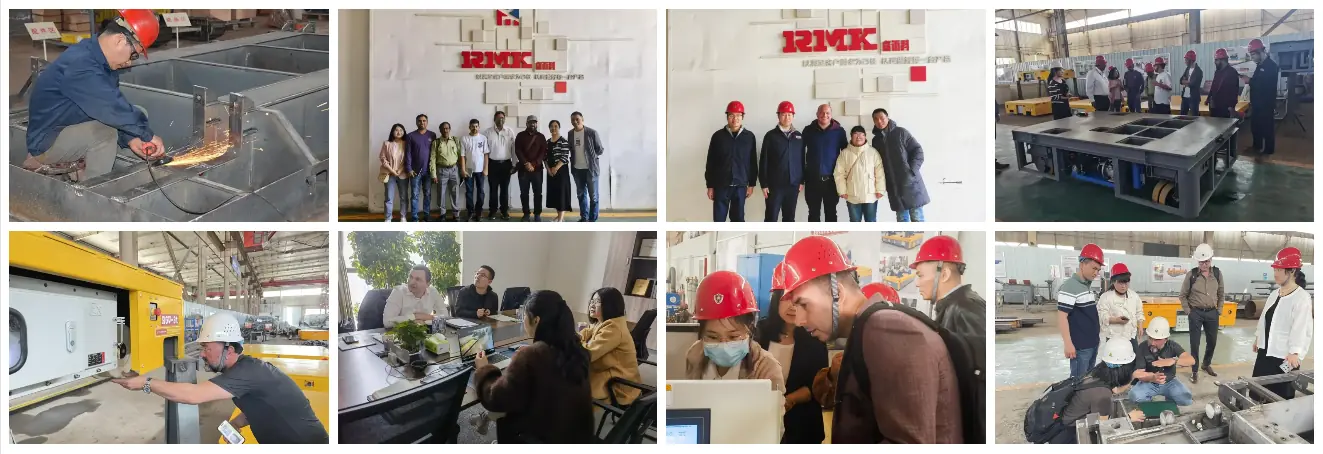
REMARKABLE specializes in the design and manufacture of industrial rail transfer carts. Our engineering and production teams handle project design, equipment manufacturing, assembly, and testing. We supply customized material handling equipment to customers in overseas markets.
If you are planning a rail transfer cart project, kontaktieren Sie uns with your load capacity, workpiece dimensions, track layout, and operating requirements. Our team will review your application and provide a suitable power system and equipment configuration.
FAQ
What are the main types of rail transfer carts?
The three main types are battery-powered, cable-reel-powered, and low-voltage-powered rail transfer carts. They are classified by how electrical power is supplied to the drive system.
How does a battery-powered rail transfer cart work?
A battery-powered rail transfer cart uses an onboard battery to supply electricity to its drive motor. The battery powers the cart during operation and is recharged through a charging system.
How does a cable-reel-powered transfer cart work?
A cable-reel-powered transfer cart receives external AC power through a traveling cable connected to an onboard reel. The reel releases and retracts the cable as the cart moves along the track.
What is a low-voltage-powered rail transfer cart?
A low-voltage rail transfer cart receives power through conductive rails. An external step-down transformer reduces the supply voltage, while an onboard current collector transfers electricity to the drive system.
What is the difference between battery- and cable-reel-powered transfer carts?
Battery-powered carts use onboard batteries and require periodic charging. Cable-reel-powered carts receive continuous external power through a traveling cable, but require cable routing and reel maintenance along the track.
What is the difference between cable reel and low-voltage rail transfer carts?
Cable reel carts transmit power through a traveling cable, while low-voltage carts collect power from conductive rails. Cable reel systems require cable management; low-voltage systems require dedicated powered track installation.
Which type of rail transfer cart is suitable for continuous operation?
Cable reel and low-voltage-powered rail transfer carts are suitable for continuous operation because they receive external power. Their configurations must account for operating cycles, electrical capacity, and maintenance access.
How do I choose the right rail transfer cart for my factory?
Choose a rail transfer cart based on rated load, track length, transport frequency, available power supply, and control requirements. Workpiece dimensions, workshop conditions, and maintenance arrangements also affect the final configuration.