
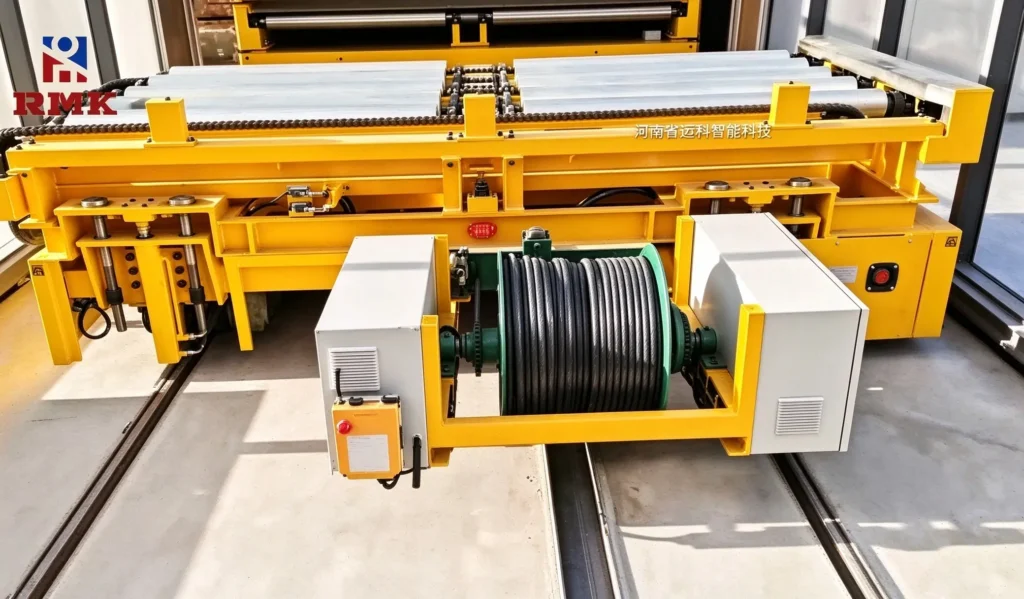
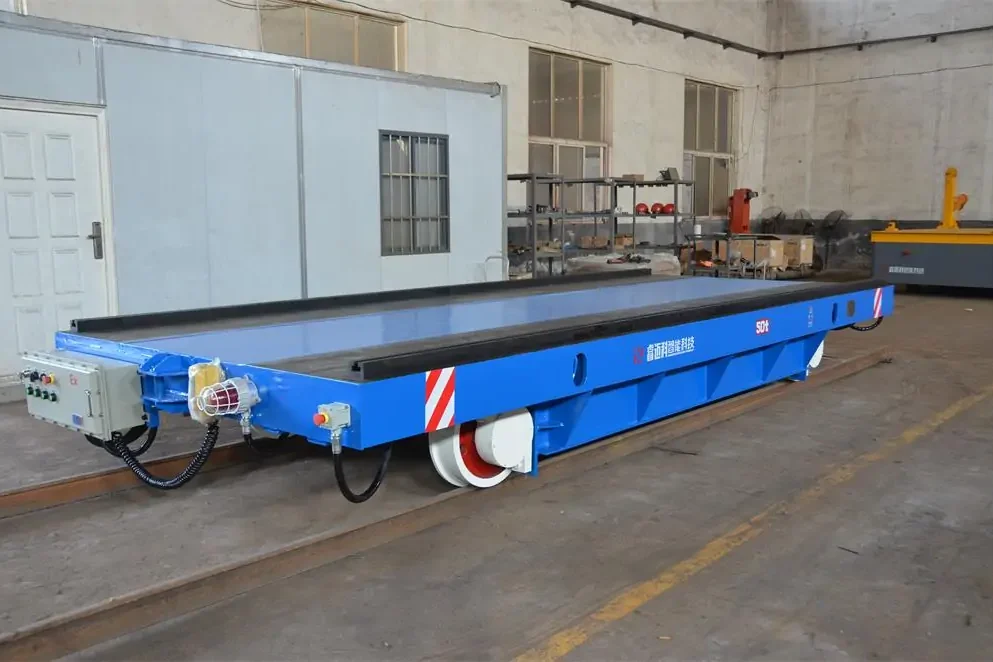
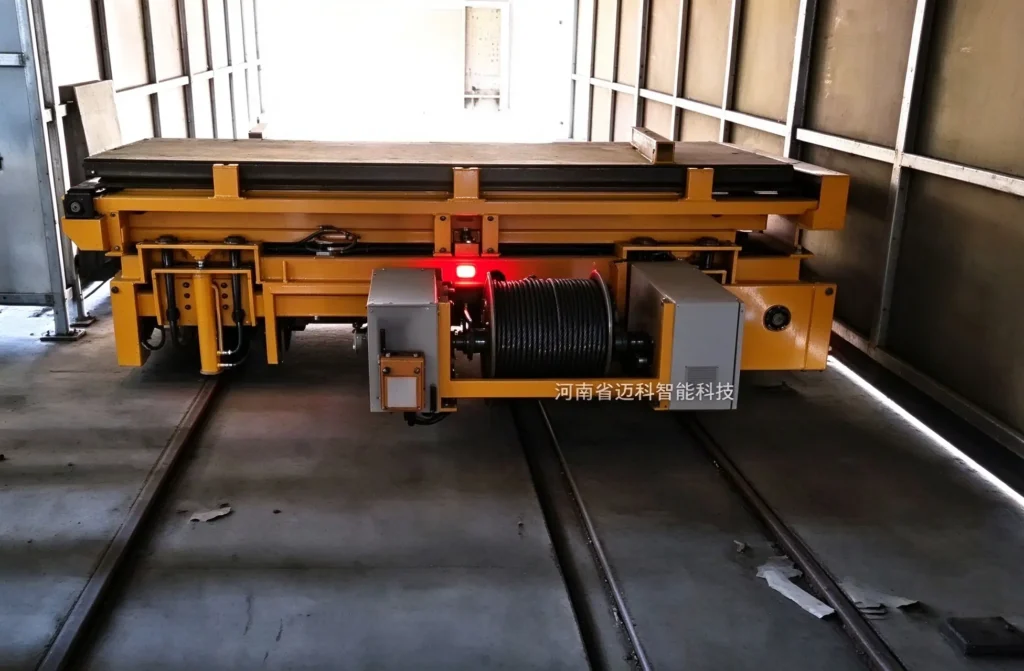
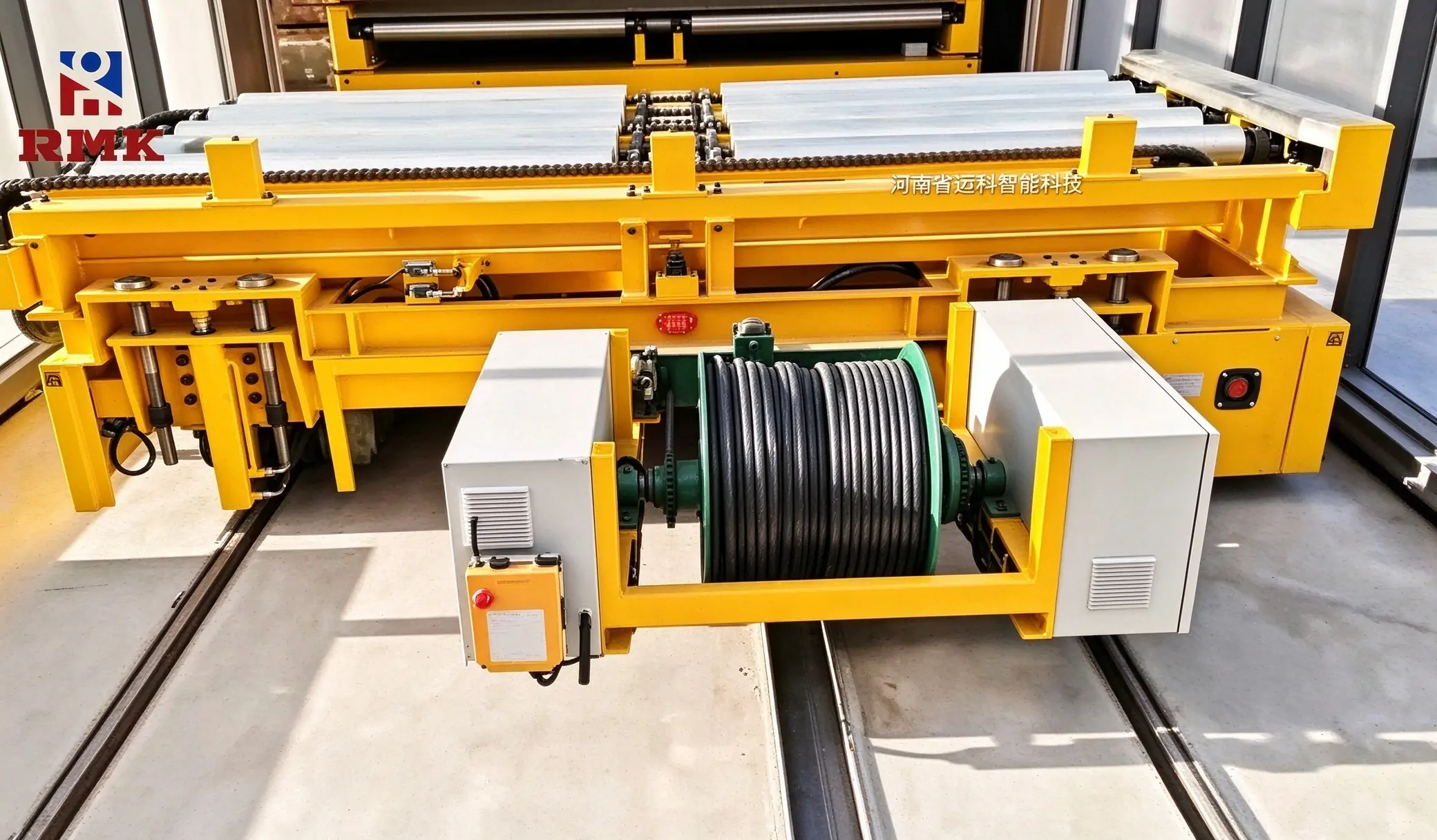
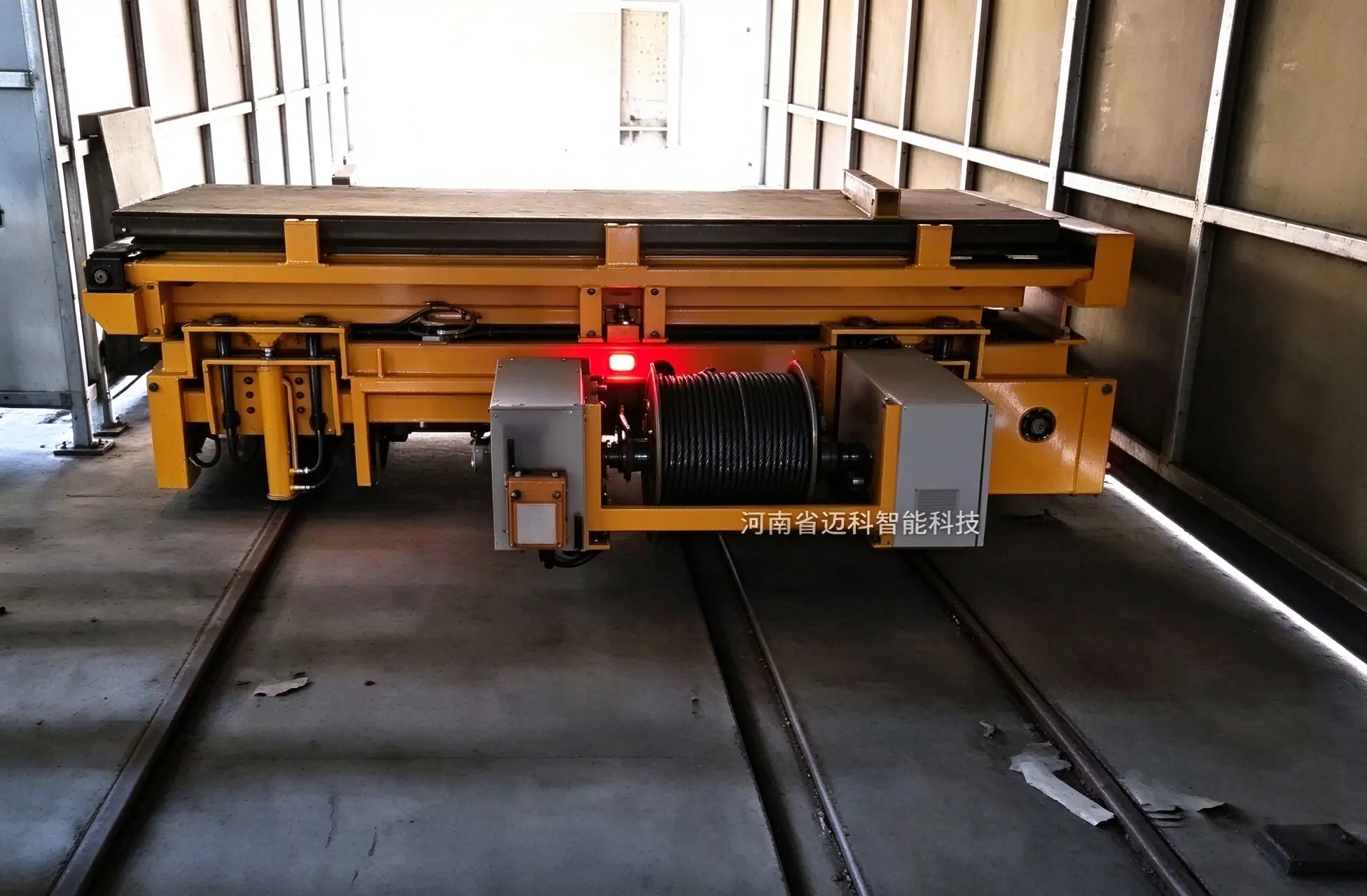
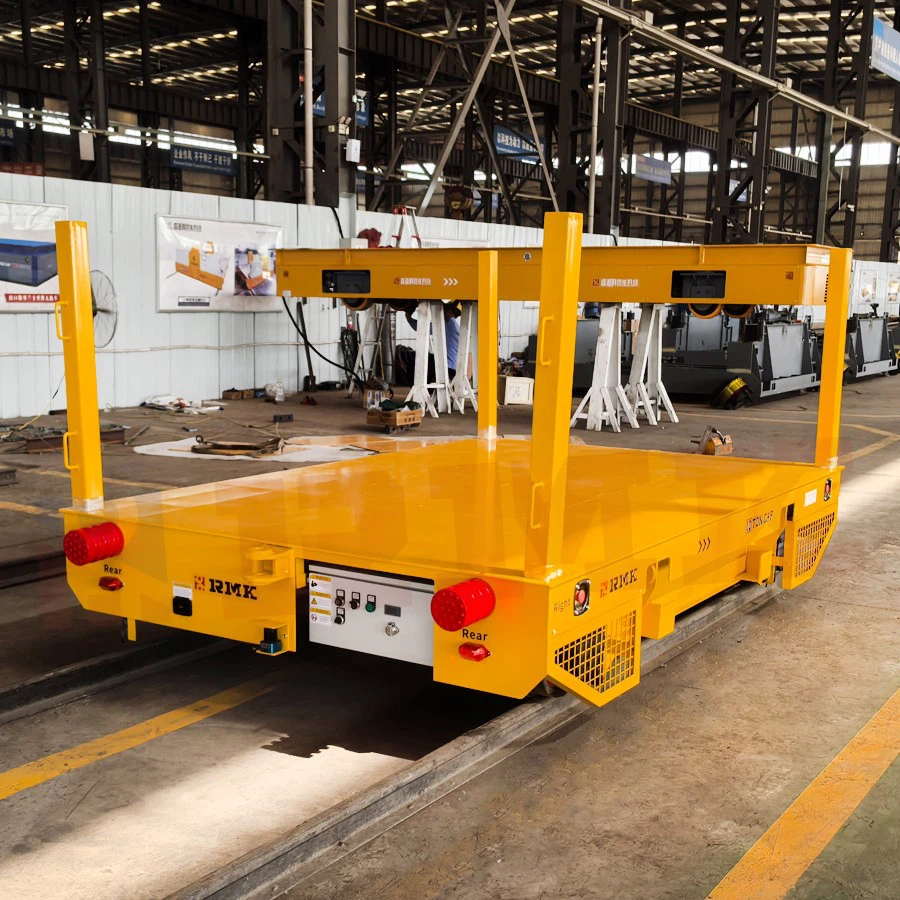
El carro de transferencia RMK sobre rieles, alimentado mediante enrollador de cable, está diseñado para la manipulación de cargas pesadas en recorridos fijos sobre rieles. La alimentación externa de CA llega al carro a través de un cable móvil gestionado por un enrollador automático, lo que permite ciclos de transporte frecuentes sin necesidad de recargar baterías de tracción. Es adecuado para transportar materiales de acero, moldes, componentes de maquinaria y otras cargas pesadas en instalaciones industriales.
- Capacidad de carga nominal: Según el proyecto; los diseños especiales para cargas pesadas requieren una revisión de ingeniería
- Fuente de alimentación: Alimentación externa de CA mediante enrollador de cable
- Velocidad de funcionamiento: Personalizado según los requisitos de operación
- Modo de control: Pendant / Mando inalámbrico / PLC
¿Qué es un carro de transferencia sobre rieles alimentado mediante enrollador de cable?
Cada carro de transferencia sobre rieles alimentado mediante enrollador de cable se diseña para adaptarse a condiciones de operación específicas. La capacidad de carga, las dimensiones de la plataforma, el ancho de vía, el sistema de enrollador de cable y la configuración de accionamiento son personalizables. Se ofrecen plataformas planas, plataformas en V, mesas de rodillos y dispositivos especiales de manipulación de cargas según los requisitos de la carga y de la producción. Hay opciones de control mediante botonera colgante, mando inalámbrico y PLC.
Un carro de transferencia sobre rieles alimentado mediante enrollador de cable, también conocido como carro de transferencia con enrollador de cable o carro de transferencia sobre rieles de la serie KPJ, es un vehículo eléctrico de manipulación de materiales diseñado para transportar cargas pesadas sobre rieles fijos. Utiliza una alimentación externa de CA transmitida a través de un cable móvil, con un enrollador de cable montado en el carro para enrollar y desenrollar automáticamente el cable durante la operación.
El sistema de enrollador de cable suministra energía de forma continua al motor de accionamiento y al sistema de control eléctrico mientras el carro se desplaza hacia adelante o hacia atrás. A diferencia de los carros de transferencia alimentados por batería, no depende de la capacidad de una batería a bordo ni de ciclos de carga. A diferencia de los carros alimentados por rieles de baja tensión, recibe energía a través de un cable flexible en lugar de rieles conductores.
Los carros de transferencia sobre rieles alimentados mediante enrollador de cable se utilizan en fábricas, plantas siderúrgicas, almacenes e instalaciones de producción donde se requieren rutas de transporte fijas y ciclos de funcionamiento frecuentes. La capacidad de carga, la distancia de recorrido, la configuración del enrollador de cable y el diseño de la plataforma pueden adaptarse a la disposición de transporte y a las condiciones de trabajo.
Especificaciones técnicas del carro de transferencia sobre rieles alimentado mediante enrollador de cable
| Parámetro | Configuración de referencia |
|---|---|
| Capacidad de carga nominal | Según el proyecto; los diseños especiales para cargas pesadas requieren una revisión de ingeniería |
| Dimensiones de la plataforma (L × An × Al) | Especificadas según la carga y la disposición de carga |
| Fuente de Alimentación | CA 380 V, 50 Hz |
| Velocidad de funcionamiento | 0–30 m/min |
| Ilimitada | Hasta 200 m (según la configuración del enrollador de cable) |
| Tipo sobre riel | Rieles de acero de las series P / QU |
| Sistema de transmisión | Motor de CA + reductor |
| Tipo con carrete de cable | Accionado por resorte / Motorizado |
| Modo de Control | Pendant / Mando inalámbrico / PLC |
| Tipo de plataforma | Plana / En V / De rodillos |
| Material de la rueda | Acero fundido |
| Estructura del bastidor | Viga cajón de acero soldado |
| Dispositivos de seguridad | Parada de emergencia / Alarma acústica y visual |
| Entorno Operativo | Interior / Exterior |
Nota: Estos son rangos de diseño de referencia, no las especificaciones de un único modelo estándar. Los parámetros finales dependen de la carga, la disposición de los rieles, la alimentación eléctrica, la longitud del cable y las condiciones de funcionamiento. Para proyectos especiales pueden evaluarse capacidades y distancias de recorrido superiores a los rangos indicados.
Estructura y componentes principales del carro de transferencia sobre rieles alimentado mediante enrollador de cable
Un carro de transferencia sobre rieles alimentado mediante enrollador de cable consta de un bastidor de acero soldado, un conjunto de enrollador de cable, un cable móvil, un sistema de accionamiento, ruedas de acero y componentes de control eléctrico. Cada componente se selecciona según la carga nominal, la disposición de los rieles, la distancia de recorrido y las condiciones de funcionamiento.
| Componente | Función |
|---|---|
| Bastidor de acero: | Una estructura de vigas cajón soldadas diseñada para soportar la carga nominal y distribuir el peso entre los conjuntos de ruedas. |
| Sistema de enrollador de cable: | Montado en el carro para enrollar y desenrollar el cable móvil durante el desplazamiento; está disponible en configuraciones accionadas por resorte o motorizadas. |
| Cable móvil: | Transmite la energía eléctrica desde la alimentación externa al carro; la longitud, la sección y el radio de curvatura del cable se especifican según la distancia de recorrido y el diseño del enrollador. |
| Motor de accionamiento y transmisión: | El motor eléctrico y el reductor transmiten el par de accionamiento a las ruedas para controlar el desplazamiento hacia delante y hacia atrás. |
| Ruedas de acero: | Sostienen el carro y la carga, y transfieren la carga a los rieles a través de los conjuntos de ruedas. |
| Sistema de Control Eléctrico: | Gestiona la distribución de energía, el funcionamiento del motor, el control de velocidad, la dirección de desplazamiento y la protección eléctrica. |
| Sistema de mando: | Permite el mando mediante botonera colgante, control remoto inalámbrico o PLC, según el proceso de manipulación. |
Configuraciones opcionales de plataforma y manipulación:
- Plataforma en V: Mantiene en posición bobinas de acero, tuberías y otras cargas cilíndricas.
- Plataforma de rodillos: Se conecta con las líneas de producción para la carga y descarga de materiales.
- Plataforma elevadora hidráulica: Eleva la carga hasta la altura de trabajo requerida.
- Dispositivos de sujeción a medida: Posicionan y aseguran piezas especiales durante el transporte.
El bastidor, el sistema de accionamiento y el conjunto del tambor enrollacables constituyen la estructura funcional principal del carro. Los tipos de plataforma, los mecanismos de elevación, los dispositivos de sujeción y las opciones de control se configuran según las dimensiones de la carga, el proceso de manipulación y los requisitos del emplazamiento.
Funcionamiento de un carro de transferencia sobre rieles alimentado mediante tambor enrollacables
Un carro de transferencia sobre rieles alimentado mediante tambor enrollacables recibe energía eléctrica de una fuente externa de CA a través de un cable móvil conectado al tambor enrollacables instalado en el carro. A medida que el carro se desplaza por los rieles fijos, el tambor desenrolla o enrolla el cable para gestionar su longitud y mantener la conexión eléctrica. El sistema de control eléctrico regula el funcionamiento del motor, la dirección de desplazamiento y la velocidad.
Proceso de trabajo:
- Conexión eléctrica: La alimentación externa de CA se suministra al carro a través del cable móvil.
- Desenrollado del cable: A medida que el carro se aleja del punto de conexión eléctrica, el tambor desenrollacables libera la longitud de cable necesaria.
- Control eléctrico: The control cabinet distributes power to the drive motors and control circuits.
- Motor Drive: The motor transmits torque through the gearbox to the wheel assemblies.
- Rail Movement: The cart travels forward or backward along the rails according to the operator’s commands.
- Cable Retraction: As the cart moves toward the power connection, the reel retrieves cable to control slack and reduce the risk of tangling.
On a cable reel powered rail transfer cart, the reel maintains the electrical connection throughout movement. Spring-driven and motorized cable reels use different winding and release mechanisms; the selection depends on travel distance, operating speed, cable specifications, and installation conditions.
Advantages of Cable Reel Power
Continuous External Power Supply
Draws power from an external AC source through a traveling cable, eliminating dependence on onboard battery capacity and charging cycles.
No Onboard Battery Maintenance
Eliminates traction battery replacement, charging equipment, and routine battery maintenance.
Suitable for Frequent Operations
Supports repeated transport cycles and extended operating hours on fixed rail routes in industrial production facilities.
Controlled Rail-Guided Movement
Steel wheel assemblies follow fixed tracks, maintaining a defined travel path for heavy material handling between designated workstations.
Flexible Platform Design
Available with flat decks, V-shaped platforms, roller tables, and custom fixtures for different cargo dimensions and loading requirements.
Configurable Cable Reel System
Spring-driven and motorized cable reels accommodate different cable lengths, travel speeds, and installation layouts.
Industrial Applications
Cable Reel Powered Rail Transfer Carts are used in industrial facilities with fixed transport routes and frequent heavy-load handling requirements. Platform structures and load capacities are selected according to the materials, production processes, and site layout.
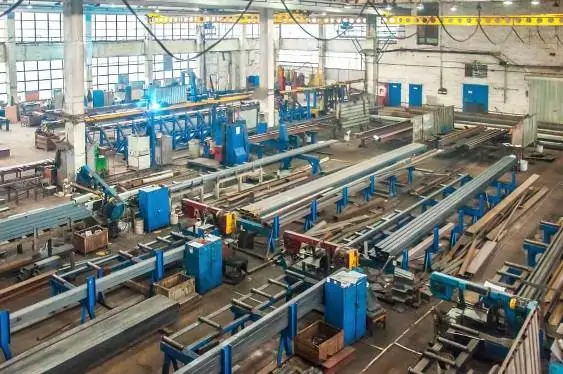
Acerías
Transport steel coils, plates, billets, and other heavy metal materials between production areas. V-shaped platforms are available for cylindrical loads.
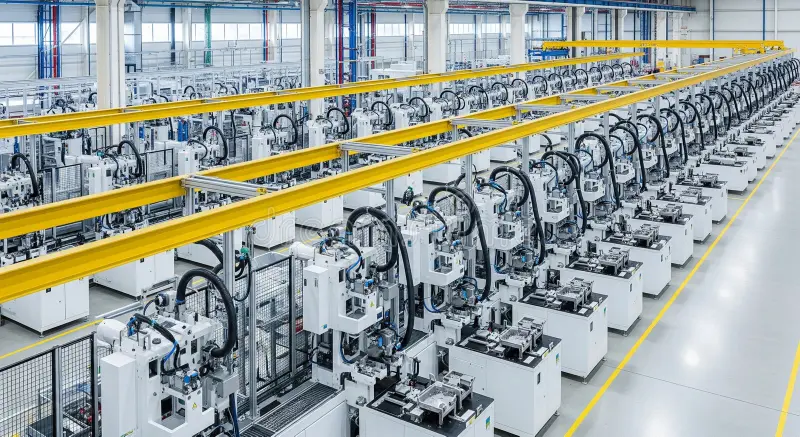
Fabricación de maquinaria
Move machine components, heavy equipment bases, steel structures, and assembled parts between machining and assembly workstations.
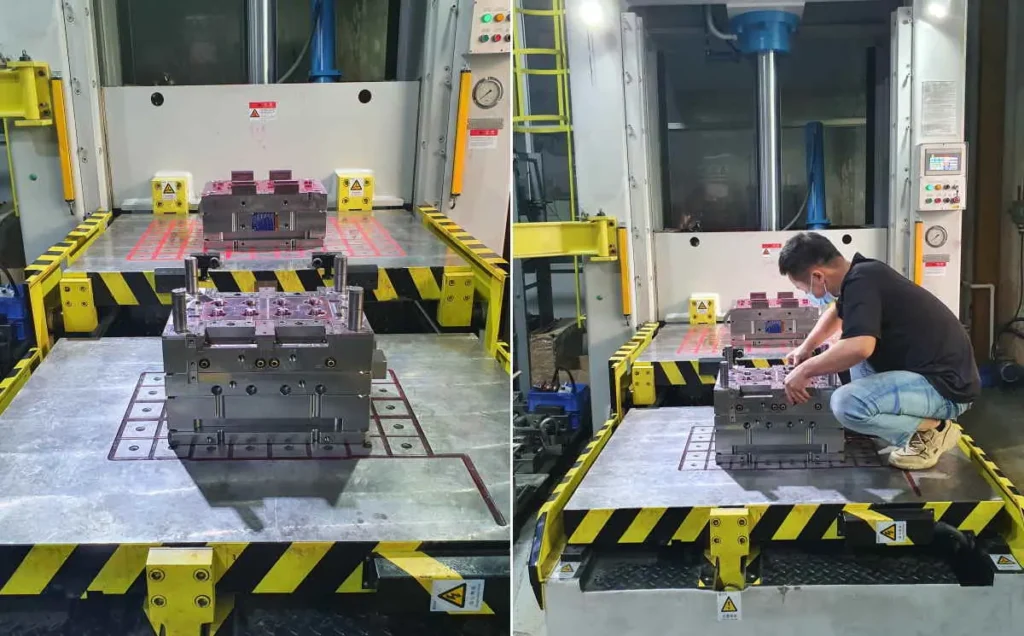
Mold Workshops
Transfer injection molds, stamping dies, and other heavy tooling between storage areas, maintenance stations, and production machines.
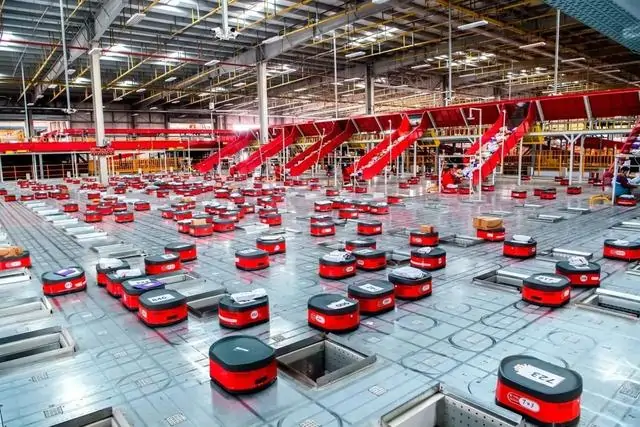
Production Lines
Transport workpieces between designated processing stations. Roller platforms can be configured for loading and unloading at production line interfaces.
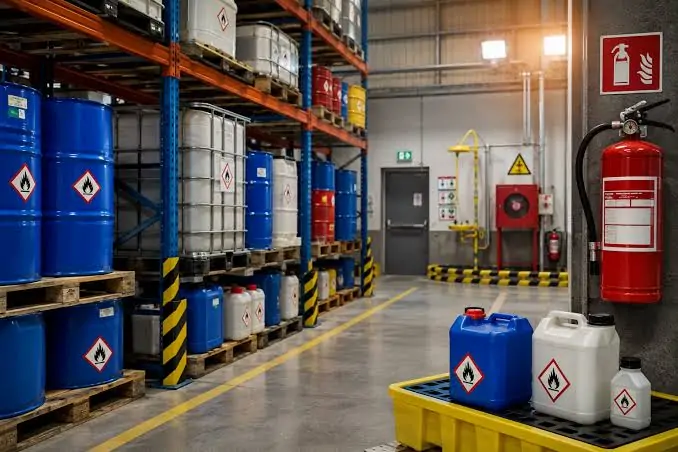
Warehouses and Storage Facilities
Handle heavy materials, industrial components, and packaged goods between storage zones, loading areas, and dispatch stations.
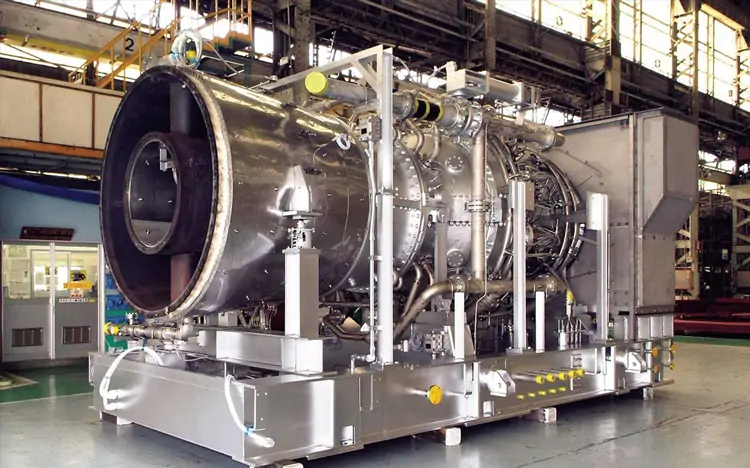
Construcción naval y fabricación de equipos pesados
Move large structural components, equipment sections, and fabricated assemblies across designated workshop and assembly areas.
How to Choose a Cable Reel Powered Rail Transfer Cart
Selecting a cable reel powered rail transfer cart requires checking the cargo specifications, rail layout, power supply, and operating conditions.
- Load Capacity and Cargo Dimensions: Specify the maximum cargo weight, overall dimensions, center of gravity, and load distribution. The rated capacity must cover the total working load.
- Rail Layout and Travel Distance: Provide the rail length, gauge, track alignment, and turning radius. Straight and curved track layouts require different wheel and cable routing arrangements.
- Cable Reel Configuration: Select a spring-driven or motorized cable reel according to travel distance, operating speed, cable length, and installation position. Cable diameter and minimum bending radius must match the reel specifications.
- Power Supply Requirements: Confirm the available voltage, frequency, phase configuration, and power connection location. Motor power and cable cross-section must match the electrical load.
- Operating Speed and Control: Define the required travel speed, positioning accuracy, and operating cycle. Pendant control, wireless remote control, or PLC integration can be selected according to the production process.
- Trayectoria y Modo de Operación: Specify indoor or outdoor operation, ambient temperature, dust, moisture, and exposure to heat or corrosive substances. Special electrical protection and structural modifications require project assessment.
Cable Routing and Power Connection Layout
A cable reel powered rail transfer cart receives electricity through a flexible cable connected to a fixed supply point. The onboard reel pays out or retrieves the cable as the cart moves. The supply point, reel position, and cable path should be planned together across the full travel route. Our guide to cable transfer carts explains the main cable supply arrangements and their applications.
Power Connection Location
Select the connection point according to the track layout, available electrical supply, and required working range. Include the cable length needed between the connection point and the cart at each end of its travel.
Cable Path
Check the payout direction, cable guides, and clearance from wheels, drive components, and loading equipment. The route should avoid sharp edges, excessive twisting, and bends tighter than the cable manufacturer’s permitted radius.
Workshop Traffic
Identify crossings with forklift routes, pedestrian aisles, and loading areas. Where crossings cannot be avoided, assess a recessed channel, a suitable protective cover, or another engineered routing arrangement. Any protection must accommodate cable movement without trapping, crushing, or abrading the cable.
Cable Selection and Protection
Use a cable rated for the selected reeling arrangement and operating conditions. Check allowable tension, repeated bending, abrasion, temperature, and exposure to moisture or chemicals. The cable guides and reel geometry must be compatible with the selected cable.
Maintenance Access
Leave enough space to inspect the drum, guides, electrical connections, and reel drive. Cable replacement and maintenance should be possible with the equipment stopped and its electrical supply isolated.
Spring-Driven and Motorized Cable Reels
Both spring-driven and motorized reels can manage the power cable on a rail transfer cart. Selection depends on the required cable length, cable weight, travel speed, acceleration, operating cycle, and allowable cable tension. The ratings of the proposed reel matter more than a general distinction between short and long routes.
| Factor de selección | Spring-Driven and Motorized Reel Considerations |
|---|---|
| Método de Impulsión | Spring-driven reels use stored spring energy to retrieve the cable. Motorized reels use an electric drive to control retrieval and, where provided by the design, cable payout. |
| Cable Length and Weight | Spring-driven reels are often considered for shorter runs and lighter cables, provided that spring torque remains suitable throughout the working range. Motorized reels can accommodate longer or heavier cable arrangements when the drum, drive and supporting structure are sized accordingly. Neither type has a universal travel-distance limit. |
| Travel Speed and Tension | A spring-driven reel must maintain acceptable cable tension as the effective drum radius and spring torque change. A motorized reel uses its drive and control arrangement to manage winding torque or speed. For either type, the permitted travel speed and acceleration must be checked against the reel ratings and cable limits. |
| Frecuencia de Operación | Check the rated duty of the spring mechanism or motorized drive against the expected transport cycles. Frequent starts, reversals and extended operation require an assessment of component life, thermal limits and winding performance. A motorized reel should not be assumed to support continuous duty unless its ratings confirm this. |
| Mantenimiento | Spring-driven reels require inspection of the spring mechanism, guides, drum and cable condition. Motorized reels also require inspection of the motor, transmission, and controls fitted to the selected assembly. Electrical transfer components, including slip rings where fitted, should be included in the maintenance plan. |
When specifying a cable reel powered rail transfer cart, confirm usable cable capacity, winding torque, allowable tension, cable diameter and minimum bending radius. The reel supplier should verify the proposed operating cycle against the selected assembly.
Factors Affecting Travel Distance
The effective travel distance of a cable reel powered rail transfer cart is not simply the total cable length. Connection leads, the cable path and any turns that must remain on the drum reduce the length available for working travel. The position of the fixed supply point also changes the relationship between cable payout and cart movement.
- Usable Reel Capacity
Drum diameter, winding width, cable diameter, and the permitted number of cable layers determine storage capacity. The usable working length must also allow for the reel manufacturer’s required residual turns or other retention provisions. - Supply Point Position
Calculate the cable path from the fixed connection to the cart throughout the route. An end-fed layout and a centrally fed layout may require different payout and retrieval arrangements. The maximum working range must be checked against the actual geometry rather than inferred from cable length alone. - Connection and Routing Allowances
Allow for fixed connections, cable guides, bends and transitions. Trenches, obstacles and protective structures may increase the required path length. Reserve cable must be managed so that it does not create uncontrolled slack or interfere with the cart. - Voltage Drop and Cable Heating
Check conductor size, circuit length, operating current and connection resistance against the permitted voltage drop, including motor starting conditions. Cable current ratings must also account for the installation method, ambient temperature, and operation with cable remaining wound on the reel.
The specified operating range should satisfy both the mechanical payout requirements and the electrical limits. For longer routes or demanding operating cycles, verify reel torque, cable tension, starting voltage, and thermal duty before confirming the configuration.
Comparison of Transfer Cart Power Supply Types
| Fuente de Alimentación | Power Arrangement | Aplicación |
|---|---|---|
| Alimentado por Carrete de Cable | Main Characteristics: External power transmitted through a retractable cable | Suitable Conditions: Fixed routes with suitable cable management |
| Alimentado por batería | Main Characteristics: Onboard battery supplies electrical power | Suitable Conditions: Fixed rail routes without trailing power cables |
| Low Voltage Rail Powered | Main Characteristics: Power transmitted through conductive rails | Suitable Conditions: Fixed routes with dedicated rail power infrastructure |
The final selection should account for route layout, operating frequency, electrical installation and maintenance requirements. Compare low-voltage rail power when a traveling cable is impractical, or review the full electric rail transfer cart range.
Custom Cable Reel Powered Rail Transfer Cart Options
RMK designs cable reel powered rail transfer carts around cargo specifications, transport routes, and site operating conditions. Customization covers the cart structure, loading platform, cable reel system, drive configuration, electrical controls, and production line interfaces.
- Load Capacity and Frame Design: Frame dimensions, structural reinforcement, and wheel load distribution are designed around the rated load, cargo dimensions, and center of gravity.
- Platform and Loading Configuration: Platform length, width, and height can be customized. Options include flat decks, V-shaped platforms, roller tables, hydraulic lifting platforms, and special fixtures for different loading and unloading methods.
- Cable Reel and Power System: Spring-driven or motorized cable reels are selected based on cable length, cable specifications, travel speed, and installation layout. Power voltage and cable cross-section are matched to the site supply.
- Rail Layout and Wheel Configuration: Rail gauge, wheelbase, wheel diameter, wheel quantity, and track arrangement are specified for the transport route, track structure, and floor layout.
- Drive System and Operating Performance: Motor power, gearbox ratio, braking system, travel speed, and operating duty are configured for the rated load and required transport cycles.
- Control and Positioning System: Pendant control, wireless remote control and PLC integration are available. Limit switches, positioning sensors, fixed-point stopping, and automatic travel control can be specified for the operating process.
- Safety and Environmental Protection: Emergency stops, audible and visual alarms, travel limit switches, and electrical protection devices can be configured. Anti-corrosion, dust protection, heat-resistant, and explosion-proof designs require assessment of site conditions.
- Multi-Cart and Production Line Integration: Multiple-cart coordination, equipment interlocking, PLC communication, and production line interfaces can be designed for projects requiring coordinated material handling.
RMK provides equipment design and manufacturing based on approved project specifications. Final dimensions, component selections, electrical parameters, and optional functions are confirmed in the technical proposal and engineering drawings.
Cable Reel Powered Rail Transfer Cart Manufacturer & Supplier
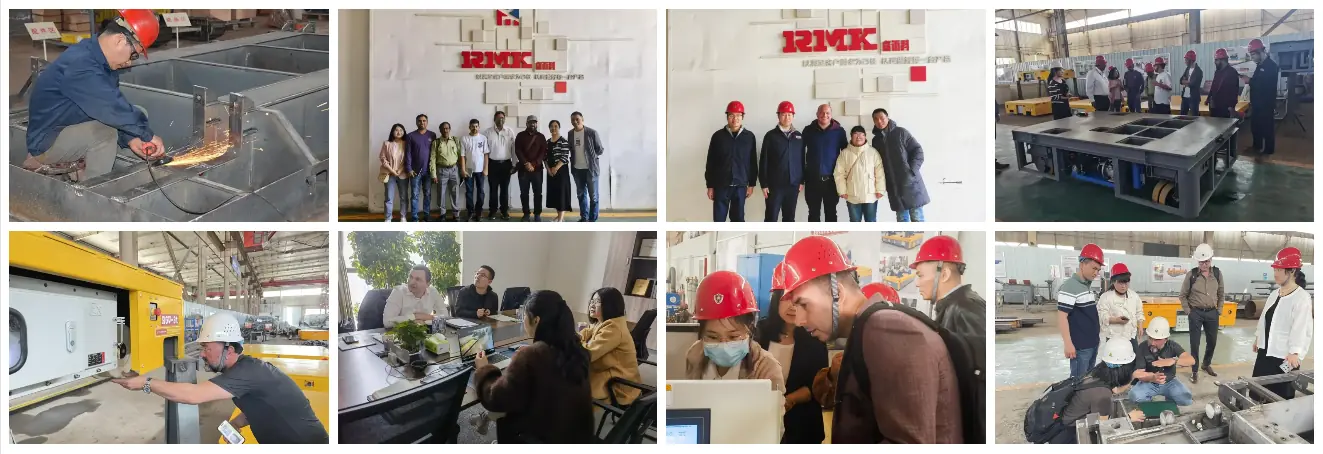
REMARKABLE is a manufacturer and supplier of cable reel powered rail transfer carts for industrial material handling. The company provides customized transfer cart solutions for different load capacities, platform dimensions, rail layouts, power supply systems, and operating conditions. Contact RMK to request the technical documentation and conformity information available for the proposed model and destination market.
REMARKABLE provides project consultation, equipment design, manufacturing, installation guidance, operation training, and after-sales technical support for overseas customers. Warranty service is provided under the agreed product warranty terms. Contacte a REMARKABLE with your cargo specifications, transport route, and site requirements to discuss a cable reel powered rail transfer cart for your project.
PREGUNTAS FRECUENTES
What is a cable reel powered rail transfer cart?
A cable reel powered rail transfer cart is an electric material handling vehicle that travels on fixed rails and receives external power through a traveling cable managed by an onboard cable reel.
How does a cable reel powered rail transfer cart work?
External AC power passes through the traveling cable to the cart’s electrical system. The motor drives the wheels through a gearbox, while the cable reel releases or winds the cable during travel.
What is the load capacity of a cable reel powered rail transfer cart?
Load capacities vary by model and design. RMK provides customized configurations for different industrial loads. The rated capacity must be confirmed against the selected model and actual cargo specifications.
How far can a cable reel powered rail transfer cart travel?
Travel distance depends on cable length, reel capacity, winding speed and cable routing. The required distance should be specified during design to determine the appropriate reel and cable configuration.
What types of cable reels are used on rail transfer carts?
Common types include spring-driven and motorized cable reels. Spring-driven reels use mechanical spring force for cable retraction, while motorized reels use an electric drive for controlled winding.
Can a cable reel powered rail transfer cart operate continuously?
It can support extended operation with external power. Continuous duty depends on motor ratings, cooling capacity, cable specifications and the electrical system’s operating limits.
Can a cable reel powered rail transfer cart run on curved tracks?
Yes, with a suitable design. Track radius, wheel arrangement, cable routing, and reel position must be evaluated. Not all standard configurations support curved-track operation.
What information is needed to customize a cable reel powered rail transfer cart?
Provide the cargo weight and dimensions, rail layout, travel distance, power supply, required speed, control mode, and operating environment. These details form the basis for equipment design.
Related Rail Transfer Cart Articles


Discuss Your Transfer Cart Requirements
Send the cargo weight and dimensions, rail layout, travel distance, operating cycle, and available power supply. RMK can review the application and prepare a configuration and quotation with a defined scope of supply. For the main cost factors, see our electric transfer cart pricing guide.
- Carga: Cargo and fixture weights, dimensions, and load positions
- Track: Rail gauge, profile, route length and curve radii
- Duty: Trips per shift, travel speed and stopping requirements
- Site: Available power, loading method and working environment