
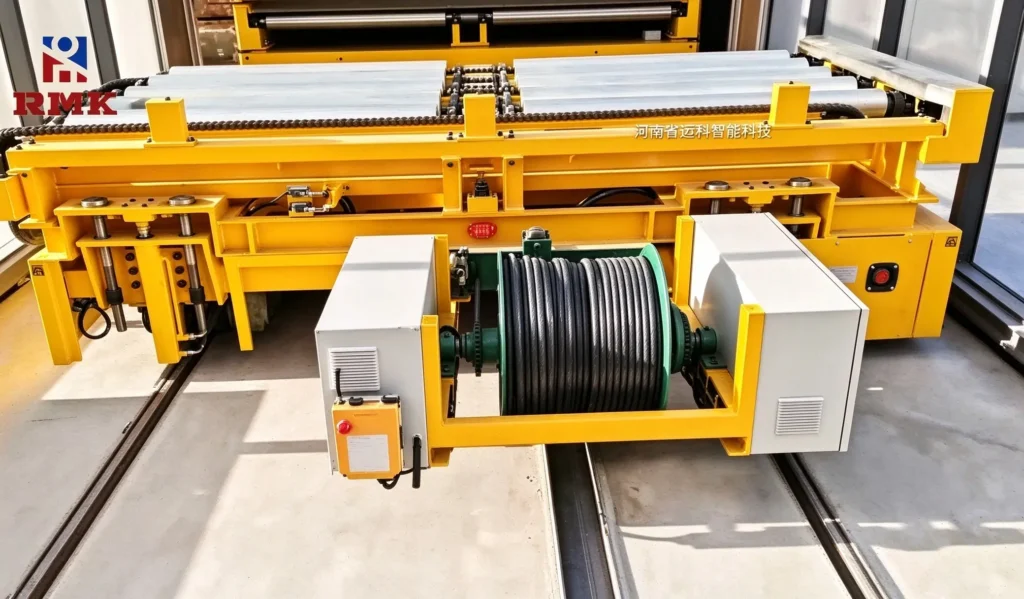
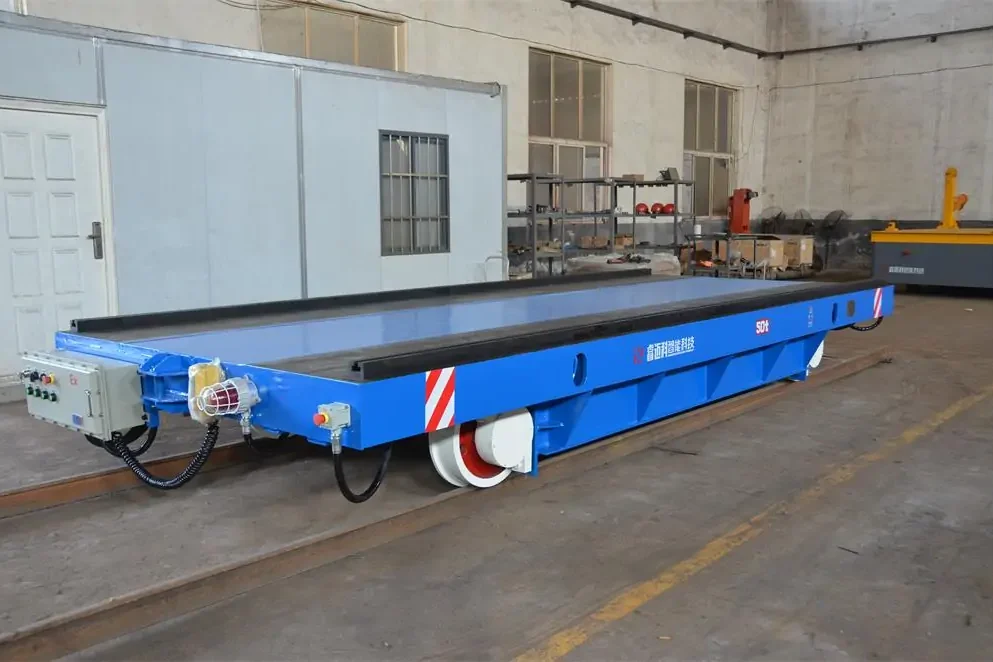
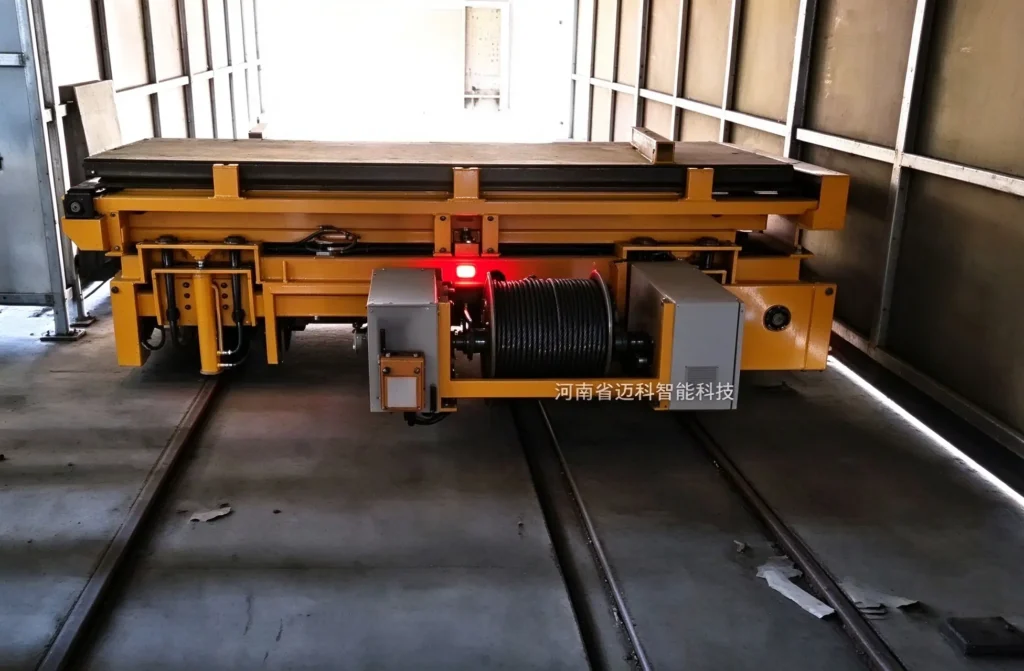
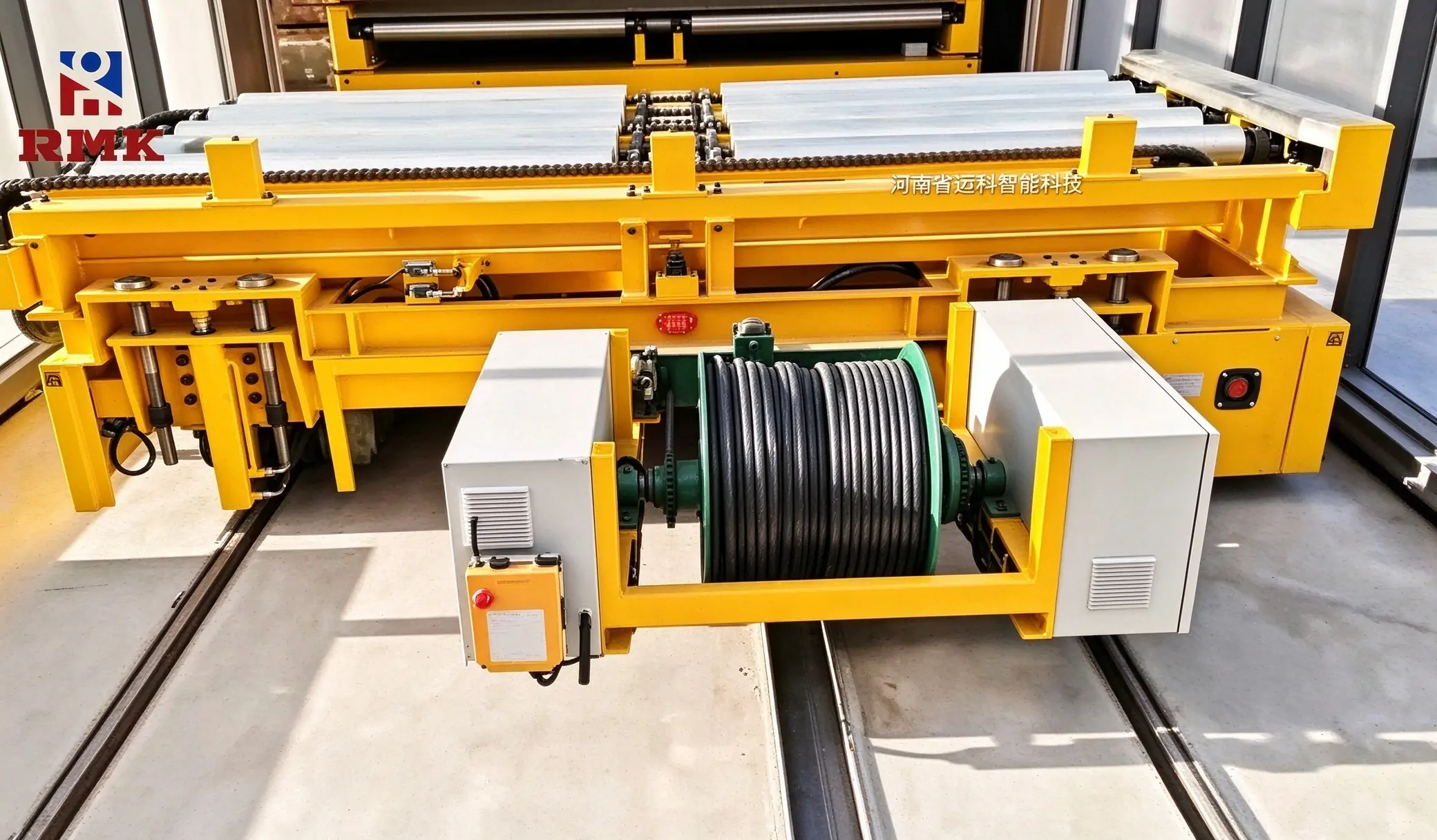
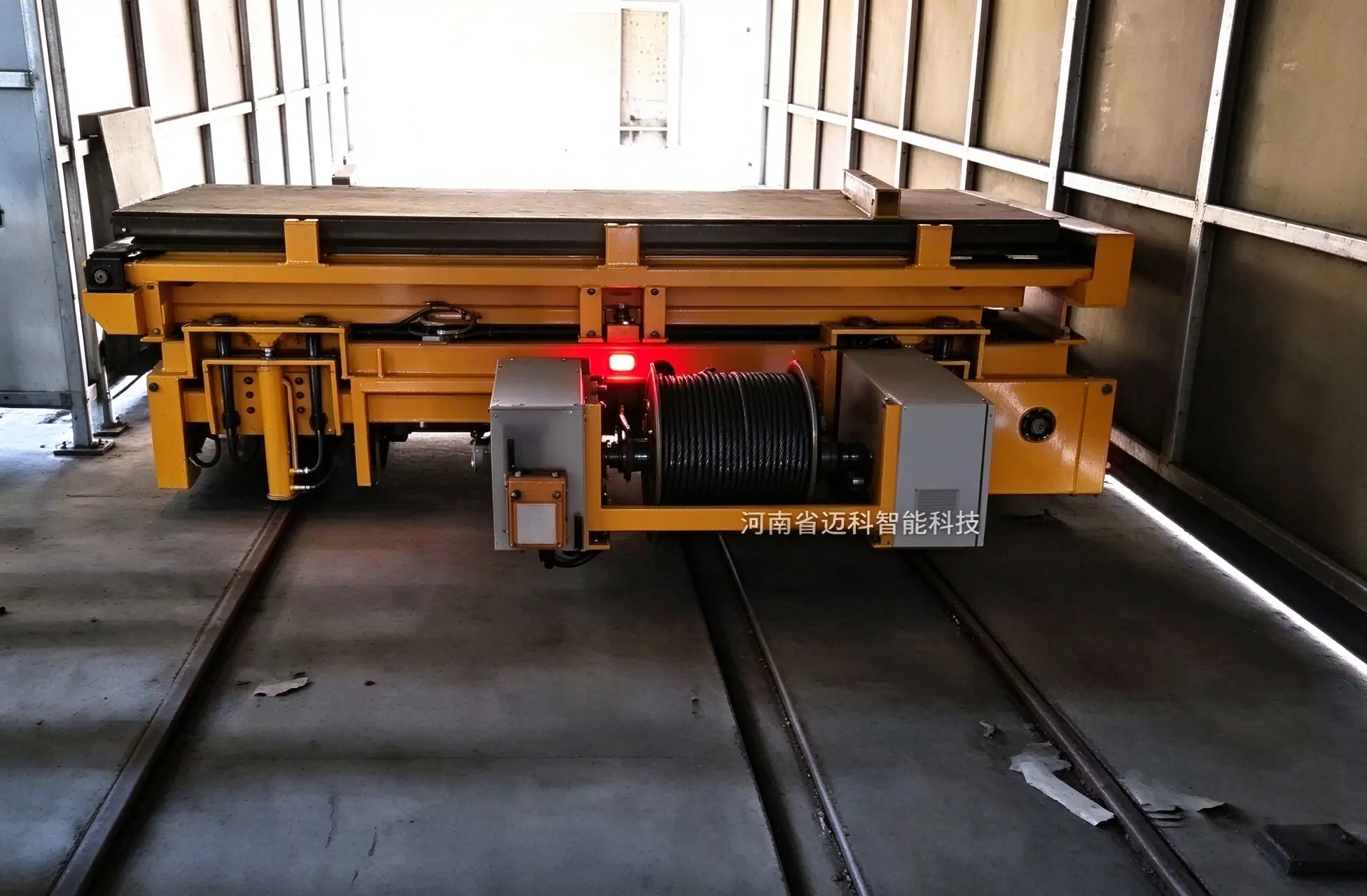
Der schienengebundene Transferwagen RMK mit Kabeltrommelversorgung ist für den Schwerlasttransport auf festen Schienenstrecken ausgelegt. Die externe Wechselstromversorgung erfolgt über ein Schleppkabel, das von einer automatischen Kabeltrommel geführt wird. Dadurch sind häufige Transportzyklen ohne Laden einer Traktionsbatterie möglich. Der Wagen eignet sich für den Transport von Stahlmaterialien, Formen, Maschinenkomponenten und anderen schweren Lasten innerhalb von Industrieanlagen.
- Nenntragfähigkeit: Projektspezifisch; Sonderausführungen für schwere Lasten erfordern eine technische Prüfung
- Stromversorgung: Externe Wechselstromversorgung über Kabeltrommel
- Batterie, Kabeltrommel, Schleifleitung, Niederspannungsschiene usw. An die Betriebsanforderungen angepasst
- wie V-Rahmen, U-Kanal oder verstellbarer Stützrahmen. Hängepult / Funkfernbedienung / SPS
Was ist ein schienengebundener Transferwagen mit Kabeltrommelversorgung?
Jeder schienengebundene Transferwagen mit Kabeltrommelversorgung wird für die jeweiligen Betriebsbedingungen ausgelegt. Tragfähigkeit, Plattformabmessungen, Spurweite, Kabeltrommelsystem und Antriebskonfiguration sind anpassbar. Je nach Transportgut und Produktionsanforderungen stehen Flachplattformen, V-förmige Plattformen, Rollentische und spezielle Lastaufnahmeeinrichtungen zur Verfügung. Als Steuerungsoptionen stehen Hängetaster, Funkfernsteuerung und SPS-Steuerung zur Verfügung.
Ein schienengebundener Transferwagen mit Kabeltrommelversorgung, auch als Transferwagen mit Kabeltrommel oder schienengebundener Transferwagen der KPJ-Serie bezeichnet, ist ein elektrisch angetriebenes Transportfahrzeug für schwere Lasten auf festen Schienen. Er wird über ein Schleppkabel mit externem Wechselstrom versorgt. Eine auf dem Wagen montierte Kabeltrommel wickelt das Kabel während des Betriebs automatisch auf und ab.
Das Kabeltrommelsystem versorgt den Fahrmotor und die elektrische Steuerung während der Vorwärts- und Rückwärtsfahrt kontinuierlich mit Strom. Anders als batteriebetriebene Transferwagen ist es nicht von der Kapazität einer an Bord befindlichen Batterie oder von Ladezyklen abhängig. Im Gegensatz zu Wagen mit Niederspannungs-Schienenversorgung erfolgt die Stromzufuhr über ein flexibles Kabel und nicht über stromführende Schienen.
Schienengebundene Transferwagen mit Stromversorgung über Kabeltrommel werden in Fabriken, Stahlwerken, Lagern und Produktionsanlagen eingesetzt, in denen feste Transportstrecken und häufige Fahrzyklen erforderlich sind. Tragfähigkeit, Fahrstrecke, Kabeltrommelausführung und Plattformgestaltung können an das Transportlayout und die Betriebsbedingungen angepasst werden.
Technische Daten des schienengebundenen Transferwagens mit Stromversorgung über Kabeltrommel
| Parameter | Referenzkonfiguration |
|---|---|
| Nennbelastbarkeit | Projektspezifisch; Sonderausführungen für schwere Lasten erfordern eine technische Prüfung |
| Plattformabmessungen (L × B × H) | Entsprechend dem Transportgut und der Beladungsanordnung festgelegt |
| Verwendet standardmäßige industrielle elektrische Komponenten. | AC 380 V, 50 Hz |
| Laufgeschwindigkeit | 0–30 m/min |
| Fahrstrecke | Bis zu 200 m (abhängig von der Kabeltrommelausführung) |
| Schienentyp | Stahlschienen der P-Serie / QU-Serie |
| Antriebssystem | Drehstrommotor + Getriebe |
| Kabeltrommeltyp | Federgetrieben / motorisch angetrieben |
| Steuerungsmodus | Hängepult / Funkfernbedienung / SPS |
| Plattformtyp | Flach / V-förmig / mit Rollen |
| Material der Räder | Stahlguss |
| Rahmenstruktur | Geschweißter Stahlkastenträger |
| Sicherheitseinrichtungen | Not-Halt / akustischer und optischer Alarm |
| Betriebsumgebung | Innen / Außen |
Hinweis: Dies sind Auslegungsbereiche zur Orientierung und keine technischen Daten eines einzelnen Standardmodells. Die endgültigen Parameter hängen von der Last, dem Schienenlayout, der Stromversorgung, der Kabellänge und den Betriebsbedingungen ab. Tragfähigkeiten und Fahrstrecken außerhalb der angegebenen Bereiche können für Sonderprojekte geprüft werden.
Aufbau und Hauptkomponenten des schienengebundenen Transferwagens mit Stromversorgung über Kabeltrommel
Ein schienengebundener Transferwagen mit Stromversorgung über Kabeltrommel besteht aus einem geschweißten Stahlrahmen, einer Kabeltrommeleinheit, einem Schleppkabel, einem Antriebssystem, Stahlrädern und elektrischen Steuerungskomponenten. Jede Komponente wird entsprechend der Nennlast, dem Schienenlayout, der Fahrstrecke und den Betriebsbedingungen ausgewählt.
| Komponente | Funktion |
|---|---|
| Stahlrahmen: | Eine geschweißte Kastenträgerkonstruktion, die zur Aufnahme der Nennlast und zur Verteilung des Gewichts auf die Radsätze ausgelegt ist. |
| Kabeltrommelsystem: | Auf dem Wagen montiert, um das Schleppkabel während der Fahrt auf- und abzuwickeln; federgetriebene und motorisch angetriebene Ausführungen sind verfügbar. |
| Schleppkabel: | Überträgt elektrische Energie von der externen Stromversorgung zum Wagen. Kabellänge, Querschnitt und Biegeradius werden entsprechend der Fahrstrecke und der Kabeltrommelausführung festgelegt. |
| Antriebsmotor und Getriebe: | Elektromotor und Getriebe übertragen das Antriebsdrehmoment auf die Räder und ermöglichen eine kontrollierte Vorwärts- und Rückwärtsfahrt. |
| Stahlräder: | Tragen den Wagen und die Ladung und übertragen die Last über die Radbaugruppen auf die Schienen. |
| Elektrisches Steuerungssystem: | Steuert die Stromverteilung, den Motorbetrieb, die Geschwindigkeit und die Fahrtrichtung sowie die elektrischen Schutzfunktionen. |
| Bediensystem: | Ermöglicht je nach Transportprozess die Bedienung über ein kabelgebundenes Bediengerät, eine Funkfernsteuerung oder eine SPS. |
Optionale Plattform- und Handhabungskonfigurationen:
- V-förmige Plattform: Hält Stahlcoils, Rohre und andere zylindrische Lasten in Position.
- Rollenplattform: Ermöglicht die Anbindung an Produktionslinien zum Be- und Entladen von Material.
- Hydraulische Hubplattform: Hebt die Ladung auf die erforderliche Arbeitshöhe.
- Kundenspezifische Vorrichtungen: Positionieren und sichern spezielle Werkstücke während des Transports.
Der Rahmen, das Antriebssystem und die Kabeltrommelbaugruppe bilden die funktionale Grundstruktur des Wagens. Plattformtypen, Hubmechanismen, Vorrichtungen und Steuerungsoptionen werden entsprechend den Abmessungen der Ladung, dem Transportprozess und den Standortanforderungen ausgelegt.
Funktionsweise eines schienengebundenen Transportwagens mit Kabeltrommel
Ein schienengebundener Transportwagen mit Kabeltrommel erhält elektrische Energie von einer externen Wechselstromquelle über ein mitgeführtes Kabel, das mit der Kabeltrommel auf dem Wagen verbunden ist. Während sich der Wagen auf den fest verlegten Schienen bewegt, spult die Trommel das Kabel ab oder auf, um dessen Länge anzupassen und die Stromverbindung aufrechtzuerhalten. Die elektrische Steuerung regelt den Motorbetrieb, die Fahrtrichtung und die Geschwindigkeit.
Arbeitsablauf:
- Stromanschluss: Der Wagen wird über das mitgeführte Kabel mit Wechselstrom aus einer externen Quelle versorgt.
- Kabelabwicklung: As the cart moves away from the power connection, the cable reel releases the required cable length.
- Electrical Control: The control cabinet distributes power to the drive motors and control circuits.
- Motor Drive: The motor transmits torque through the gearbox to the wheel assemblies.
- Rail Movement: The cart travels forward or backward along the rails according to the operator’s commands.
- Cable Retraction: As the cart moves toward the power connection, the reel retrieves cable to control slack and reduce the risk of tangling.
On a cable reel powered rail transfer cart, the reel maintains the electrical connection throughout movement. Spring-driven and motorized cable reels use different winding and release mechanisms; the selection depends on travel distance, operating speed, cable specifications, and installation conditions.
Advantages of Cable Reel Power
Continuous External Power Supply
Draws power from an external AC source through a traveling cable, eliminating dependence on onboard battery capacity and charging cycles.
No Onboard Battery Maintenance
Eliminates traction battery replacement, charging equipment, and routine battery maintenance.
Suitable for Frequent Operations
Supports repeated transport cycles and extended operating hours on fixed rail routes in industrial production facilities.
Controlled Rail-Guided Movement
Steel wheel assemblies follow fixed tracks, maintaining a defined travel path for heavy material handling between designated workstations.
Flexible Platform Design
Available with flat decks, V-shaped platforms, roller tables, and custom fixtures for different cargo dimensions and loading requirements.
Configurable Cable Reel System
Spring-driven and motorized cable reels accommodate different cable lengths, travel speeds, and installation layouts.
Industrial Applications
Cable Reel Powered Rail Transfer Carts are used in industrial facilities with fixed transport routes and frequent heavy-load handling requirements. Platform structures and load capacities are selected according to the materials, production processes, and site layout.
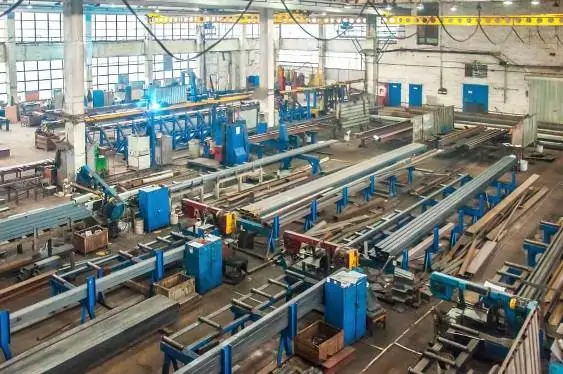
Stahlwerke
Transport steel coils, plates, billets, and other heavy metal materials between production areas. V-shaped platforms are available for cylindrical loads.
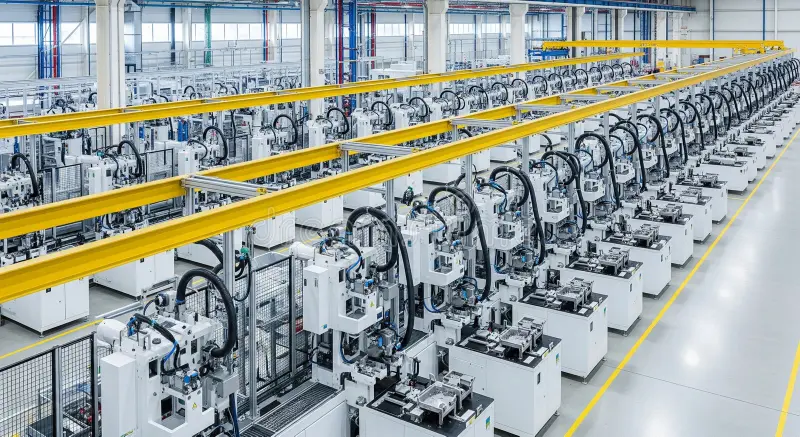
Maschinenbau
Move machine components, heavy equipment bases, steel structures, and assembled parts between machining and assembly workstations.
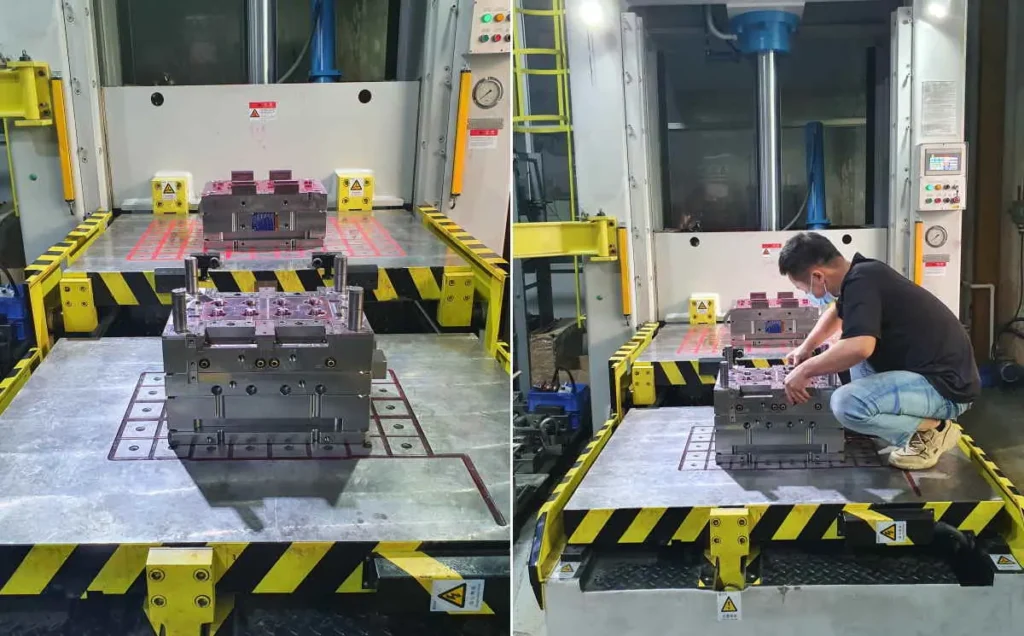
Mold Workshops
Transfer injection molds, stamping dies, and other heavy tooling between storage areas, maintenance stations, and production machines.
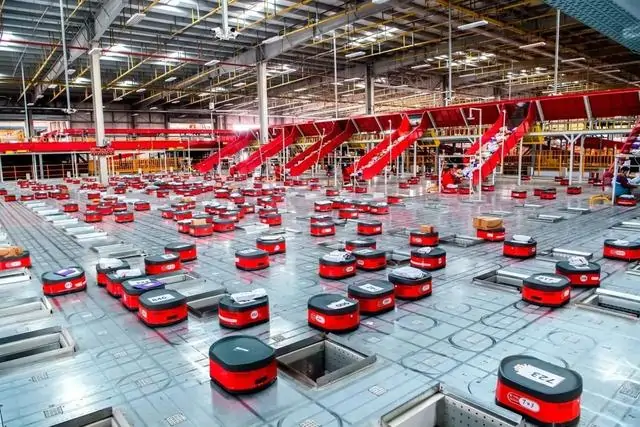
Production Lines
Transport workpieces between designated processing stations. Roller platforms can be configured for loading and unloading at production line interfaces.
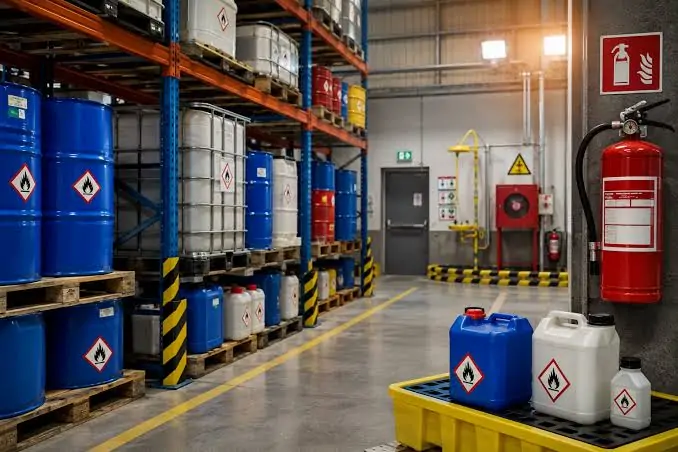
Warehouses and Storage Facilities
Handle heavy materials, industrial components, and packaged goods between storage zones, loading areas, and dispatch stations.

Schiffbau und Schwermaschinenbau
Move large structural components, equipment sections, and fabricated assemblies across designated workshop and assembly areas.
How to Choose a Cable Reel Powered Rail Transfer Cart
Selecting a cable reel powered rail transfer cart requires checking the cargo specifications, rail layout, power supply, and operating conditions.
- Load Capacity and Cargo Dimensions: Specify the maximum cargo weight, overall dimensions, center of gravity, and load distribution. The rated capacity must cover the total working load.
- Rail Layout and Travel Distance: Provide the rail length, gauge, track alignment, and turning radius. Straight and curved track layouts require different wheel and cable routing arrangements.
- Cable Reel Configuration: Select a spring-driven or motorized cable reel according to travel distance, operating speed, cable length, and installation position. Cable diameter and minimum bending radius must match the reel specifications.
- Power Supply Requirements: Confirm the available voltage, frequency, phase configuration, and power connection location. Motor power and cable cross-section must match the electrical load.
- Operating Speed and Control: Define the required travel speed, positioning accuracy, and operating cycle. Pendant control, wireless remote control, or PLC integration can be selected according to the production process.
- Fahrweg und Betriebsmodus: Specify indoor or outdoor operation, ambient temperature, dust, moisture, and exposure to heat or corrosive substances. Special electrical protection and structural modifications require project assessment.
Cable Routing and Power Connection Layout
A cable reel powered rail transfer cart receives electricity through a flexible cable connected to a fixed supply point. The onboard reel pays out or retrieves the cable as the cart moves. The supply point, reel position, and cable path should be planned together across the full travel route. Our guide to cable transfer carts explains the main cable supply arrangements and their applications.
Power Connection Location
Select the connection point according to the track layout, available electrical supply, and required working range. Include the cable length needed between the connection point and the cart at each end of its travel.
Cable Path
Check the payout direction, cable guides, and clearance from wheels, drive components, and loading equipment. The route should avoid sharp edges, excessive twisting, and bends tighter than the cable manufacturer’s permitted radius.
Workshop Traffic
Identify crossings with forklift routes, pedestrian aisles, and loading areas. Where crossings cannot be avoided, assess a recessed channel, a suitable protective cover, or another engineered routing arrangement. Any protection must accommodate cable movement without trapping, crushing, or abrading the cable.
Cable Selection and Protection
Use a cable rated for the selected reeling arrangement and operating conditions. Check allowable tension, repeated bending, abrasion, temperature, and exposure to moisture or chemicals. The cable guides and reel geometry must be compatible with the selected cable.
Maintenance Access
Leave enough space to inspect the drum, guides, electrical connections, and reel drive. Cable replacement and maintenance should be possible with the equipment stopped and its electrical supply isolated.
Spring-Driven and Motorized Cable Reels
Both spring-driven and motorized reels can manage the power cable on a rail transfer cart. Selection depends on the required cable length, cable weight, travel speed, acceleration, operating cycle, and allowable cable tension. The ratings of the proposed reel matter more than a general distinction between short and long routes.
| Auswahlfaktor | Spring-Driven and Motorized Reel Considerations |
|---|---|
| Antriebsmethode | Spring-driven reels use stored spring energy to retrieve the cable. Motorized reels use an electric drive to control retrieval and, where provided by the design, cable payout. |
| Cable Length and Weight | Spring-driven reels are often considered for shorter runs and lighter cables, provided that spring torque remains suitable throughout the working range. Motorized reels can accommodate longer or heavier cable arrangements when the drum, drive and supporting structure are sized accordingly. Neither type has a universal travel-distance limit. |
| Travel Speed and Tension | A spring-driven reel must maintain acceptable cable tension as the effective drum radius and spring torque change. A motorized reel uses its drive and control arrangement to manage winding torque or speed. For either type, the permitted travel speed and acceleration must be checked against the reel ratings and cable limits. |
| Betriebsfrequenz | Check the rated duty of the spring mechanism or motorized drive against the expected transport cycles. Frequent starts, reversals and extended operation require an assessment of component life, thermal limits and winding performance. A motorized reel should not be assumed to support continuous duty unless its ratings confirm this. |
| Wartung | Spring-driven reels require inspection of the spring mechanism, guides, drum and cable condition. Motorized reels also require inspection of the motor, transmission, and controls fitted to the selected assembly. Electrical transfer components, including slip rings where fitted, should be included in the maintenance plan. |
When specifying a cable reel powered rail transfer cart, confirm usable cable capacity, winding torque, allowable tension, cable diameter and minimum bending radius. The reel supplier should verify the proposed operating cycle against the selected assembly.
Factors Affecting Travel Distance
The effective travel distance of a cable reel powered rail transfer cart is not simply the total cable length. Connection leads, the cable path and any turns that must remain on the drum reduce the length available for working travel. The position of the fixed supply point also changes the relationship between cable payout and cart movement.
- Usable Reel Capacity
Drum diameter, winding width, cable diameter, and the permitted number of cable layers determine storage capacity. The usable working length must also allow for the reel manufacturer’s required residual turns or other retention provisions. - Supply Point Position
Calculate the cable path from the fixed connection to the cart throughout the route. An end-fed layout and a centrally fed layout may require different payout and retrieval arrangements. The maximum working range must be checked against the actual geometry rather than inferred from cable length alone. - Connection and Routing Allowances
Allow for fixed connections, cable guides, bends and transitions. Trenches, obstacles and protective structures may increase the required path length. Reserve cable must be managed so that it does not create uncontrolled slack or interfere with the cart. - Voltage Drop and Cable Heating
Check conductor size, circuit length, operating current and connection resistance against the permitted voltage drop, including motor starting conditions. Cable current ratings must also account for the installation method, ambient temperature, and operation with cable remaining wound on the reel.
The specified operating range should satisfy both the mechanical payout requirements and the electrical limits. For longer routes or demanding operating cycles, verify reel torque, cable tension, starting voltage, and thermal duty before confirming the configuration.
Comparison of Transfer Cart Power Supply Types
| Verwendet standardmäßige industrielle elektrische Komponenten. | Power Arrangement | Anmeldung |
|---|---|---|
| Kabeltrommel-angetrieben | Main Characteristics: External power transmitted through a retractable cable | Suitable Conditions: Fixed routes with suitable cable management |
| Batteriebetrieben | Main Characteristics: Onboard battery supplies electrical power | Suitable Conditions: Fixed rail routes without trailing power cables |
| Low Voltage Rail Powered | Main Characteristics: Power transmitted through conductive rails | Suitable Conditions: Fixed routes with dedicated rail power infrastructure |
The final selection should account for route layout, operating frequency, electrical installation and maintenance requirements. Compare low-voltage rail power when a traveling cable is impractical, or review the full elektrischen Schienentransportwagen range.
Custom Cable Reel Powered Rail Transfer Cart Options
RMK designs cable reel powered rail transfer carts around cargo specifications, transport routes, and site operating conditions. Customization covers the cart structure, loading platform, cable reel system, drive configuration, electrical controls, and production line interfaces.
- Load Capacity and Frame Design: Frame dimensions, structural reinforcement, and wheel load distribution are designed around the rated load, cargo dimensions, and center of gravity.
- Platform and Loading Configuration: Platform length, width, and height can be customized. Options include flat decks, V-shaped platforms, roller tables, hydraulic lifting platforms, and special fixtures for different loading and unloading methods.
- Cable Reel and Power System: Spring-driven or motorized cable reels are selected based on cable length, cable specifications, travel speed, and installation layout. Power voltage and cable cross-section are matched to the site supply.
- Rail Layout and Wheel Configuration: Rail gauge, wheelbase, wheel diameter, wheel quantity, and track arrangement are specified for the transport route, track structure, and floor layout.
- Drive System and Operating Performance: Motor power, gearbox ratio, braking system, travel speed, and operating duty are configured for the rated load and required transport cycles.
- Control and Positioning System: Pendant control, wireless remote control and PLC integration are available. Limit switches, positioning sensors, fixed-point stopping, and automatic travel control can be specified for the operating process.
- Safety and Environmental Protection: Emergency stops, audible and visual alarms, travel limit switches, and electrical protection devices can be configured. Anti-corrosion, dust protection, heat-resistant, and explosion-proof designs require assessment of site conditions.
- Multi-Cart and Production Line Integration: Multiple-cart coordination, equipment interlocking, PLC communication, and production line interfaces can be designed for projects requiring coordinated material handling.
RMK provides equipment design and manufacturing based on approved project specifications. Final dimensions, component selections, electrical parameters, and optional functions are confirmed in the technical proposal and engineering drawings.
Cable Reel Powered Rail Transfer Cart Manufacturer & Supplier
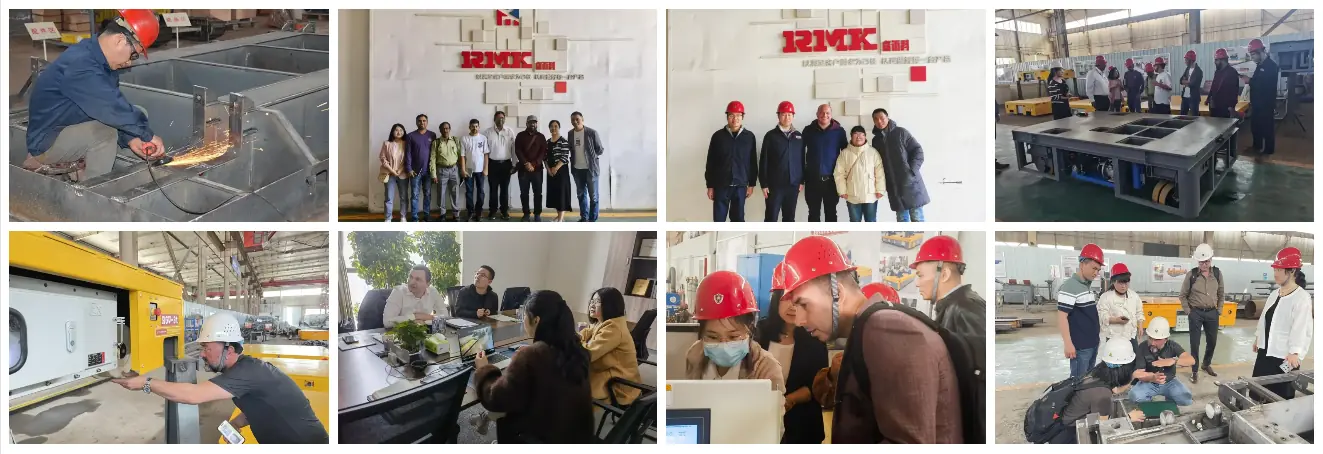
REMARKABLE is a manufacturer and supplier of cable reel powered rail transfer carts for industrial material handling. The company provides customized transfer cart solutions for different load capacities, platform dimensions, rail layouts, power supply systems, and operating conditions. Contact RMK to request the technical documentation and conformity information available for the proposed model and destination market.
REMARKABLE provides project consultation, equipment design, manufacturing, installation guidance, operation training, and after-sales technical support for overseas customers. Warranty service is provided under the agreed product warranty terms. Kontaktieren Sie REMARKABLE with your cargo specifications, transport route, and site requirements to discuss a cable reel powered rail transfer cart for your project.
FAQ
What is a cable reel powered rail transfer cart?
A cable reel powered rail transfer cart is an electric material handling vehicle that travels on fixed rails and receives external power through a traveling cable managed by an onboard cable reel.
How does a cable reel powered rail transfer cart work?
External AC power passes through the traveling cable to the cart’s electrical system. The motor drives the wheels through a gearbox, while the cable reel releases or winds the cable during travel.
What is the load capacity of a cable reel powered rail transfer cart?
Load capacities vary by model and design. RMK provides customized configurations for different industrial loads. The rated capacity must be confirmed against the selected model and actual cargo specifications.
How far can a cable reel powered rail transfer cart travel?
Travel distance depends on cable length, reel capacity, winding speed and cable routing. The required distance should be specified during design to determine the appropriate reel and cable configuration.
What types of cable reels are used on rail transfer carts?
Common types include spring-driven and motorized cable reels. Spring-driven reels use mechanical spring force for cable retraction, while motorized reels use an electric drive for controlled winding.
Can a cable reel powered rail transfer cart operate continuously?
It can support extended operation with external power. Continuous duty depends on motor ratings, cooling capacity, cable specifications and the electrical system’s operating limits.
Can a cable reel powered rail transfer cart run on curved tracks?
Yes, with a suitable design. Track radius, wheel arrangement, cable routing, and reel position must be evaluated. Not all standard configurations support curved-track operation.
What information is needed to customize a cable reel powered rail transfer cart?
Provide the cargo weight and dimensions, rail layout, travel distance, power supply, required speed, control mode, and operating environment. These details form the basis for equipment design.
Related Rail Transfer Cart Articles


Discuss Your Transfer Cart Requirements
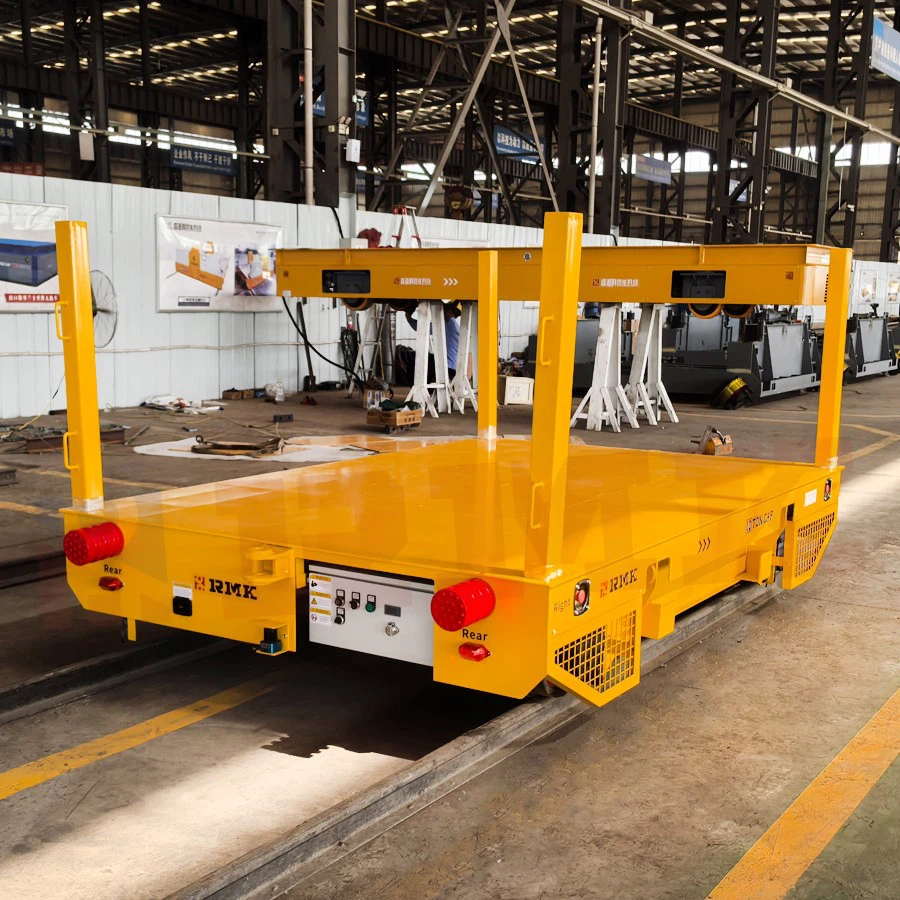
Send the cargo weight and dimensions, rail layout, travel distance, operating cycle, and available power supply. RMK can review the application and prepare a configuration and quotation with a defined scope of supply. For the main cost factors, see our electric transfer cart pricing guide.
- Belastung: Cargo and fixture weights, dimensions, and load positions
- Track: Rail gauge, profile, route length and curve radii
- Duty: Trips per shift, travel speed and stopping requirements
- Site: Available power, loading method and working environment